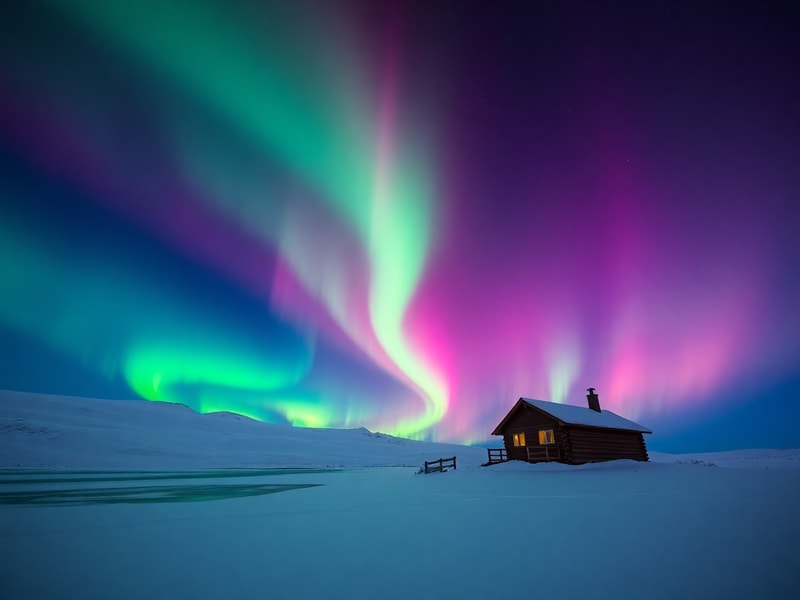
The Sun occasionally reminds us of its immense power through events like coronal mass ejections (CMEs), which send billions of tons of solar material hurtling toward Earth. When these charged particles interact with our planet’s magnetic field, they create one of nature’s most spectacular displays: the aurora. Recent solar activity has made auroras visible at latitudes much further south than usual, offering both scientists and skywatchers an extraordinary opportunity.
Understanding Coronal Mass Ejections and Their Impact
Coronal mass ejections are large-scale expulsions of plasma and magnetic field from the Sun’s corona. They occur when magnetic energy stored in the Sun’s atmosphere builds up and is suddenly released. These eruptions can travel through space at speeds ranging from 250 to 3,000 kilometers per second, taking between 15 hours to several days to reach Earth.
When a CME arrives at Earth, it interacts with our planet’s magnetosphere. The solar particles are funneled toward the poles where they collide with atmospheric gases, primarily oxygen and nitrogen. These collisions release energy in the form of light, creating the aurora borealis (northern lights) and aurora australis (southern lights). The colors we see—green, pink, purple, red—depend on which gas is excited and at what altitude the collision occurs.
The intensity of an auroral display depends on several factors:
- CME speed and magnetic field strength: Faster CMEs with stronger magnetic fields produce more intense auroras.
- Direction of the CME’s magnetic field: When the CME’s magnetic field is oriented southward (opposite to Earth’s), it more effectively couples with Earth’s magnetosphere, enhancing auroral activity.
- Solar wind conditions: The background solar wind can either amplify or diminish the effects of a CME.
- Time of year: Auroras are typically more visible during the equinoxes due to the orientation of Earth’s magnetic field.
Recent Solar Activity and Unusual Aurora Displays
Solar Cycle 25, which began in December 2019, has proven to be more active than initially predicted. The Sun’s activity follows an approximately 11-year cycle, with periods of high activity (solar maximum) marked by increased sunspots, solar flares, and CMEs. We are currently approaching solar maximum, which is expected to peak between 2024 and 2025.
In recent months, several strong CMEs have impacted Earth, leading to auroral displays visible at latitudes where they are rarely seen. On March 23, 2023, a G4-class geomagnetic storm (classified as “severe” on the NOAA scale) produced auroras visible as far south as Arizona in the United States and the south coast of England. This was one of the most southerly auroral displays in decades, capturing widespread attention.
Such events provide valuable data for scientists studying space weather. The Science section of Dave’s Locker frequently covers solar phenomena and their effects on Earth. These observations help improve our understanding of how solar storms can impact power grids, satellite operations, and communication systems.
How to Predict and Observe Aurora from Coronal Mass Ejections
Predicting when and where auroras will be visible requires monitoring several key indicators. Space weather forecasters rely on data from satellites such as the Deep Space Climate Observatory (DSCOVR) and the Advanced Composition Explorer (ACE), which measure the solar wind and interplanetary magnetic field in real-time.
One of the most critical measurements is the Bz component of the interplanetary magnetic field (IMF). When the Bz component turns strongly southward (negative values), it indicates a higher likelihood of geomagnetic storms and auroral activity. The Kp index, a measure of geomagnetic activity on a scale from 0 to 9, is another essential tool. Auroras are typically visible at lower latitudes when the Kp index reaches 7 or higher.
For those hoping to observe an aurora from a CME, here are some practical tips:
- Check space weather forecasts: Websites like the NOAA Space Weather Prediction Center provide up-to-date forecasts and alerts.
- Find dark skies: Light pollution significantly reduces aurora visibility. Use tools like the Dark Site Finder to locate optimal viewing spots.
- Look north (or south in the southern hemisphere): Auroras are most commonly seen near the magnetic poles, so face the northern horizon in the northern hemisphere and the southern horizon in the southern hemisphere.
- Be patient and persistent: Auroras can be faint and may take time to develop. Allow at least an hour for your eyes to adjust to the darkness.
- Use the right camera settings: If photographing the aurora, use a tripod, a wide-angle lens, and a high ISO setting (1600-3200). A long exposure (10-20 seconds) can capture more detail.
The Broader Implications of Increased Solar Activity
While auroras are a beautiful consequence of CMEs, the broader implications of increased solar activity are more complex. Solar storms have the potential to disrupt modern infrastructure in several ways:
- Power grids: Geomagnetically induced currents (GICs) can flow through power lines, transformers, and grounding systems, potentially causing widespread blackouts. The 1989 geomagnetic storm famously caused a nine-hour blackout in Quebec, Canada.
- Satellite operations: Increased radiation can damage satellite electronics, degrade solar panels, and disrupt communications. GPS signals, which are critical for navigation and timing, can be particularly affected.
- Aviation: High-altitude flights, especially those near the poles, can experience increased radiation exposure and communication blackouts during strong solar storms.
- Pipeline corrosion: GICs can accelerate the corrosion of long pipelines, such as those used for oil and gas transport.
Governments and organizations worldwide are working to mitigate these risks. The Space Weather Action Plan, established by the U.S. government, aims to improve forecasting capabilities and infrastructure resilience. Similarly, the European Space Agency’s (ESA) Space Weather Service Network provides real-time monitoring and alerts for Europe.
Understanding the relationship between CMEs and auroras not only enhances our appreciation of these natural phenomena but also underscores the importance of space weather research. As solar activity continues to rise, the lessons learned from recent events will be invaluable in preparing for future solar storms.
Conclusion: Embracing the Beauty and Understanding the Power of Solar Storms
The recent surge in coronal mass ejections has provided a stunning reminder of the Sun’s dynamic nature and its profound influence on Earth. Auroras, once a mysterious and awe-inspiring spectacle, are now better understood thanks to advances in space weather science. These events also serve as a humbling reminder of our planet’s vulnerability to solar activity.
For skywatchers, the increased frequency and intensity of auroras offer more opportunities to witness one of nature’s most breathtaking displays. Whether you’re an amateur astronomer, a photographer, or simply someone who appreciates the beauty of the night sky, keeping an eye on space weather forecasts can lead to unforgettable experiences.
At the same time, the scientific and practical implications of solar storms cannot be overstated. As we approach solar maximum, investing in space weather research and infrastructure resilience is more critical than ever. By studying these events, we not only deepen our understanding of the Sun-Earth connection but also better prepare ourselves for the challenges and opportunities that lie ahead.
For more insights into space weather and its effects, explore the Science and Technology sections of Dave’s Locker. Stay informed, stay curious, and keep looking up.