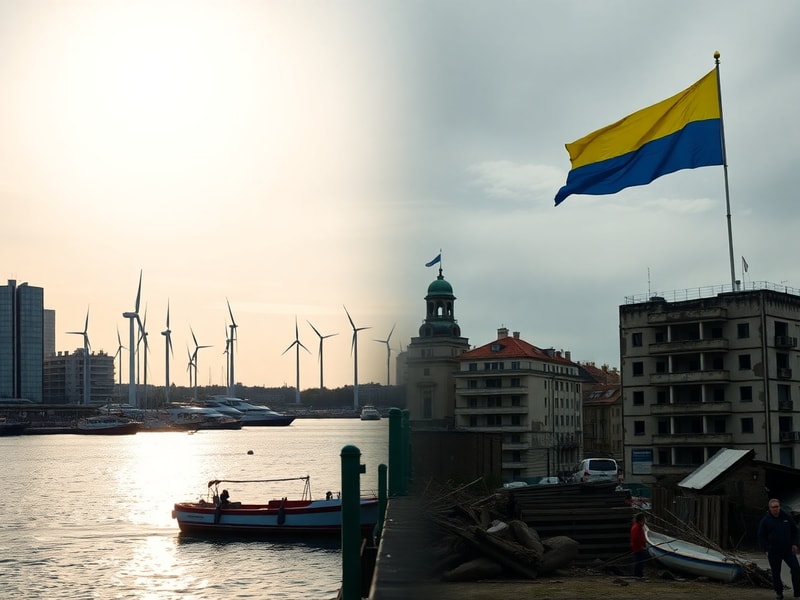
Denmark vs Ukraine: A Comparative Look at Two European Nations
Denmark and Ukraine are two distinct European nations with contrasting histories, cultures, and contemporary challenges. While Denmark is a small but prosperous Nordic country, Ukraine is a larger Eastern European nation navigating war and reconstruction. This comparison explores their demographics, economies, political landscapes, and cultural identities to highlight what sets them apart.
The Geographical and Demographic Divide
Denmark is a peninsula and archipelago in Northern Europe, bordered by Germany and connected to Sweden via the Øresund Bridge. Its population of approximately 5.9 million is ethnically homogeneous, with a high standard of living and a strong welfare system. Urban centers like Copenhagen, Aarhus, and Odense drive the country’s economic and cultural life.
Ukraine, in contrast, is the second-largest country in Europe by area, stretching from Eastern Europe to the Black Sea. It has a population of around 36 million, though war has displaced millions. The nation is ethnically diverse, with significant Ukrainian, Russian, and other minority groups. Major cities like Kyiv, Lviv, and Odessa serve as cultural and economic hubs, each with distinct historical influences.
Economic Contrasts: Stability vs. Struggle
Denmark boasts one of the world’s most robust economies, characterized by high GDP per capita, low unemployment, and a strong focus on green energy and innovation. The country is home to global brands like Lego, Maersk, and Carlsberg. Its mixed economy balances private enterprise with extensive public services, supported by a high tax base.
Ukraine’s economy has faced severe disruptions due to Russia’s invasion. Before the war, it was an agricultural powerhouse, a major producer of grains, and a growing tech hub, earning the nickname “the breadbasket of Europe.” However, infrastructure damage, sanctions, and population displacement have strained its resources. International aid and reconstruction efforts are critical to its recovery.
Political Landscapes: From Consensus to Conflict
Denmark operates as a stable parliamentary democracy with a constitutional monarchy. It is a founding member of NATO and the European Union, known for its consensus-driven politics and progressive policies. The country consistently ranks high in global happiness and transparency indexes.
Ukraine, meanwhile, has undergone dramatic political shifts. The 2014 Euromaidan protests led to the ousting of pro-Russian President Viktor Yanukovych, followed by Russia’s annexation of Crimea. The 2022 full-scale invasion further solidified Ukraine’s pro-Western orientation. President Volodymyr Zelenskyy has become a global symbol of resistance, while the war has reshaped the country’s political priorities toward defense and sovereignty.
Cultural and Historical Influences
Denmark’s culture is shaped by its Viking heritage and Lutheran traditions. The concept of “hygge,” emphasizing coziness and community, reflects its societal values. Danish design, literature, and cinema—such as the works of Hans Christian Andersen and Lars von Trier—have left a global mark. The country also hosts major events like the Copenhagen Jazz Festival and Roskilde Festival.
Ukraine’s cultural identity is deeply tied to its struggle for independence and identity. From the Kyivan Rus’ era to the Cossack Hetmanate, its history is marked by resilience. Traditional folk music, embroidered vyshyvanka shirts, and dishes like borscht and varenyky remain central to national pride. Kyiv’s Maidan Square and Lviv’s historic center symbolize both its past and present fight for freedom.
War has profoundly impacted Ukrainian culture. Museums have relocated artifacts to safety, artists have documented conflict through works like the Kyiv Biennial, and global support for Ukrainian music and film has surged. Meanwhile, Denmark has seen an influx of Ukrainian refugees, fostering cultural exchanges and solidarity.
Education and Innovation: Two Approaches to Progress
Denmark’s education system is publicly funded and prioritizes creativity and critical thinking. The University of Copenhagen and Aarhus University are globally ranked, and the country invests heavily in research and development. Denmark also leads in sustainable innovation, with wind energy accounting for over half of its electricity.
Ukraine’s education sector has faced significant challenges due to war. Universities like Taras Shevchenko National University in Kyiv have adapted by offering online courses and relocating programs. Despite the obstacles, Ukraine has a strong tradition in science and technology, producing notable figures in IT and aerospace. The country’s IT sector, often called the “Ukrainian Silicon Valley,” continues to thrive even amid conflict.
Tourism: From Scenic Beauty to Resilient Landmarks
Denmark attracts visitors with its picturesque landscapes, historic castles like Kronborg, and vibrant cities. The Tivoli Gardens in Copenhagen and the white cliffs of Møn are popular destinations. Tourism contributes significantly to the economy, with eco-tourism and cycling vacations gaining popularity.
Ukraine’s tourism industry has been devastated by war, but its potential remains vast. The Carpathian Mountains, Crimean coast, and historic cities like Chernivtsi offer breathtaking experiences. Before the invasion, Ukraine was becoming known for its affordable travel and cultural tourism. Efforts to rebuild and promote safe travel are underway, with initiatives like travel safety guides emerging to support visitors.
Conclusion: Shared Challenges, Divergent Paths
Denmark and Ukraine represent two sides of Europe’s contemporary experience: one of stability and prosperity, the other of resilience and reconstruction. While Denmark leverages its strengths in innovation and social welfare, Ukraine’s future hinges on its ability to recover and redefine itself in the face of adversity. Both nations, however, share a commitment to preserving their unique identities and contributing to Europe’s collective future.
As Ukraine rebuilds, international support remains vital. Denmark, as a neighboring EU and NATO member, plays a key role in providing aid and solidarity. The contrast between these two countries underscores the fragility of peace and the enduring power of national spirit.