Kareem Abdul-Jabbar: From Basketball Legend to Global Icon
“`html
Kareem Abdul-Jabbar: A Legacy Beyond Basketball
Kareem Abdul-Jabbar stands as one of the most towering figures in both sports and public intellectual life, a man whose influence transcends the boundaries of the basketball court. With a career that spanned two decades and a post-retirement career that has lasted even longer, Abdul-Jabbar has shaped conversations around race, justice, and culture in America and beyond. His name is synonymous with excellence, activism, and an enduring commitment to using his platform for meaningful change.
Born Ferdinand Lewis Alcindor Jr. on April 16, 1947, in New York City, Abdul-Jabbar’s early life was marked by athletic dominance and intellectual curiosity. He attended Power Memorial Academy, where he led his high school team to a 71-game winning streak and three consecutive state championships. His towering 7’2″ frame and unmatched skill set made him a national sensation long before he stepped onto a college court at UCLA under the legendary coach John Wooden.
The Rise of a Legend at UCLA
Under Wooden’s guidance, Abdul-Jabbar—then still known as Lew Alcindor—transformed into a basketball prodigy. He led UCLA to three consecutive NCAA championships from 1967 to 1969, a period during which the Bruins compiled an astonishing 88-2 record. His signature skyhook shot became nearly unstoppable, a move so effective that opposing teams had no viable counter. The dominance of Abdul-Jabbar and UCLA redefined college basketball, setting new standards for team performance and individual skill.
Yet his time at UCLA was not merely about basketball. Abdul-Jabbar’s growing awareness of social issues, particularly the civil rights movement and the Vietnam War, began to shape his worldview. He converted to Islam in 1968 and changed his name to Kareem Abdul-Jabbar, a decision rooted in both spiritual conviction and a rejection of the racial identity imposed on him by colonial history. This transformation was both personal and political, reflecting a broader shift among Black athletes toward self-determination and activism.
A Six-Time NBA Champion and Cultural Icon
Selected first overall by the Milwaukee Bucks in the 1969 NBA Draft, Abdul-Jabbar quickly established himself as the league’s most dominant center. In his rookie season, he averaged 28.8 points and 14.5 rebounds per game, earning Rookie of the Year honors. The next year, he teamed up with point guard Oscar Robertson, and in 1971, the Bucks won their first NBA championship, with Abdul-Jabbar capturing Finals MVP honors.
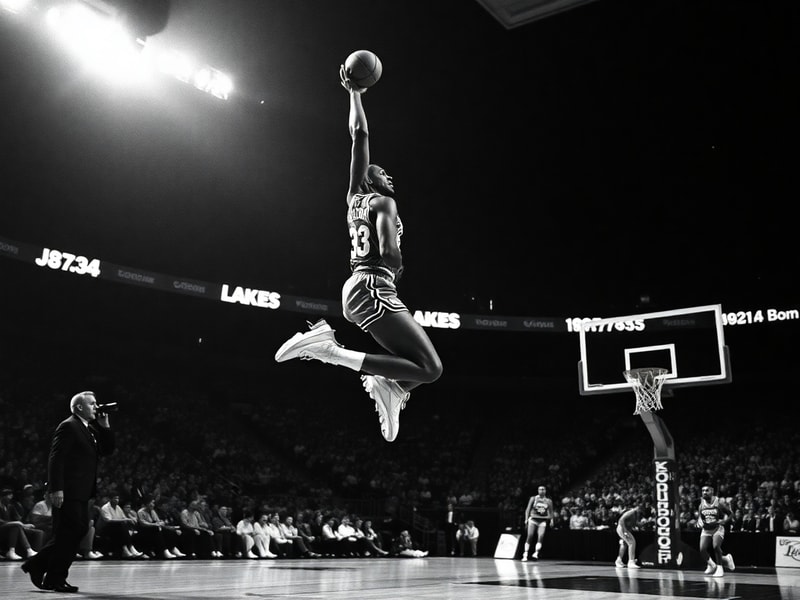
After a highly publicized trade to the Los Angeles Lakers in 1975, Abdul-Jabbar formed one of the greatest duos in sports history with Magic Johnson. Together, they led the “Showtime” Lakers to five championships between 1980 and 1988, cementing Abdul-Jabbar’s legacy as the NBA’s all-time leading scorer—a record he held until 2023. His longevity and consistency were unparalleled; he played at an elite level into his 40s, retiring in 1989 at age 42.
Beyond statistics, Abdul-Jabbar’s influence extended into the cultural fabric of the United States. As a Black Muslim athlete in the 1970s and 80s, he faced both admiration and suspicion. His dignified presence and eloquent public speaking challenged stereotypes about athletes being one-dimensional. He became a voice for social justice, writing op-eds, speaking at universities, and engaging with leaders such as Nelson Mandela during South Africa’s anti-apartheid struggle.
From the Court to the Page: A Voice of Reason and Reform
Abdul-Jabbar’s transition from professional athlete to public intellectual was seamless. He authored several books, including his 1983 memoir Giant Steps, which blended personal narrative with reflections on race and identity. In Coach Wooden and Me (2017), he revisited his relationship with his mentor, offering insights into leadership, mentorship, and mutual respect across racial lines.
His writing has appeared in The New York Times, Time, and The Washington Post, where he tackled topics such as police brutality, education reform, and the role of athletes in activism. He has also been a vocal advocate for the preservation of African American history, supporting institutions like the National Museum of African American History and Culture in Washington, D.C.
In 2016, Abdul-Jabbar was awarded the Presidential Medal of Freedom by President Barack Obama, a recognition of his contributions to sports, literature, and social justice. The citation honored him as “a critically acclaimed author, a dynamic spoken-word performer, and an outspoken education reform advocate.”
A Global Perspective: Abdul-Jabbar’s Influence Beyond America
While Abdul-Jabbar is undeniably an American icon, his impact resonates globally. His engagement with international causes—particularly his support for education and youth development—has made him a respected figure in countries across Africa, Europe, and the Middle East. During the 1990s, he traveled to South Africa multiple times, meeting with Mandela and supporting efforts to dismantle apartheid’s legacy.
His 2012 appointment as the NBA’s global ambassador further extended his reach, allowing him to promote basketball development and social responsibility on a worldwide scale. In countries like China, India, and Brazil, Abdul-Jabbar’s name carries weight not only as a basketball legend but as a symbol of integrity and service.
Abdul-Jabbar’s global perspective is also evident in his critique of colonialism and his celebration of African cultural heritage. He has used his platform to highlight the achievements of African civilizations, countering Western-centric narratives in education and media. His 2011 book On the Shoulders of Giants explored the history of the Harlem Renaissance through the lens of Black excellence, emphasizing continuity across generations.
Key Contributions to Global Dialogue
- Sports Diplomacy: Used basketball as a bridge for international engagement and cultural exchange.
- Educational Advocacy: Supported literacy programs and STEM initiatives, particularly in underserved communities.
- Interfaith Dialogue: Promoted conversations between faith communities, drawing from his own Islamic faith and interfaith experiences.
- Youth Empowerment: Partnered with organizations like the Jackie Robinson Foundation to mentor young leaders of color.
Legacy: More Than a Record Holder
Abdul-Jabbar’s legacy is often reduced to his skyhook or his scoring records, but such a narrow focus obscures the depth of his contributions. He has spent over five decades using his voice to challenge injustice, uplift marginalized communities, and redefine what it means to be a public intellectual. His activism has evolved with the times—from protesting the Vietnam War to advocating for criminal justice reform in the 21st century—but his core values have remained consistent: dignity, education, and equality.
Today, at 77 years old, Abdul-Jabbar continues to write, speak, and mentor. He serves as a senior fellow at the USC Center on Public Diplomacy, where he explores the intersection of sports and global politics. He has also lent his voice to documentaries, including Black Patriots: Heroes of the Revolution (2020), which highlights unsung Black figures in early American history.
In an era where athletes are increasingly expected to use their platforms for social change, Abdul-Jabbar remains a model of principled leadership. He has shown that greatness is not measured solely by trophies or titles, but by the impact one leaves on the world. His journey from a New York housing project to global influence is a testament to the power of discipline, intellect, and moral courage.
As we reflect on his life, it is clear that Kareem Abdul-Jabbar’s story is not just one of athletic achievement—it is a story of cultural transformation, intellectual courage, and unwavering commitment to justice. He has not only changed the game of basketball; he has changed the game of life.