Nuneaton Bridge: A Historic Crossing with Modern Significance
Nestled in the heart of Warwickshire, the town of Nuneaton boasts a rich industrial heritage and a landscape shaped by centuries of trade, migration, and innovation. At the center of this history is Nuneaton Bridge, a structure that has quietly witnessed the evolution of the region from a medieval market town to a modern commuter hub. Though often overshadowed by more glamorous landmarks, this bridge is a testament to the enduring role of infrastructure in shaping local identity and connectivity.
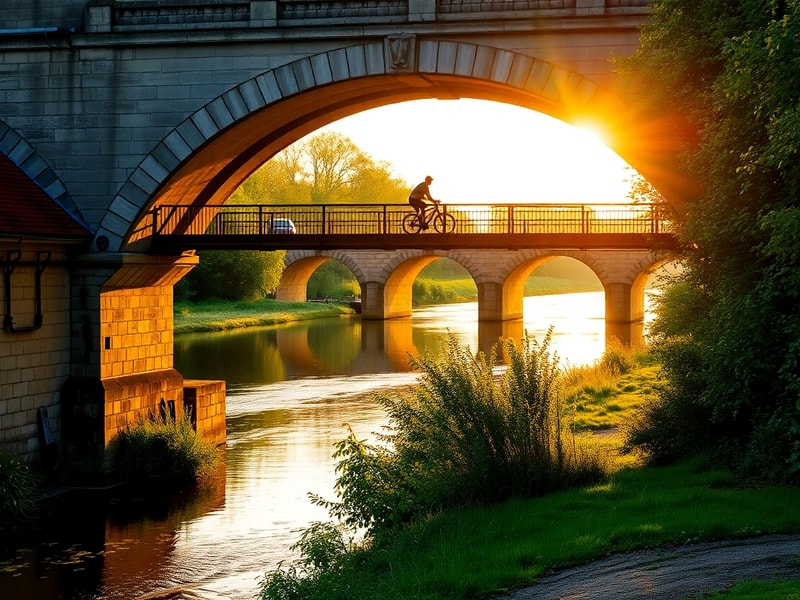
The bridge spans the River Anker, a modest but historically vital waterway that once powered mills and transported goods during the Industrial Revolution. Unlike grand Victorian viaducts or sweeping modern motorway crossings, Nuneaton Bridge embodies a quieter kind of engineering—one that prioritizes functionality over ornamentation. Its unassuming presence belies a deeper story of adaptation, resilience, and the ways in which even the most ordinary structures can anchor a community’s sense of place.
The Historical Layers of Nuneaton Bridge
Archaeological studies suggest that a crossing at this site may date back to the 12th century, when Nuneaton was granted market rights by royal charter. The original bridge, likely constructed of timber, would have served as a critical link for merchants traveling between Coventry and Leicester. By the 16th century, as trade expanded and the town grew, stone and brick versions replaced earlier wooden spans, reflecting the increasing wealth and ambition of the area.
One of the most defining moments in the bridge’s history occurred during the English Civil War. In 1642, as tensions between Royalists and Parliamentarians escalated, Nuneaton became a strategic point due to its central location. Accounts from the period describe skirmishes near the bridge, with both sides recognizing its importance for troop movements and supply lines. Though the bridge itself suffered little damage, its symbolic role as a connector—of people, ideas, and power—was firmly established.
The 19th century brought further transformation. The arrival of the Coventry Canal in 1769 and later the railway in the 1840s shifted the local economy toward manufacturing, particularly textiles and engineering. Nuneaton Bridge adapted again, widened to accommodate heavier traffic and reinforced to support steam-powered barges and early automobiles. These changes mirrored broader shifts across Britain, where infrastructure became a tool of economic modernization and social control.
Cultural Symbolism and Community Identity
To residents of Nuneaton, the bridge is more than a functional crossing—it is a cultural landmark. For generations, it has served as a meeting point, a landmark for navigation, and a silent witness to personal milestones. Couples have posed for photographs on its railings. Children have tested its echoes by shouting into the river below. Local artists and poets have drawn inspiration from its weathered stone and the way it frames the changing seasons.
The bridge also reflects the town’s evolving demographics. In the 20th century, Nuneaton attracted workers from across the British Isles, including large communities from Ireland, the Caribbean, and South Asia. Each wave of migration brought new traditions, cuisines, and languages, subtly reshaping the town’s character. The bridge, as a shared space, became a microcosm of this diversity—a place where different worlds briefly intersected.
In literature and local folklore, the bridge appears in various guises. It has been described as a threshold between the old and the new, the rural and the urban, the familiar and the unknown. One Nuneaton-born writer, George Eliot (whose real name was Mary Ann Evans), set part of her novel Scenes of Clerical Life in the vicinity, though she never directly referenced the bridge. Yet the spirit of transition she explored—between tradition and progress—echoes in the bridge’s own history.
A Global Perspective: Bridges as Cultural Artifacts
Nuneaton Bridge is not unique in its dual role as both a physical structure and a cultural symbol. Across the world, bridges often serve as metaphors for connection, division, or transformation. In Japan, the bridges of Kyoto are celebrated in poetry and art as places of reflection and impermanence. In the United States, the Brooklyn Bridge became a symbol of urban ambition and immigrant aspiration. In India, the Howrah Bridge in Kolkata is an icon of postcolonial identity and resilience.
What sets Nuneaton Bridge apart is its ordinariness. While grand bridges like the Golden Gate or the Tower Bridge dominate global imagination, structures like Nuneaton’s remind us that heritage is not only found in the monumental. It is also embedded in the everyday—the bridges we cross without thinking, the paths we take without noticing. These places tell a different kind of history, one rooted in lived experience rather than grand narratives.
From a global perspective, Nuneaton Bridge can be seen as part of a broader pattern: the quiet persistence of local infrastructure in an era of globalization. While high-speed rail and digital networks dominate headlines, bridges like this one continue to anchor communities, fostering a sense of continuity and belonging. They are reminders that progress is not always about speed or scale—sometimes, it is about presence.
Challenges and Future of Nuneaton Bridge
Despite its historical value, Nuneaton Bridge faces modern challenges. Increased traffic, particularly from commuters heading to Coventry and Birmingham, has raised concerns about structural wear and congestion. Environmental pressures, including flood risks from the River Anker, have prompted calls for renovation and reinforcement. Meanwhile, debates rage in towns across Britain about balancing heritage preservation with the demands of contemporary life.
In response, local authorities have explored several options. A recent feasibility study proposed a pedestrian and cycle bridge adjacent to the existing structure, aiming to reduce traffic while enhancing connectivity for non-motorized users. Such a project would not only ease congestion but also reinforce the bridge’s role as a space for community gathering rather than merely passage.
There is also growing interest in interpreting the bridge’s history more publicly. Plans for a heritage trail, including signage and digital resources, could help residents and visitors alike understand the layers of time embedded in its stones. Partnerships with local schools and heritage groups could transform the bridge into a living classroom, where history is not just read about but experienced.
Ultimately, the future of Nuneaton Bridge will depend on how the town chooses to value it. Will it be preserved as a relic of the past, or reimagined as a bridge to the future? The answer may lie not in dramatic restoration or demolition, but in thoughtful adaptation—keeping the bridge’s soul intact while ensuring it continues to serve the needs of those who cross it every day.
Why Nuneaton Bridge Matters Beyond Its Town
In an age of rapid urbanization and digital disconnection, places like Nuneaton Bridge offer a counterpoint. They remind us of the value of slow time, of tangible connections, and of the stories that accumulate in the cracks of our built environment. They challenge the assumption that only the new, the shiny, or the globally significant deserves attention.
Nuneaton Bridge also invites reflection on the role of local journalism in preserving such histories. In documenting the everyday, in listening to the voices of those who remember its past and envision its future, we keep alive a sense of shared humanity. It is not just a structure of stone and mortar—it is a vessel of memory, a bridge between generations.
As the seasons change and the river continues to flow beneath it, Nuneaton Bridge remains. Not as a monument to be admired from afar, but as a silent partner in the daily lives of those who pass over it. In its quiet endurance, it teaches a lesson that transcends geography: that some connections are not built with steel or concrete, but with time, memory, and the unspoken bonds of community.