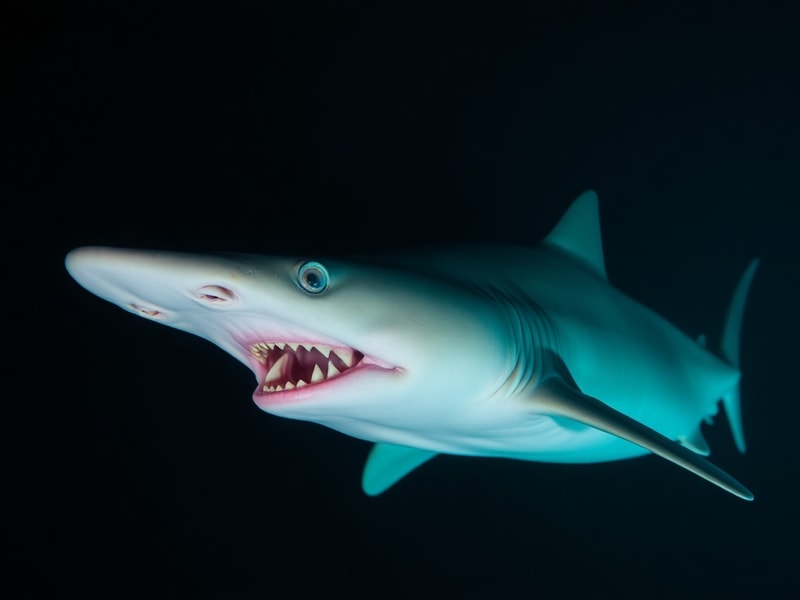
Deep-sea exploration has always been as much about patience as it is about technology. The goblin shark, with its bizarre pinkish hue and protruding jaws, remains one of the ocean’s most elusive predators. Marine biologist Alan Jamieson has dedicated years to studying this enigmatic creature, uncovering behaviors and adaptations that challenge our understanding of deep-sea ecosystems. His recent research not only sheds light on the goblin shark’s biology but also offers broader insights into the fragile balance of life in the abyss.
Who Is Alan Jamieson and Why Does His Work Matter?
Alan Jamieson is a senior lecturer in marine ecology at the University of Western Australia and the chief scientist at the Deep-Sea Research Group. With over 15 years of experience deploying deep-sea cameras and traps, Jamieson has become a leading authority on the creatures that inhabit the ocean’s deepest trenches. His work bridges the gap between scientific discovery and public fascination, making complex deep-sea ecosystems accessible to broader audiences.
Jamieson’s approach combines cutting-edge technology with rigorous fieldwork. Using autonomous deep-sea landers—unmanned vehicles equipped with cameras and sensors—he captures footage and data from depths exceeding 6,000 meters. These expeditions have revealed that the goblin shark is far more active and widespread than previously believed, forcing scientists to reconsider its role in deep-sea food chains.
His research also highlights the importance of international collaboration. Jamieson has partnered with institutions worldwide, from Japan’s Japan Agency for Marine-Earth Science and Technology to the Schmidt Ocean Institute in the United States. These partnerships have expanded the scope of deep-sea research, proving that no single nation or agency can explore the abyss alone.
Key Findings from Jamieson’s Goblin Shark Study
Jamieson’s most recent study, published in the journal Deep-Sea Research Part I, presents several groundbreaking observations about the goblin shark (Mitsukurina owstoni). Below are the most significant findings:
- Unexpected Activity Levels: Previous assumptions held that goblin sharks were sluggish, ambush predators. Jamieson’s footage shows they are agile swimmers, capable of rapid bursts of speed to capture prey.
- Global Distribution: The study confirms goblin sharks inhabit deep-sea trenches across the Pacific, Atlantic, and Indian Oceans, dispelling the myth that they are confined to a few isolated locations.
- Feeding Adaptations: Their highly protrusible jaws, which extend nearly half their body length, allow them to snatch prey from narrow crevices in the seafloor. Jamieson’s team captured footage of a goblin shark using this adaptation to consume a small fish.
- Reproductive Mysteries: Little is known about goblin shark reproduction. Jamieson’s research suggests they may have a slow reproductive rate, making them particularly vulnerable to deep-sea fishing pressures.
The study also challenges long-held beliefs about deep-sea biodiversity. By documenting goblin sharks in multiple trenches, Jamieson’s work underscores how interconnected these ecosystems are, despite the vast distances separating them.
Broader Implications for Deep-Sea Conservation
The goblin shark is not just a biological curiosity; it is a sentinel species for deep-sea health. As apex predators, they play a crucial role in maintaining the balance of their ecosystems. Jamieson’s findings carry significant implications for conservation efforts, particularly as deep-sea mining and bottom trawling threaten these fragile habitats.
One of the most pressing concerns is the lack of regulatory protections for deep-sea species. Unlike their shallow-water counterparts, goblin sharks and other deep-sea creatures fall into a governance gray area. International bodies like the International Seabed Authority (ISA) have yet to implement comprehensive protections for species like the goblin shark, despite mounting evidence of their ecological importance.
Jamieson advocates for a precautionary approach to deep-sea exploitation. “We know so little about these animals that any large-scale industrial activity risks irreversible damage,” he warns. His research serves as a call to action for policymakers to prioritize deep-sea conservation before it’s too late.
Another critical takeaway is the need for improved deep-sea monitoring technologies. Traditional methods, such as trawling, are destructive and inefficient. Jamieson’s use of autonomous landers and high-definition cameras offers a non-invasive alternative, but scaling these technologies remains a challenge. Investing in such innovations could revolutionize our understanding of the deep sea while minimizing ecological harm.
What’s Next for Goblin Shark Research?
Jamieson’s work is far from complete. Future expeditions will focus on mapping the goblin shark’s migration patterns using satellite tags and genetic studies to determine population connectivity across ocean basins. There is also a push to sequence the goblin shark’s genome, which could reveal evolutionary adaptations unique to deep-sea life.
For marine enthusiasts and scientists alike, the goblin shark represents both a mystery and a marvel. Its bizarre appearance and elusive nature make it a symbol of the deep sea’s untapped potential. As Jamieson’s research demonstrates, every discovery in the abyss brings us one step closer to understanding—and protecting—our planet’s final frontier.
For those interested in exploring more about deep-sea mysteries and marine conservation, visit Dave’s Locker Science category for in-depth articles and resources. To learn about the latest trends in ocean exploration technology, check out our Technology section.
The deep sea is not just a place of darkness; it is a world of wonder, resilience, and fragility. Alan Jamieson’s work reminds us that even in the most remote corners of the planet, life persists—and it is worth fighting to preserve.