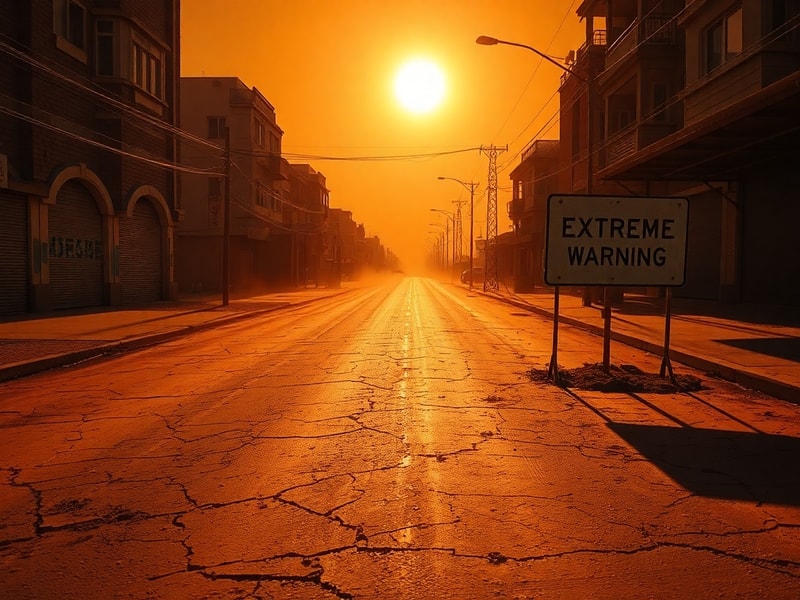
extreme heat warning
“`html
Understanding Extreme Heat Warnings: A Global Challenge
The past decade has seen a sharp rise in extreme heat events worldwide, prompting meteorological agencies to issue warnings with increasing urgency. These alerts are not merely cautionary notes—they serve as critical tools for public safety, economic planning, and environmental policy. As temperatures continue to break records, the conversation around heat warnings has expanded beyond weather reports into discussions about public health, urban infrastructure, and global climate policy.
Extreme heat warnings are triggered when forecasted temperatures or heat index values pose significant risks to human health, particularly for vulnerable populations. These warnings often come with specific recommendations: limit outdoor activities, stay hydrated, and check on elderly neighbors or those without air conditioning. But what exactly defines an “extreme heat warning,” and how do different regions respond when the mercury climbs to dangerous levels?
The Science Behind Heat Warnings: How Are They Issued?
Meteorological agencies, such as the National Weather Service in the United States or the Met Office in the United Kingdom, use a combination of temperature thresholds, humidity levels, and health risk models to determine when to issue extreme heat warnings. In the U.S., for example, the National Weather Service declares an Excessive Heat Warning when the heat index—a measure of how hot it feels when humidity is factored in—is expected to exceed 105°F (40.5°C) for two or more days, or 110°F (43.3°C) for any duration.
Globally, the thresholds vary. In Europe, the Meteoalarm system issues color-coded alerts (yellow, orange, red) based on the severity of expected heat. A red alert, the highest level, indicates a “very dangerous” situation where heat stress is likely even for healthy individuals. Meanwhile, in South Asia, where extreme heat is a seasonal norm, warnings are often tied to agricultural cycles, as prolonged heat can devastate crops and trigger food shortages.
The criteria for issuing warnings also consider local acclimatization. A temperature of 35°C (95°F) in London might warrant a national emergency, while the same temperature in Delhi during summer is barely noticed. This variability underscores the importance of localized warning systems that account for regional climate patterns and public health infrastructure.
Cultural and Economic Impacts: More Than Just a Weather Report
Extreme heat warnings ripple through societies in ways that extend far beyond immediate health risks. In many parts of the world, heat waves disrupt daily life, strain energy grids, and exacerbate social inequalities. For instance, during the 2022 European heat wave, officials in France and Spain reported a 30% increase in heat-related hospitalizations. The economic toll was equally staggering, with agricultural losses in Spain alone exceeding €2 billion due to crop failures and livestock stress.
Cultural responses to extreme heat also reflect deep-seated societal values. In Japan, where summer heat is both a seasonal expectation and a cultural challenge, the phrase mushi atsui (“humid and hot”) is a common refrain during the natsu yasumi (summer break). However, the growing intensity of heat waves has led to new traditions, such as uchimizu—the practice of sprinkling water in front of homes to cool the air—a tradition now being revived as a climate adaptation strategy.
In the United States, extreme heat has become a political flashpoint. Cities like Phoenix and Los Angeles are investing in “cool pavement” initiatives, where reflective coatings are applied to roads to reduce surface temperatures. Meanwhile, debates rage over the role of air conditioning in exacerbating energy demand and carbon emissions. The paradox is striking: as the planet warms, the solutions to extreme heat often rely on technologies that contribute to the problem.
Adapting to a Hotter World: Strategies for the Future
As extreme heat events become more frequent and intense, governments, businesses, and communities are exploring innovative ways to adapt. One approach is urban planning that prioritizes green spaces and shade structures. Cities like Melbourne and Singapore have integrated “cool corridors” into their designs, using trees, water features, and reflective materials to lower ambient temperatures.
Another critical strategy is improving early warning systems. In India, for example, the Health Ministry has partnered with local organizations to send SMS alerts to vulnerable populations during heat waves. These messages provide actionable advice, such as drinking oral rehydration solutions or avoiding midday sun. Similarly, in Europe, the EU’s Heat-Health Action Plans coordinate responses across member states, ensuring that elderly care facilities and hospitals are prepared for extreme temperatures.
Yet adaptation is not just about technology or infrastructure—it’s also about behavior. Public education campaigns, such as those in Australia where “Slip, Slop, Slap” (slip on a shirt, slop on sunscreen, slap on a hat) has become a cultural mantra, play a vital role in reducing heat-related illnesses. Schools and workplaces are also rethinking schedules, with some cities in the Middle East adopting siestas during peak heat hours.
The challenge ahead is daunting, but not insurmountable. A 2023 report by the World Meteorological Organization warned that without immediate action, the number of people exposed to dangerous heat could increase by 15 times by 2050. This projection highlights the need for both mitigation—reducing greenhouse gas emissions—and adaptation—preparing societies for the heat that is already inevitable.
Conclusion: Heat Warnings as a Call to Action
Extreme heat warnings are more than technical advisories; they are urgent reminders of a planet in flux. They demand collective action: from individuals checking on their neighbors to policymakers investing in resilient infrastructure. The stories of communities adapting to heat—whether through ancient traditions or cutting-edge technology—offer a glimmer of hope in an otherwise dire landscape.
As temperatures rise, so too must our response. Whether through smarter urban design, robust public health strategies, or global climate agreements, the fight against extreme heat is a test of our ability to innovate and cooperate. The warnings are clear. The question now is whether we will heed them.
—
METADATA
{
“title”: “Extreme Heat Warnings: How the World is Fighting a Rising Threat”,
“metaDescription”: “Extreme heat warnings are becoming more common worldwide. Discover how different countries respond and what the future holds.”,
“categories”: [“News”, “Science”],
“tags”: [“extreme heat warnings”, “climate change”, “public health”, “urban heat”, “heat wave adaptation”],
“imageDescription”: “Aerial view of a sun-baked city with cracked pavement and sparse shade, highlighting the urban heat island effect. The sky is hazy with heat distortion, and a thermometer graphic overlay shows temperatures exceeding 110°F (43°C). The mood is stark and urgent, emphasizing the physical reality of extreme heat.”
}
—END METADATA—
“`