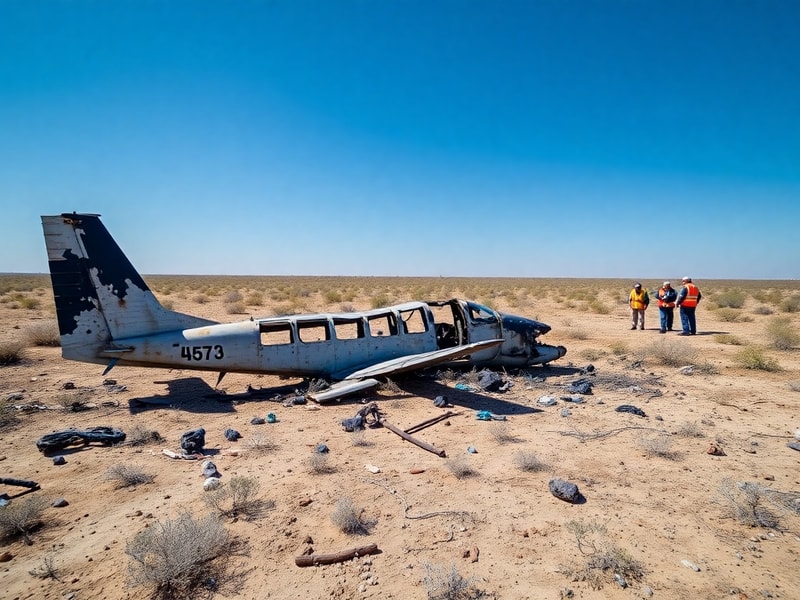
The Laredo plane crash on June 12, 2024, has sent shockwaves through the aviation community, raising immediate questions about pilot training, aircraft maintenance, and regional weather patterns. The single-engine Cessna 208 Caravan, operated by a local air charter service, went down shortly after takeoff from Laredo International Airport, killing all six passengers and the pilot. Authorities confirmed the wreckage was found approximately three miles from the airport, with debris scattered across a rural area near the Nueces River.
Initial reports from the National Transportation Safety Board (NTSB) indicate the aircraft experienced a sudden loss of altitude shortly after climbing to 1,500 feet. Witnesses described hearing a loud engine sputtering before the plane banked sharply to the left and descended rapidly. Emergency responders arrived within minutes, but the crash site’s remote location and rugged terrain complicated recovery efforts. The NTSB has launched a full investigation, with preliminary findings expected within 30 days.
Timeline of the Incident: Key Moments Leading to the Crash
The sequence of events unfolded rapidly, beginning with the aircraft’s departure at 10:47 AM local time. According to air traffic control recordings, the pilot reported no mechanical issues during the initial climb. However, radar data shows the plane deviated from its planned flight path within 90 seconds of takeoff, turning northwest instead of continuing south toward its intended destination. The sudden maneuver coincided with a sharp drop in altitude, from 1,200 feet to under 500 feet in less than 30 seconds.
A local rancher, who witnessed the crash from his property, told reporters he saw the plane’s right wing dip before the nose pointed downward. “It wasn’t like it was spinning or anything,” he said. “It just fell straight out of the sky.” The NTSB’s preliminary report highlights two critical factors: a possible engine malfunction and severe turbulence reported in the area at the time of the incident. Investigators are reviewing data from the plane’s flight data recorder, which was recovered intact despite the impact damage.
Weather conditions at the time of the crash included gusty winds up to 25 mph and scattered thunderstorms in the vicinity. The Laredo area had been under a marginal weather advisory for general aviation since early morning, though the airport remained operational. The NTSB is examining whether the pilot received adequate weather briefings before departure and whether the aircraft’s performance specifications aligned with the challenging conditions.
Regulatory Oversight and Pilot Training: Where Did the System Fail?
The Cessna 208 Caravan involved in the crash is a widely used aircraft in regional air charter services, particularly in Texas and the Southwest. However, its single-engine design and vulnerability to adverse weather have long raised concerns among aviation safety advocates. According to the Federal Aviation Administration (FAA), the pilot held a commercial pilot license with an instrument rating, which allows for flight in low visibility conditions. But questions remain about his experience in handling severe turbulence and engine failures.
Public records show the pilot had logged approximately 4,200 flight hours, with 1,800 hours in the Cessna 208. While this exceeds the minimum requirements for commercial operations, critics argue that regional air charter services often employ pilots with limited turbine-engine experience. The FAA’s Part 135 regulations, which govern on-demand air charter operations, require pilots to complete recurrent training every 12 months. However, the depth of this training—particularly in emergency procedures—varies significantly between operators.
A former colleague of the deceased pilot, who requested anonymity, described him as “meticulous” but noted that the company had recently expanded its routes into more challenging weather corridors. “They were pushing for more flights in marginal conditions,” the source said. “I warned him about the risks, but the company was under pressure to meet demand.” The NTSB is expected to scrutinize the air charter service’s safety protocols and whether pressure to maintain schedules contributed to the accident.
Key Regulatory Concerns Highlighted by the Crash
- Instrument Rating Requirements: While the pilot held an instrument rating, critics question whether this was sufficient for the turbulent conditions encountered.
- Flight Time vs. Turbine Experience: The pilot’s 4,200 total hours included only 1,800 in the Cessna 208, raising questions about familiarity with the aircraft’s systems.
- Part 135 Oversight: The FAA’s regulatory framework for air charter services has been criticized for inconsistencies in training and maintenance standards.
- Weather Advisory Protocols: The NTSB is investigating whether the pilot received adequate weather briefings and whether the airport’s decision to remain open was justified.
Community Impact and Economic Consequences
The crash has left a deep scar on the Laredo community, where the air charter service was a vital link for business travelers, medical patients, and freight transport. The company, Laredo Skyways, had operated in the region for 15 years and employed 23 people, including three pilots. Local business owners described the loss as devastating, particularly for those who relied on the service for time-sensitive deliveries.
“This wasn’t just a plane going down,” said Maria Gonzalez, owner of a logistics company that frequently used Laredo Skyways. “It was a lifeline for small businesses here. Now, we’re scrambling to find alternatives, and the costs are through the roof.” The crash has also disrupted medical transport services, with at least two patients in critical condition rerouted to San Antonio hospitals, adding hours to their travel time.
Economically, the incident could have ripple effects across South Texas. Laredo International Airport, which handled over 120,000 passengers in 2023, may face increased scrutiny from travelers wary of regional air services. The airport’s director, Carlos Ramirez, acknowledged the challenge ahead. “We’re cooperating fully with the NTSB, but we know this will have long-term implications,” he said. “Passengers may start choosing commercial airlines over charters, even if it means longer travel times.”
Lessons from Past Crashes: How Often Does This Happen?
Aviation safety experts point to a pattern of fatal crashes involving single-engine aircraft in Texas and the Southwest. According to the NTSB, there have been 14 fatal crashes involving Cessna 208s in the U.S. over the past decade, with Texas accounting for three of those incidents. While the overall safety record of the aircraft is strong—with a fatal accident rate of 0.34 per 100,000 flight hours—the risks are amplified in regions prone to severe weather and challenging terrain.
One notable case is the 2019 crash of a Cessna 208 in Midland, Texas, which killed two people. The NTSB cited pilot error and inadequate pre-flight planning as contributing factors. In another incident, a 2021 crash in Arizona was linked to engine failure, prompting the FAA to issue an emergency airworthiness directive for certain Cessna 208 models. These cases underscore the importance of rigorous maintenance and pilot training, particularly in high-risk environments.
The Laredo crash has reignited debates about the need for stricter regulations on single-engine charter flights. Some advocates are calling for mandatory terrain awareness and warning systems (TAWS) in all Part 135 operations, as well as real-time weather monitoring for pilots. “This isn’t about pointing fingers,” said an aviation safety consultant. “It’s about learning from these tragedies and making sure they don’t happen again.”
Comparative Analysis: Single-Engine vs. Multi-Engine Charter Safety
- Accident Rates: Multi-engine aircraft have a fatal accident rate of 0.12 per 100,000 flight hours, compared to 0.34 for single-engine aircraft like the Cessna 208.
- Engine Redundancy: Single-engine aircraft are more vulnerable to total power loss, whereas multi-engine planes can often maintain altitude with one engine inoperative.
- Weather Performance: Multi-engine aircraft are generally better equipped to handle turbulence and crosswinds, though both types are affected by severe weather.
- Cost Considerations: Single-engine charters are often cheaper, which has led to their widespread use in regional air services, despite the higher risk profile.
Looking Ahead: What Changes Can We Expect?
The NTSB’s final report on the Laredo crash is not expected for several months, but interim recommendations could be issued as early as July. Industry analysts predict these recommendations will focus on three key areas: pilot training, weather advisory protocols, and aircraft maintenance standards. The FAA has already indicated it will review its oversight of Part 135 operators, particularly those operating in high-risk regions.
For the Laredo community, the path to recovery will be long. The air charter service’s insurance policy is expected to cover most of the damages, but the emotional toll on families and employees is immeasurable. Local officials are exploring options to restore confidence in regional air travel, including enhanced safety briefings for passengers and increased transparency from charter operators.
“We owe it to the victims to learn from this tragedy,” said Texas Congressman Henry Cuellar, who represents the Laredo area. “That means not just investigating what went wrong, but ensuring it never happens again.” Meanwhile, the NTSB continues its painstaking work, examining every piece of evidence to piece together the final moments of Flight 712.
As the aviation community grapples with the aftermath, one thing is clear: the Laredo plane crash will serve as a critical case study in the ongoing effort to balance safety, efficiency, and accessibility in regional air travel.
For more on aviation safety trends, visit our News section. To explore regional air travel statistics, check out our Analysis page.