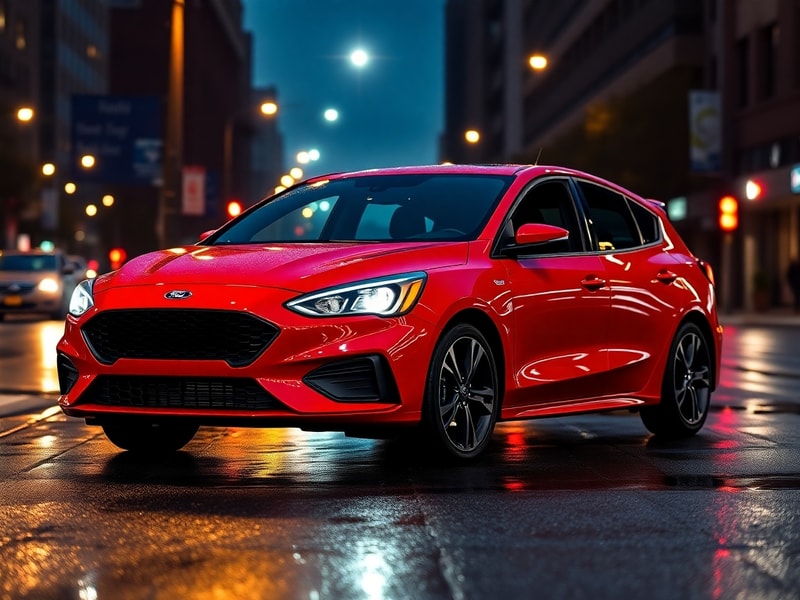
The Ford Focus: A Compact Car That Defined a Generation
The Ford Focus arrived in 1998 as a replacement for the Ford Escort, immediately positioning itself as a modern, driver-focused compact car. Marketed as a vehicle that combined practicality with driving pleasure, it struck a chord with buyers who wanted reliability without sacrificing engagement behind the wheel. Over its four generations, the Focus became one of Ford’s best-selling models worldwide, with over 16 million units produced across more than 100 countries. Its success wasn’t just about numbers—it reshaped consumer expectations for what a compact car could be.
What set the Focus apart from competitors like the Toyota Corolla or Honda Civic was its driving dynamics. Ford prioritized responsive steering, balanced suspension, and an interior designed around the driver. This approach appealed to enthusiasts and commuters alike, proving that affordability didn’t have to mean compromise. The Focus also embraced innovation early, introducing features like keyless entry and available navigation systems at a time when many rivals were still relying on basic amenities.
The car’s global footprint further cemented its legacy. While it dominated markets like Europe and North America, it also found strong footholds in emerging economies, where its durability and adaptability made it a practical choice. The Focus wasn’t just a product—it was a statement about Ford’s ability to deliver value without sacrificing quality.
A Look Back at the Four Generations of the Ford Focus
The first-generation Ford Focus (1998–2004) debuted in Europe before expanding to the U.S. in 2000. It was built on Ford’s new C1 platform, which allowed for better handling and a roomier cabin than its predecessor. The hatchback and sedan versions offered versatility, while the ZX3 and ZTS trims catered to different buyer preferences. Critics praised its ride quality and interior ergonomics, though some early models faced reliability concerns with transmissions.
The second generation (2004–2011) refined the formula with sharper styling and improved safety ratings. Ford introduced the Focus ST in 2005, a hot hatch that delivered 225 horsepower and became a cult favorite among enthusiasts. The 2008 refresh brought updated front-end styling and available SYNC infotainment, one of the first systems to integrate Bluetooth and voice control. By this point, the Focus had solidified its reputation as a car that could adapt to changing consumer tastes.
The third generation (2011–2018) marked a shift toward fuel efficiency and tech integration. The C3 platform underpinning this model was lighter and more rigid, improving both handling and crash protection. Ford expanded the powertrain lineup with the EcoBoost engine, a turbocharged option that delivered power without sacrificing economy. The Focus Electric, introduced in 2012, was one of the first affordable mass-market electric cars in the U.S., though limited range and charging infrastructure kept sales modest. Meanwhile, the Focus RS returned in 2016 as a high-performance variant with all-wheel drive and 350 horsepower, proving Ford’s commitment to performance variants.
The fourth and final generation (2018–2024) leaned into connectivity and efficiency. The redesigned model featured Ford’s Co-Pilot360 safety suite, including adaptive cruise control and lane-keeping assist. Hybrid and plug-in hybrid versions joined the lineup, reflecting the industry’s pivot toward electrification. However, Ford’s decision to discontinue the Focus in North America after 2024—replacing it with the electric Mustang Mach-E and traditional sedan-focused models—signaled a strategic shift away from compact cars in favor of SUVs and electric vehicles.
Key Milestones in the Ford Focus Timeline
- 1998: First-generation Focus debuts in Europe with Zetec and Duratec engines.
- 2000: U.S. introduction with a 2.0L four-cylinder engine and available five-speed manual transmission.
- 2005: Focus ST launches in Europe, offering 225 hp and sport-tuned suspension.
- 2008: SYNC infotainment system introduced, integrating Bluetooth and voice control.
- 2012: Focus Electric debuts as one of the first affordable EVs in the U.S.
- 2016: Focus RS returns with 350 hp and all-wheel drive, targeting enthusiasts.
- 2018: Fourth-generation model debuts with Co-Pilot360 safety features and hybrid options.
- 2024: Ford announces the end of Focus production in North America.
Why the Ford Focus Mattered Beyond the Numbers
The Focus wasn’t just a commercial success—it influenced the entire compact car segment. Before the Focus, many compact cars were seen as utilitarian at best, boring at worst. Ford changed that perception by designing a car that felt alive to drive. The Focus’s success forced competitors like Volkswagen and Hyundai to elevate their own compact offerings, leading to cars like the Golf GTI and Elantra N. Its emphasis on driver engagement set a new standard for what consumers could expect from a budget-friendly vehicle.
Another critical aspect of the Focus’s legacy was its adaptability. Ford tailored the model to different markets, offering everything from the stripped-down base model to the fully loaded Titanium trim. In Europe, the Focus became a family favorite, while in the U.S., it competed directly with the Civic and Corolla. This versatility allowed Ford to dominate segments where other manufacturers struggled to gain traction. Even in emerging markets like Brazil and China, the Focus proved that a global car could succeed without sacrificing local relevance.
The Focus also played a role in Ford’s broader strategy. The car helped fund the development of other models, including the Fusion and Escape SUVs. Its platform served as the foundation for the Ford C-Max and Kuga, demonstrating the flexibility of Ford’s global architecture. When Ford shifted its focus toward trucks, SUVs, and electric vehicles, the end of the Focus in North America wasn’t just about one model—it reflected a company-wide pivot toward higher-margin segments.
For enthusiasts, the Focus’s performance variants left a lasting mark. The ST and RS models proved that a compact car could deliver supercar-like thrills without the supercar price tag. These hot hatches became icons in the tuning and motorsport communities, with aftermarket support that extended their lifespans long after production ended. The Focus RS, in particular, became a benchmark for hot hatches, influencing later models like the Honda Civic Type R and Volkswagen Golf R.
The Future of Compact Cars After the Ford Focus
Ford’s decision to discontinue the Focus in North America reflects broader industry trends. Compact cars now account for a shrinking share of the market, with SUVs and crossovers dominating sales. The shift toward electrification is another factor—while the Focus Electric was ahead of its time, today’s compact EVs like the Volkswagen ID.3 and Tesla Model 3 offer longer ranges and more advanced technology. Legacy automakers are prioritizing models that can command higher profit margins, leaving less room for affordable compacts.
Yet the demand for compact cars hasn’t disappeared entirely. In urban areas, where parking and fuel efficiency are critical, models like the Toyota Corolla and Mazda3 continue to thrive. The challenge for automakers will be balancing affordability with the latest technology, particularly in the transition to electric. Ford’s exit from the segment doesn’t mean the end of compact cars—it means the segment is evolving. Future models will likely be smaller, lighter, and more connected, with autonomous driving features trickling down from premium vehicles.
The Focus’s legacy will live on in the cars it inspired. Its DNA can be seen in the 2024 Ford Puma, a crossover that borrows from the Focus’s playbook but adapts to modern tastes. Globally, the Focus remains in production for markets like Europe and South America, where compact cars still hold strong appeal. For a generation of drivers, the Focus wasn’t just a car—it was a rite of passage, a first set of wheels that taught them what driving could be.
As the automotive industry continues to change, the Ford Focus stands as a reminder of a time when a compact car could be both practical and exhilarating. Its story is one of innovation, adaptability, and a relentless focus on the driver—qualities that will define the next generation of cars, whether they wear a Ford badge or not.