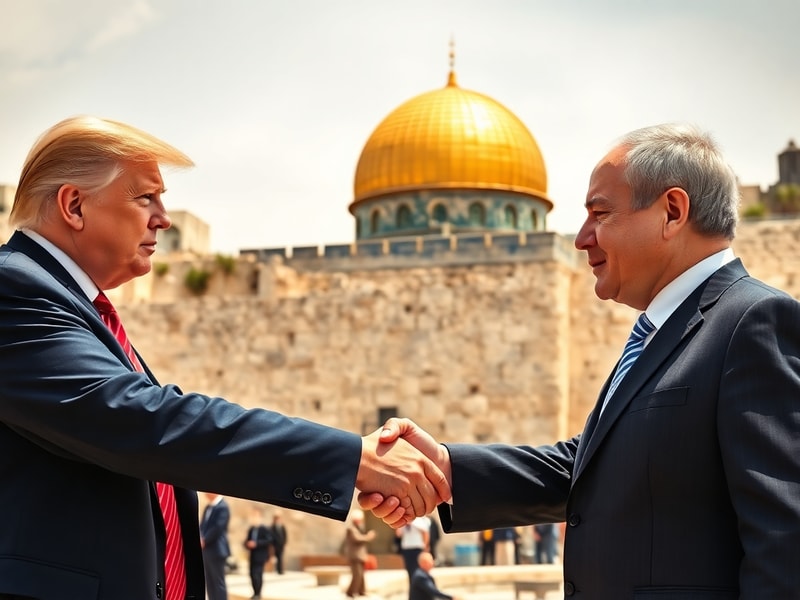
Donald Trump’s relationship with Israel during his presidency and beyond has been one of the most scrutinized and polarizing dynamics in modern U.S. foreign policy. From his decision to move the American embassy to Jerusalem to his brokering of the Abraham Accords, Trump positioned himself as one of the most pro-Israel presidents in recent history. Yet his approach was not without controversy, drawing both fierce support and sharp criticism from global observers. The implications of his policies continue to shape Middle East diplomacy, domestic American politics, and the broader geopolitical landscape.
Trump’s Pro-Israel Policy: A Break from Tradition
One of the most defining moments of Trump’s presidency was his recognition of Jerusalem as the capital of Israel in December 2017. The move reversed decades of U.S. policy and fulfilled a long-standing promise to conservative and evangelical voters who form a key part of his political base. The decision was met with immediate international condemnation, including from close U.S. allies, but it also energized Trump’s supporters who viewed it as a bold, necessary correction to what they saw as an unjust status quo.
In May 2018, the U.S. embassy was officially relocated from Tel Aviv to Jerusalem, a symbolic act that underscored Trump’s commitment to Israel’s narrative of sovereignty. The move was celebrated by Israeli Prime Minister Benjamin Netanyahu and many in the American Jewish community aligned with the Republican Party. However, it also deepened tensions with Palestinians, who view East Jerusalem as the capital of a future Palestinian state. The decision effectively sidelined the Palestinian Authority in peace negotiations and shifted the U.S. stance closer to Israel’s position than any previous administration.
Key Policy Actions Under Trump
Trump’s Israel policy was not limited to symbolic gestures. His administration took several concrete steps that reshaped the U.S.-Israel relationship and Middle East diplomacy:
- Withdrawal from the Iran Nuclear Deal (JCPOA): In 2018, Trump unilaterally pulled the U.S. out of the Iran nuclear agreement, a move widely supported by Israel. The decision was framed as necessary to counter Iran’s regional aggression and its proxies, including Hezbollah and Hamas. Israel’s military and intelligence cooperation with the U.S. intensified in the wake of this decision, particularly in cyber warfare and covert operations against Iranian targets in Syria and elsewhere.
- Recognition of Israeli Sovereignty Over the Golan Heights: In March 2019, the Trump administration formally recognized Israel’s sovereignty over the Golan Heights, territory captured from Syria in the 1967 Six-Day War. The move was largely symbolic but reinforced Israel’s strategic control over the region and signaled U.S. support for Israel’s security concerns in the face of Iranian and Hezbollah presence near the border.
- Abraham Accords Normalization Agreements: Trump’s signature foreign policy achievement in the region was brokering normalization deals between Israel and several Arab states, including the United Arab Emirates, Bahrain, Sudan, and Morocco. These agreements, known collectively as the Abraham Accords, marked a significant shift in Arab-Israeli relations, breaking long-standing taboos about direct engagement with Israel. The deals were framed as a counter to Iran’s influence and a step toward broader Middle East peace.
- Cutting Aid to the Palestinians: The Trump administration slashed hundreds of millions of dollars in U.S. aid to the Palestinians, including funding for the United Nations Relief and Works Agency (UNRWA), which supports Palestinian refugees. The move was part of a broader strategy to pressure the Palestinian Authority to return to negotiations on terms more favorable to Israel. Critics argued that the cuts exacerbated humanitarian crises in Gaza and the West Bank, while supporters saw it as a necessary pushback against what they viewed as Palestinian intransigence.
The Domestic Political Dividends of Trump’s Israel Stance
Trump’s unwavering support for Israel was not merely a matter of foreign policy; it was a cornerstone of his domestic political strategy. By aligning closely with Israel’s government and hardline factions within the American Jewish community, he consolidated support among evangelical Christians—a group that played a crucial role in his 2016 and 2020 election victories. His policies resonated deeply with voters who saw Israel as a key ally in the fight against radical Islam and a moral beacon in a region often viewed as hostile to Western values.
His administration’s actions also helped solidify his base within the Republican Party. Figures like Vice President Mike Pence and Secretary of State Mike Pompeo were vocal advocates for Israel, and their public support for policies like the embassy move and the Golan Heights recognition reinforced Trump’s image as a leader who kept his promises. This alignment helped shift the Republican platform further to the right on Israel, moving away from the more balanced approach of past administrations toward a stance that prioritized Israeli security interests above Palestinian aspirations.
Yet the political dividends came with risks. Trump’s policies alienated many American Jews, particularly younger and more liberal-leaning voters, who were more likely to support a two-state solution and were critical of Israel’s settlement expansion. Polls showed a growing generational divide within the Jewish community over Israel, with younger Jews increasingly sympathetic to Palestinian rights. This shift complicated Trump’s outreach to Jewish voters, who had traditionally leaned Democratic but showed signs of fragmentation during his presidency.
Broader Implications: Geopolitics and the Future of Middle East Diplomacy
The long-term consequences of Trump’s Israel policies are still unfolding. On one hand, the Abraham Accords represent a historic shift in regional dynamics, with the potential to reshape economic and security cooperation between Israel and its Arab neighbors. The agreements have already led to increased trade, tourism, and intelligence sharing, particularly between Israel and Gulf states. These developments could lay the groundwork for a more stable Middle East, one where Israel is less isolated and more integrated into the region’s economic and diplomatic fabric.
On the other hand, Trump’s policies have also entrenched divisions. The lack of progress on the Israeli-Palestinian conflict has left the Palestinian question largely frozen, with little prospect for a negotiated resolution in sight. The Trump administration’s approach—characterized by pressure on the Palestinian Authority and uncritical support for Israel—has sidelined the possibility of a two-state solution, at least in the near term. This has left many analysts warning of a one-state reality emerging, where Israel controls the entire territory between the Mediterranean Sea and the Jordan River but faces growing demographic and moral challenges.
The geopolitical ripple effects extend beyond the Middle East. Trump’s policies have emboldened other nations to take similarly bold stances on contentious issues, from China’s actions in the South China Sea to Russia’s invasion of Ukraine. The precedent set by the U.S. embassy move in Jerusalem has shown that major powers can unilaterally redraw diplomatic norms without facing immediate consequences. This has contributed to a more fragmented and unpredictable global order, where traditional alliances and multilateral institutions are increasingly strained.
For Israel, Trump’s presidency provided a rare moment of alignment with a U.S. administration that shared its vision of the Middle East. Netanyahu, who had a famously close relationship with Trump, often referred to him as the “greatest friend Israel has ever had in the White House.” Yet the relationship was not without its tensions. Trump’s unpredictability and transactional approach to diplomacy sometimes clashed with Israel’s long-term strategic interests, particularly in areas like arms sales to Gulf states and the potential for a future Palestinian state.
What’s Next? The Biden Administration and Beyond
With Joe Biden’s victory in the 2020 U.S. presidential election, the tone of U.S. policy toward Israel shifted once again. Biden, who had served as vice president under Barack Obama, has sought to distance himself from Trump’s most controversial policies while maintaining strong support for Israel’s security. His administration has restored aid to the Palestinians, re-engaged with the Iran nuclear deal (though with limited success), and criticized Israel’s settlement expansion in the West Bank. Yet Biden has also faced pressure from progressive Democrats to take a harder line on Israel, particularly in the wake of the 2023 Israel-Hamas war.
The future of U.S.-Israel relations will likely be shaped by several key factors. First, the outcome of the Israeli-Palestinian conflict remains uncertain. With no clear path to a two-state solution and rising violence in the West Bank and Gaza, the status quo appears increasingly unsustainable. Second, the role of Iran will continue to dominate regional calculations. Israel’s military actions against Iranian targets, including its covert campaign in Syria and public strikes in Iran itself, suggest that the shadow war between the two nations will persist regardless of U.S. policy shifts. Third, the Abraham Accords will test their durability. While the normalization agreements have held so far, their long-term success depends on tangible benefits for the Arab signatories and continued U.S. engagement.
For Trump, his legacy on Israel will likely remain a defining feature of his political identity. His supporters continue to champion his policies as necessary for Israel’s security and America’s interests, while critics argue that they have undermined U.S. credibility as a neutral mediator and deepened regional divisions. Regardless of one’s perspective, there is no denying that Trump’s approach has left an indelible mark on Middle East diplomacy—and on the broader landscape of U.S. foreign policy.
As the region navigates an increasingly complex geopolitical environment, the lessons of Trump’s presidency offer both caution and opportunity. For those who advocate for a more balanced U.S. role in the Middle East, the risks of unilateralism and uncritical support are clear. Yet for those who see Israel as a vital ally in a turbulent region, Trump’s policies represent a bold and necessary reassertion of American leadership. The debate over his legacy will continue to shape the future of U.S.-Israel relations—and the broader struggle for peace and stability in the Middle East.