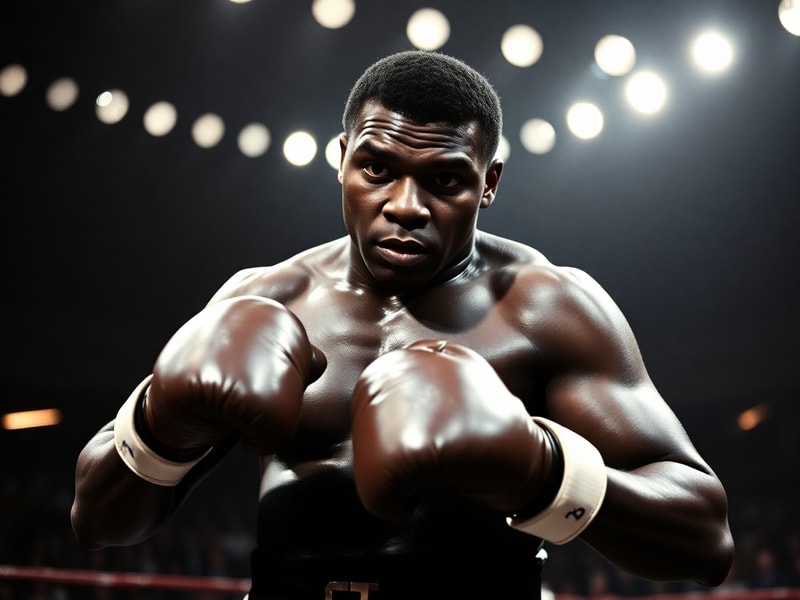
Joe Louis Barrow stood 6’2″ over a boxing ring, but his presence towered over mid-century America. Born in 1914 in rural Alabama, Louis spent his teenage years in Detroit, where he discovered boxing as a path away from the assembly line. His professional debut in 1934 marked the arrival of a quiet force whose punches would echo far beyond the ropes. Nicknamed the “Brown Bomber,” Louis didn’t just dominate opponents; he reshaped expectations about what an African American athlete could achieve in a segregated nation.
The rise of a champion and the fight against Jim Crow
Louis turned professional after winning the 1934 National AAU light-heavyweight title. His early career followed a carefully managed trajectory, with manager John Roxborough steering him toward elite black managers like Julian Black and trainer Jack Blackburn, who shaped both his technique and his persona. Blackburn instilled defensive discipline, teaching Louis that a single clean shot could end a fight—an ethos that defined Louis’s approach.
The Brown Bomber’s rise coincided with the Great Depression, when sports provided a rare escape from economic despair. His 1935 knockout of former champion Primo Carnera in six rounds at Madison Square Garden electrified a nation hungry for heroes. Yet Louis’s significance extended beyond athletic prowess. Each victory became a subtle rebuke to Jim Crow segregation, delivered in a style that refused to conform to racial stereotypes of the era.
His 1936 loss to Max Schmeling, a German fighter co-opted by Nazi propaganda, transformed Louis from champion to symbol. When Louis avenged that defeat in 1938 with a first-round knockout in Yankee Stadium, the fight became a proxy for American democracy against totalitarianism. The German press described the defeat as “a blow to Aryan superiority,” while black newspapers celebrated Louis as a representative of racial progress.
Louis vs. Schmeling: more than a boxing match
The 1938 rematch wasn’t merely a sporting event; it was a cultural referendum. Schmeling’s handlers had positioned the fight as a clash between German might and American democracy, with Louis cast as the nation’s reluctant standard-bearer. When Louis floored Schmeling three times in the first round before the fight was stopped, the victory resonated globally. Newspapers across the United States declared it “the greatest single round in boxing history,” while African American communities saw in Louis a figure who could challenge racial hierarchies without overt political activism.
Yet the fight’s legacy remains complex. Some historians argue that Louis’s victory inadvertently reinforced the idea that African American athletes could succeed only within the confines of white-approved narratives. Others point to Louis’s post-fight statement—”I don’t want nobody to think I’m just a prizefighter. I want them to know I’m Joe Louis, the man”—as evidence of his quiet defiance within the system.
The Schmeling fights crystallized Louis’s role as a reluctant icon, one whose power came from his ability to transcend sport while operating within its constraints. His 1938 victory tour through the American South revealed the paradox of his fame: adored in the ring, yet still subject to segregation’s humiliations outside it.
A champion’s financial and cultural contradictions
Louis’s financial struggles after retirement revealed the fragility beneath his public persona. Despite earning millions during his career, he faced substantial tax debts, poor investments, and a lifestyle that outpaced his earnings. His post-boxing career included a brief stint in the Army during World War II, where he fought exhibition matches to boost morale, and later work as a referee and celebrity endorser. Yet the IRS pursued him aggressively, seizing his pension and forcing him to wrestle professionally in old age to pay debts.
His personal life mirrored these contradictions. Married four times, Louis struggled with depression and substance abuse in later years. When he died in 1981 at the age of 66, his body was donated to science for medical research—a stark contrast to the tributes that followed his death. The discrepancy between his public legacy and private reality highlighted the limited pathways available to black athletes of his generation.
Despite these challenges, Louis’s cultural footprint endured. His fights became touchstones in African American literature and music, referenced by writers like Langston Hughes and musicians including Miles Davis. His disciplined persona influenced generations of athletes, from Muhammad Ali to Mike Tyson, who saw in Louis a model of controlled power rather than showmanship.
Louis’s enduring legacy and modern relevance
Joe Louis’s significance extends beyond boxing statistics. His career intersected with the Great Migration, the New Deal era, World War II, and the civil rights movement, making him a prism through which to examine 20th-century American history. Unlike Ali, who embraced political confrontation, Louis operated within a system that demanded compliance while offering occasional rewards. This tension between accommodation and resistance shaped his legacy in ways that continue to provoke debate.
Today, Louis’s story offers lessons about the complex relationship between sports and social change. His ability to project strength without overt rebellion provided a model for athletes navigating oppressive systems. Yet his financial misfortunes serve as a cautionary tale about the limitations of individual achievement within structurally racist institutions.
Key aspects of Louis’s legacy include:
- Cultural symbolism: Louis became a vehicle for African American aspirations, though his role was often constrained by white expectations of black athletes.
- Economic realities: Despite unprecedented earnings, Louis’s post-career struggles revealed the fragility of financial security for black athletes of his era.
- Diplomatic soft power: His fights were leveraged as propaganda tools during World War II, demonstrating sports’ role in international relations.
- Influence on athletic personas: Louis’s disciplined, unflashy style influenced generations of boxers and athletes across sports.
As debates about athlete activism intensify, Louis’s career offers a historical counterpoint to contemporary discussions. His refusal to publicly challenge segregation contrasts with modern athletes who use their platforms for direct political engagement. Yet his quiet dominance within the ring provided a different kind of resistance—one that challenged stereotypes through performance rather than rhetoric.
Joe Louis’s story reminds us that heroism exists in multiple forms. His punches didn’t just knock out opponents; they challenged the narrative about who deserved to be celebrated in mid-century America. In an era when sports figures are often reduced to their most marketable traits, Louis’s complexity offers a richer understanding of athletic greatness and its broader implications.
For those interested in exploring similar stories of athletes who navigated fame and social change, visit our Sports and Culture sections for deeper analysis and historical context.