Wimbledon 2026: Night Sessions, Zero-Waste Goals and Tech Upgrades
The All England Lawn Tennis Club has begun finalizing preparations for Wimbledon 2026, marking a return to the hallowed grass of SW19 with innovations in sustainability, fan experience, and broadcast technology. While the official draw won’t occur until late June, the tournament’s governing body has already outlined key changes that promise to reshape how players, spectators, and viewers engage with tennis’ most prestigious event. From expanded night sessions to enhanced environmental initiatives, Wimbledon is positioning itself not just as a sporting spectacle, but as a blueprint for the future of major sporting events.
New Court Scheduling and Extended Night Sessions
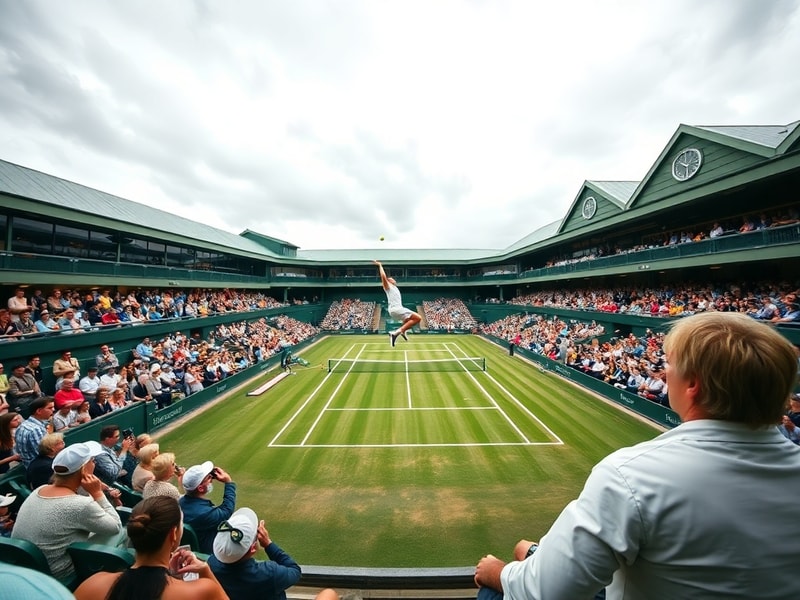
Wimbledon 2026 will debut a revised match schedule designed to reduce player fatigue and increase fan accessibility. The most notable adjustment is the introduction of a third night session on Centre Court, joining the existing evening fixtures on No. 1 Court. This follows the successful pilot of late-night play in 2024, which drew record television ratings in the United States and Asia. Under the new format, Centre Court will host a 10 p.m. start time on four evenings during the fortnight, offering prime-time audiences in Europe, the Americas, and the Asia-Pacific region.
According to tournament director Jamie Baker, the decision was driven by both fan demand and broadcast revenue potential. “We saw that night matches were not just about filling seats—they became cultural moments,” Baker told The Guardian. “In 2026, we’re making sure every major market has access to live action when it matters most.” The move also aligns with player feedback, with several top seeds requesting shorter gaps between matches to maintain rhythm during the grueling two-week stretch.
To support this shift, the grounds will undergo subtle lighting upgrades, focusing on reduced glare and improved visibility without disrupting the venue’s historic aesthetic. Additionally, Centre Court’s retractable roof will be tested for full-night operation for the first time, ensuring uninterrupted play even in unpredictable British weather.
Sustainability Takes Center Stage: A Zero-Waste Aspiration
Wimbledon has long positioned itself as a leader in environmental responsibility, but in 2026, the tournament aims to become the first major sporting event to achieve near-zero waste. The club has partnered with waste management innovators to overhaul its operational model, targeting a 98% diversion rate from landfill—a significant leap from the 61% achieved in 2023. Central to this effort is the elimination of single-use plastics in all player and staff areas, starting with reusable water stations on every court.
A key initiative involves compostable court liners and biodegradable ball cans, which will be piloted across all 19 courts. The tournament has also committed to sourcing 100% of its electricity from renewable sources, including on-site solar arrays and wind power agreements. Food waste will be processed through anaerobic digestion, with surplus produce donated to local charities via the Wimbledon Community Fund. These efforts are part of the club’s broader “Every Ball Counts” campaign, which ties sustainability directly to the sport’s ethos of precision and respect.
Critics, however, point out that grass court maintenance remains a resource-intensive process. In response, the club has invested in robotic mowers that operate on solar power and are programmed to cut grass only during optimal weather windows, reducing water usage by 30%. While some purists argue that artificial turf could reduce environmental impact, the All England Club has reaffirmed its dedication to natural grass, citing tradition and player preference as non-negotiable factors.
Tech Upgrades Enhancing Fan and Player Experiences
Wimbledon 2026 will roll out several technological enhancements aimed at both spectators on-site and the global audience. The most visible change is the expansion of 5G connectivity across the grounds, enabling real-time player statistics, augmented reality (AR) replays, and interactive fan maps via the official Wimbledon app. The app, which already serves over 1.2 million users during the tournament, will introduce AI-powered chatbots to answer questions about match schedules, transport, and player histories in multiple languages.
Players will benefit from advanced analytics tools integrated into their preparation areas. Using Hawk-Eye data and AI-driven insights, coaches will receive personalized serve and return patterns for upcoming opponents, delivered via encrypted tablets. This follows feedback from players like Novak Djokovic, who has advocated for more data-driven training between matches. The technology will be housed in a dedicated Innovation Hub, located near the players’ entrance, and will be available to all competitors regardless of ranking.
Broadcast innovation continues to be a cornerstone of Wimbledon’s appeal. For the first time, the tournament will offer volumetric video replays in select markets, allowing viewers to watch key points from multiple angles in 3D. This format, compatible with VR headsets, will be accessible through partnerships with Meta and Sony. While still in its infancy, the feature signals Wimbledon’s ambition to remain at the forefront of sports broadcasting technology.
The Road to 2026: Qualification, Wildcards, and Early Storylines
The qualification process for Wimbledon 2026 will open in December 2025, with a record 128 players competing across three rounds. The ATP and WTA have adjusted their rankings deadlines to accommodate the earlier grass court swing, including the Halle and Queen’s Club tournaments, which serve as crucial warm-up events. Notably, Wimbledon will maintain its tradition of awarding eight wildcards—four to each gender—with a focus on rising stars and former champions returning from injury. Among the early contenders for wildcards are British hopefuls Emma Raducanu and Jack Draper, both recovering from recent injuries and seeking a homecoming boost.
One of the most intriguing narratives will be the potential debut of new Grand Slam rules. After successful trials in lower-tier events, Wimbledon may adopt the “final set tiebreak at 12-12” format, replacing the traditional advantage set in the fifth and third sets. This change aims to reduce match durations and improve scheduling flexibility, particularly during night sessions. While the decision won’t be finalized until early 2026, the possibility has already sparked debate among players and analysts.
The 2026 edition will also mark the 150th anniversary of the first Wimbledon Championship, celebrated in 1877. To honor the milestone, the club plans a series of heritage exhibits, including rare footage from the 1946 tournament—held during post-war rationing—and a recreation of the original Centre Court layout. Special commemorative merchandise, designed in collaboration with the Victoria and Albert Museum, will be sold to benefit the Wimbledon Foundation’s youth programs.
The countdown to Wimbledon 2026 is not just about tennis—it’s about reimagining how tradition and innovation can coexist. With sustainability as a guiding principle, technology enhancing engagement, and a renewed focus on player welfare, the tournament is laying the groundwork for a new era. Whether it’s the drama of Centre Court under the lights or the quiet revolution of zero-waste courts, SW19 is once again poised to set the standard for global sporting events.