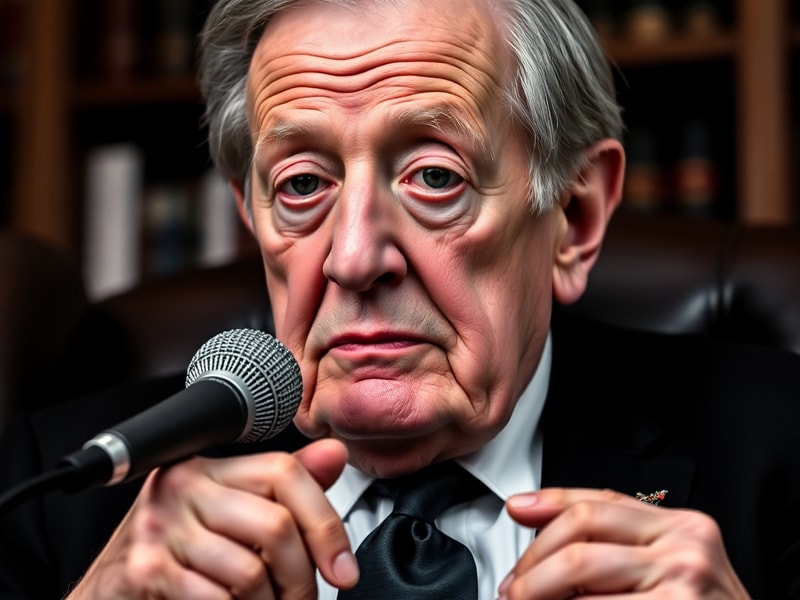
Alan Greenspan: The Fed’s Most Influential—and Controversial—Leader
Alan Greenspan, the 13th Chair of the Federal Reserve, remains one of the most influential—and divisive—figures in modern economic history. Serving from 1987 to 2006, his tenure spanned four U.S. presidencies, during which he shaped monetary policy, navigated financial crises, and left an indelible mark on the global economy. Greenspan’s leadership was defined by his faith in free markets, his advocacy for deregulation, and his sometimes-controversial decisions that both stabilized and destabilized the economy. More than two decades after he stepped down, his legacy continues to spark debate among economists, policymakers, and historians alike.
The Early Years and Rise to Power
Born on March 6, 1926, in New York City, Alan Greenspan grew up in modest circumstances during the Great Depression. His father, a stockbroker, left the family when Greenspan was young, and he was raised by his mother in a middle-class Jewish household. Despite financial challenges, Greenspan excelled academically, graduating from New York University with a degree in economics in 1948. He later earned a master’s degree from Columbia University and pursued a Ph.D. at New York University, though he never completed it. His early career included work as an economic consultant and a stint at the Conference Board, where he analyzed industrial trends.
Greenspan’s political connections proved pivotal. He became an economic advisor to President Richard Nixon in the early 1970s and later served as a member of President Gerald Ford’s Council of Economic Advisors. His reputation as a free-market advocate and his close ties to Ayn Rand, whose libertarian philosophy influenced his economic views, solidified his standing in conservative circles. By the time he was nominated to chair the Federal Reserve by President Ronald Reagan in 1987, Greenspan had established himself as a pragmatic economist with a knack for navigating political winds. His confirmation was nearly unanimous, reflecting broad confidence in his abilities.
Greenspan’s Fed: Stability and Controversy
Greenspan’s 18-year tenure at the Fed was marked by a combination of steady leadership and bold, sometimes risky decisions. He took office just weeks before the 1987 stock market crash, and his swift response—injecting liquidity into the financial system—helped avert a deeper crisis. This set the tone for his approach: prioritize financial stability while maintaining a hands-off attitude toward market intervention. His belief in the self-correcting nature of markets became a hallmark of his tenure.
One of Greenspan’s most significant contributions was his role in managing inflation. In the late 1980s and early 1990s, he aggressively raised interest rates to combat inflation, a move that stabilized prices but also drew criticism for slowing economic growth. However, his legacy in this area is complex. By the mid-1990s, inflation had fallen to historically low levels, and the U.S. economy entered a period of sustained growth known as the “Great Moderation.” Some economists credit Greenspan with this stability, while others argue that external factors, such as globalization and technological advancements, played a larger role.
Greenspan’s leadership wasn’t without controversy. His famous 2004 “fedspeak” testimony, where he suggested that long-term interest rates were “puzzlingly low,” hinted at concerns about a housing bubble. Yet, he resisted calls to raise interest rates aggressively or regulate the burgeoning subprime mortgage market. When the housing bubble burst in 2007, leading to the global financial crisis, critics lambasted Greenspan for his deregulatory stance and his faith in self-regulating markets. In a 2008 congressional hearing, he admitted that his ideology had “failed” in the face of the crisis, a rare moment of self-reflection that underscored the limitations of his economic philosophy.
The Man Behind the Myth: Personality and Influence
Greenspan’s public persona was as carefully crafted as his economic policies. Known for his cryptic, meandering speaking style—dubbed “Greenspeak”—he often spoke in riddles, leaving listeners to decipher his true intentions. His low-key demeanor and preference for behind-the-scenes negotiations earned him the nickname “the Oracle,” though his opaque communication style frustrated many. Colleagues and journalists alike noted his meticulous attention to detail and his ability to distill complex economic issues into digestible soundbites, even if those soundbites were often deliberately vague.
Beyond his professional life, Greenspan’s personal quirks added to his mystique. He was an accomplished clarinet player and a devotee of classical music, once performing with the New York Philharmonic. His second marriage to NBC journalist Andrea Mitchell in 1997 brought him into the public eye in a new way, though he remained notoriously private about his personal life. Greenspan’s intellectual curiosity extended beyond economics; he was a voracious reader with a particular interest in history and philosophy, which undoubtedly shaped his worldview.
Greenspan’s influence extended far beyond the Federal Reserve. He was a trusted advisor to presidents, a sought-after speaker, and a regular presence in Washington’s power circles. His 2007 memoir, Greenspan’s Bubbles, offered a retrospective on his career and his evolving views on the economy. In it, he acknowledged the dangers of irrational exuberance in markets—a phrase he first used in a 1996 speech to describe the dot-com bubble—and the need for better regulation. Yet, even in retirement, he remained a polarizing figure, with some praising his legacy as a steward of economic stability and others blaming him for the excesses that led to the 2008 financial crisis.
Legacy and Lessons from the Greenspan Era
Assessing Greenspan’s legacy requires weighing his achievements against his failures. On the positive side, his leadership during the 1987 crash, the 1990-1991 recession, and the early 2000s recession demonstrated his ability to act decisively in times of crisis. His focus on inflation targeting helped anchor expectations and contributed to the Great Moderation, a period of relative economic calm. Greenspan also played a key role in modernizing the Fed’s communication strategies, introducing forward guidance to help markets anticipate policy moves.
However, his legacy is indelibly tied to the 2008 financial crisis. Greenspan’s faith in self-regulating markets led him to oppose stricter regulations on derivatives and mortgage lending. His 2000 decision to allow investment banks to self-regulate their capital requirements—following the repeal of Glass-Steagall—removed key safeguards that could have mitigated the crisis. In hindsight, his reluctance to act on warnings about the housing bubble appears as a critical misstep. The crisis not only plunged the U.S. into a deep recession but also exposed the flaws in the financial system that Greenspan had helped shape.
The aftermath of the crisis prompted a reevaluation of Greenspan’s policies and the broader economic orthodoxy he represented. The Dodd-Frank Act of 2010, which imposed stricter regulations on banks and financial institutions, was a direct response to the failures of the pre-crisis era. Greenspan himself admitted that his ideology had been challenged by the events of 2008, though he remained cautious about overregulation. His legacy serves as a cautionary tale about the dangers of ideological rigidity and the limits of free-market fundamentalism.
For students of economics and policymakers alike, Greenspan’s career offers several key lessons. First, the importance of adaptability in leadership. Greenspan’s early years at the Fed were marked by a willingness to adjust policies in response to changing circumstances, but his later years demonstrated a stubbornness that may have contributed to the crisis. Second, the need for humility in the face of complex systems. The economy is not a machine that can be finely tuned; it is a dynamic, unpredictable entity that defies simplistic solutions. Finally, the role of communication in shaping policy. Greenspan’s opaque style may have contributed to market misunderstandings and eroded public trust in institutions.
Greenspan’s life and career reflect the tensions inherent in modern capitalism: the balance between innovation and regulation, growth and stability, freedom and control. His story is not just one of economic policy but of the human frailties and strengths that shape history. As the U.S. continues to grapple with the aftermath of the 2008 crisis and faces new economic challenges—from inflation to climate change—Greenspan’s legacy remains a touchstone for debate and reflection.
For those interested in exploring more about economic policies and financial history, check out our News section for the latest analysis or dive into our Business category for deeper insights into market trends and regulatory shifts.