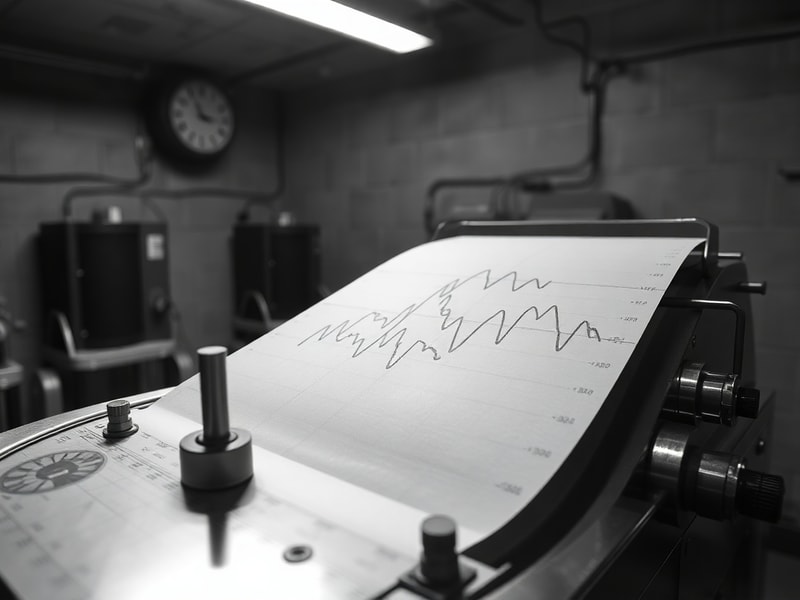
Understanding Seismic Waves: The Earth’s Hidden Messengers
When the ground trembles beneath our feet, it’s not just a random event—it’s a message from deep within the planet, delivered by seismic waves. These waves, generated by earthquakes, volcanic activity, or even human-made explosions, travel through the Earth’s layers, carrying information about the planet’s structure and the forces at play below the surface. While we often associate them with destruction, seismic waves are also invaluable tools for scientists studying the Earth’s interior, much like ultrasound imaging in medicine.
Seismic waves come in several forms, each with distinct characteristics and behaviors. The two primary types are body waves and surface waves. Body waves, which include P-waves (primary waves) and S-waves (secondary waves), travel through the Earth’s interior, while surface waves move along the planet’s outer layers. Understanding these waves helps seismologists predict earthquakes, map fault lines, and even explore other planets. Their study is a blend of physics, geology, and engineering, revealing the unseen dynamics of our world.
The Science Behind Seismic Waves
At their core, seismic waves are mechanical waves that propagate through a medium—whether solid rock, liquid magma, or even the Earth’s molten outer core. P-waves are the fastest, moving at speeds up to 14 kilometers per second in dense rocks. They are longitudinal waves, meaning they compress and expand material in the direction of travel, much like sound waves in air. This makes them the first to arrive at seismic stations after an earthquake, earning them the name “primary waves.”
S-waves, on the other hand, are slower, traveling at about 60% the speed of P-waves. They are transverse waves, shaking the ground perpendicular to their direction of travel. Unlike P-waves, S-waves cannot travel through liquids, which is why they disappear when they encounter the Earth’s outer core. This unique behavior was key to discovering the core’s liquid state in the early 20th century. Surface waves, the third major type, include Love waves and Rayleigh waves. Love waves shake the ground horizontally, while Rayleigh waves produce a rolling motion similar to ocean waves. These waves are responsible for the most damage during earthquakes because they travel along the surface, where structures are located.
Seismic waves don’t just tell us about earthquakes—they also reveal the Earth’s hidden layers. By analyzing how waves bend, reflect, or slow down as they pass through different materials, scientists create detailed images of the planet’s interior, much like a CT scan. This field, called seismic tomography, has uncovered features like subducting tectonic plates, mantle plumes, and even the boundary between the inner and outer core.
How Seismologists Use Seismic Waves
Modern seismology relies heavily on advanced technology to monitor and interpret seismic waves. Seismometers, the instruments that detect ground motion, are now highly sensitive, capable of measuring movements as small as a nanometer. Networks of these devices, such as the Global Seismographic Network, track earthquakes worldwide in real time, providing data that helps researchers understand fault mechanics and improve early warning systems.
One practical application of seismic wave analysis is earthquake early warning systems, like ShakeAlert in the U.S. or Japan’s Earthquake Early Warning. These systems use the speed difference between P-waves and S-waves to detect an earthquake’s initial tremors and send alerts seconds to minutes before the more destructive surface waves arrive. While this may seem like a small window, it can save lives by allowing people to take cover, stop trains, or shut down critical infrastructure.
Beyond earthquakes, seismic waves are used in other fields. In exploration seismology, geophysicists generate artificial seismic waves using controlled explosions or vibrating trucks to map underground oil and gas reserves. This technique, called seismic reflection profiling, is essential for the energy industry. Similarly, scientists use seismic waves to study the Moon, Mars, and even asteroids, helping us understand the composition and history of these celestial bodies.
The Role of Seismic Waves in Natural Disasters
While seismic waves are invaluable for science, they also pose significant risks. The destruction caused by earthquakes and tsunamis is directly linked to the energy carried by these waves. When an earthquake occurs, the sudden release of stress along a fault line generates seismic waves that radiate outward. The intensity of shaking depends on the earthquake’s magnitude, depth, and the local geology. Soft sediments, for example, can amplify seismic waves, leading to more severe damage in certain areas.
Tsunamis, often triggered by underwater earthquakes, are another example of seismic waves’ destructive power. When the seafloor abruptly shifts, it displaces massive volumes of water, creating waves that can travel across entire ocean basins at speeds exceeding 800 kilometers per hour. By the time they reach shore, these waves can tower over 30 meters, devastating coastal communities. Early warning systems for tsunamis rely on detecting seismic waves to predict their arrival, giving residents precious minutes to evacuate.
Volcanic activity also generates seismic waves, providing clues about a volcano’s internal processes. Before an eruption, magma moving through underground chambers creates distinctive seismic signals, such as low-frequency tremors or harmonic tremors. Monitoring these waves helps volcanologists predict eruptions, potentially saving lives. For instance, the 2021 eruption of La Soufrière in St. Vincent was preceded by weeks of seismic activity, allowing authorities to evacuate thousands of people in advance.
Seismic Waves and the Future of Earth Science
The study of seismic waves is evolving rapidly, driven by advances in technology and computing. Machine learning algorithms are now being used to analyze seismic data, improving our ability to detect earthquakes and distinguish them from other sources of ground motion, such as mining blasts or even traffic noise. These tools are particularly useful in regions with dense urban populations, where distinguishing between natural and human-made vibrations is challenging.
Another frontier is ambient noise tomography, a technique that uses background seismic noise—generated by ocean waves, wind, or human activity—to create images of the Earth’s subsurface. This method is non-invasive and cost-effective, making it ideal for studying remote or inaccessible regions. Researchers have used it to map fault lines in California, explore geothermal resources, and even monitor the stability of glaciers in Antarctica.
Looking ahead, seismic waves could play a role in addressing climate change. By studying how seismic waves interact with permafrost and glaciers, scientists can better understand the impacts of melting ice on sea levels and coastal stability. Additionally, carbon sequestration projects, which involve injecting CO₂ into underground rock formations, rely on seismic monitoring to ensure the gas remains trapped and doesn’t leak into the atmosphere.
The next generation of seismologists will likely focus on integrating seismic data with other types of geophysical measurements, such as gravity and magnetic field data, to build more comprehensive models of the Earth. Projects like EarthScope in the U.S. and EPOS in Europe are already creating vast databases of seismic information, accessible to researchers worldwide. These collaborative efforts are paving the way for breakthroughs in our understanding of the planet’s dynamic systems.
Why Seismic Waves Matter to Everyone
Seismic waves are more than just a scientific curiosity—they are a reminder of the Earth’s constant, albeit often invisible, activity. From the smallest tremors to the most catastrophic earthquakes, these waves connect us to the planet’s inner workings. For engineers, they highlight the importance of resilient infrastructure. For policymakers, they underscore the need for disaster preparedness. And for the average person, they serve as a humbling lesson in the power of natural forces.
Understanding seismic waves also fosters a deeper appreciation for the Earth sciences. Many people take for granted the stable ground beneath their feet, but seismic waves reveal a world in motion. They show how mountains rise, oceans spread, and continents drift over geological time. They remind us that the Earth is not a static rock but a living, breathing entity with its own rhythms and cycles.
As technology advances, so too will our ability to harness seismic waves for both scientific discovery and practical applications. Whether it’s improving earthquake early warning systems, exploring other planets, or mitigating the effects of climate change, the study of seismic waves will remain a cornerstone of Earth science. For now, the next time you feel a slight tremor or hear about an earthquake halfway across the world, remember: it’s not just the ground moving—it’s the planet speaking.