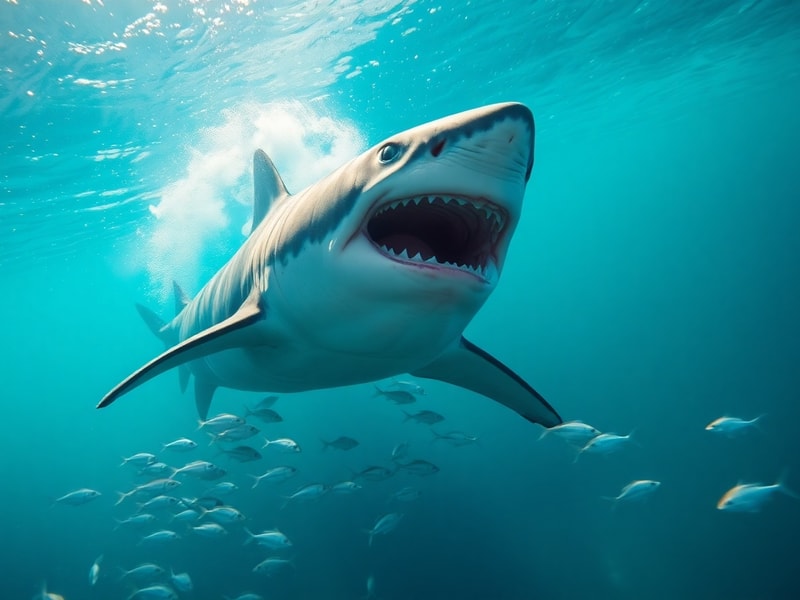
Ancient Predators of the Deep
Sharks have patrolled Earth’s oceans for over 400 million years, long before dinosaurs appeared. Their evolutionary success hinges on a combination of refined senses, adaptable biology, and a streamlined body built for speed and stealth. Unlike many modern fish, sharks lack swim bladders; instead, they rely on a large, oil-filled liver to maintain buoyancy. This ancient design has allowed them to dominate marine ecosystems across geological time.
There are more than 500 recognized species of sharks, ranging from the 8-inch dwarf lanternshark to the 60-foot whale shark. Each species has evolved unique hunting strategies and physical adaptations. Some, like the great white, use electroreception to detect the faint signals of a seal’s heartbeat. Others, such as the filter-feeding basking shark, glide through the water with their mouths agape, straining plankton from the sea.
Despite their fearsome reputation, most sharks are not apex threats to humans. In fact, humans pose a far greater danger to sharks. Overfishing, bycatch, and habitat destruction have driven many species to the brink of extinction. Conservationists now warn that nearly one-third of all shark and ray species are threatened with global extinction according to the International Union for Conservation of Nature (IUCN).
The Science of Shark Behavior and Intelligence
Sharks are often portrayed as mindless killers, but behavioral studies reveal complex social structures and cognitive abilities. Some species, like the blacktip reef shark, have been observed hunting cooperatively in groups, a rare trait among fish. Others, such as the lemon shark, demonstrate problem-solving skills in lab experiments, navigating mazes and remembering solutions for months.
Research also suggests that sharks possess long-term memory and can learn from experience. In one study, juvenile lemon sharks avoided areas where they had previously encountered predators, indicating they associate specific locations with danger. This kind of spatial learning is essential for survival in dynamic ocean environments where food sources and threats shift constantly.
Social interactions vary widely. While some sharks are solitary, others form loose aggregations during feeding or mating seasons. Whale sharks, the largest fish in the sea, often gather in large numbers in specific coastal regions, such as Mexico’s Isla Holbox or Western Australia’s Ningaloo Reef, where plankton blooms provide abundant food. These gatherings are not random; they’re driven by environmental cues and social learning passed down through generations.
Do Sharks Really Need to Keep Swimming to Breathe?
Many people believe sharks must swim continuously to breathe, but this is only true for some species. Obligate ram ventilators, like the great white and mako shark, rely on constant motion to force water over their gills. Others, such as nurse sharks and wobbegongs, can pump water over their gills while resting on the seafloor. This adaptation allows them to conserve energy during inactive periods.
Some deep-sea species, including the Greenland shark, have evolved slower metabolisms and can remain nearly motionless for extended periods. Their ability to survive in near-freezing Arctic waters highlights the incredible diversity within the shark family. These adaptations underscore how sharks have filled nearly every ecological niche in the ocean, from shallow reefs to the abyssal plain.
Human Encounters: Myths and Realities
Shark attacks on humans are statistically rare. According to the Florida Museum’s International Shark Attack File, there were just 69 unprovoked shark bites worldwide in 2023. For context, lightning strikes kill about 24,000 people annually, and bee stings account for roughly 60 deaths per year. The odds of being bitten by a shark are approximately 1 in 3.7 million.
Most shark incidents occur due to mistaken identity. Surfers, who resemble seals from below, are frequent targets. Sharks may also bite out of curiosity, especially in murky water where visibility is poor. Fatalities are even rarer: only five people died from shark attacks globally in 2023. Advances in medical treatment and emergency response have further reduced the risk of death following an encounter.
Education and prevention play crucial roles in minimizing conflicts. Beaches with shark-spotting programs, such as those in Australia and South Africa, use drones and spotters to alert swimmers to nearby sharks. In Western Australia, drone surveillance helped reduce shark-related incidents by 30% in some regions. These measures demonstrate how technology can bridge the gap between human activity and marine ecosystems.
The Global Shark Conservation Movement
Shark conservation has gained momentum in recent years, driven by scientific research and public awareness campaigns. The 1989 listing of the great white shark under CITES (Convention on International Trade in Endangered Species) marked a turning point, restricting commercial trade in their fins and parts. More recently, nations like Palau, the Maldives, and New Zealand have established shark sanctuaries, banning all shark fishing within their territorial waters.
These sanctuaries serve as critical refuges for species like the scalloped hammerhead, which migrates thousands of miles across open ocean. Research shows that shark populations within protected areas recover more quickly, with increases in both numbers and average size of individuals. For example, in the waters around the Bahamas, lemon shark populations have rebounded since the establishment of a shark sanctuary in 2011.
Grassroots movements have also played a vital role. Organizations such as Oceana, Shark Advocates International, and the Shark Trust work with governments to strengthen fishing regulations and promote sustainable seafood choices. Consumers can support these efforts by avoiding shark-derived products like fin soup and demanding traceable, sustainably sourced seafood.
Ecotourism offers another pathway to conservation. Dive operators in places like the Galápagos Islands and Fiji charge premium rates for shark-diving experiences, generating income that incentivizes protecting sharks over hunting them. A single reef shark in Palau is estimated to be worth $1.9 million over its lifetime in tourism revenue, far exceeding the $100 it would fetch in a fish market.
How You Can Help Protect Sharks
There are several practical ways individuals can contribute to shark conservation:
- Choose sustainable seafood: Use apps like Seafood Watch or the Marine Stewardship Council’s guide to make informed choices.
- Avoid shark products: Skip shark fin soup, liver oil supplements, and shark leather goods.
- Support conservation groups: Donate to or volunteer with organizations working to protect shark habitats.
- Educate others: Share accurate information about sharks to counter misconceptions and fear.
- Advocate for policy change: Contact local representatives to support shark conservation laws and marine protected areas.
Looking Ahead: The Future of Sharks in a Changing Ocean
Climate change poses a growing threat to sharks. Warming oceans disrupt migration patterns, alter prey availability, and increase the frequency of harmful algal blooms. Coral bleaching events, such as those in the Great Barrier Reef, reduce habitat complexity, making reef-associated species more vulnerable to predation and starvation.
Ocean acidification, another consequence of rising CO₂ levels, weakens the sensory abilities of sharks. Studies show that acidified water impairs their ability to detect electric fields, a critical sense for hunting. This could have cascading effects on entire food webs, particularly in tropical and subtropical regions where sharks play a keystone role.
Technology offers hope for the future. Satellite tagging and genetic research are helping scientists track shark movements and population health in unprecedented detail. Projects like Global Shark Movement, led by the Save Our Seas Foundation, combine citizen science with cutting-edge data analysis to identify critical habitats and migration corridors. These data-driven insights are essential for designing effective conservation strategies.
The next decade will be pivotal for shark conservation. With continued public support, political will, and scientific innovation, there’s a real chance to reverse the decline of these ancient mariners. The survival of sharks isn’t just about preserving biodiversity—it’s about maintaining the health of the entire ocean ecosystem. Without sharks, marine food chains could unravel, leading to unpredictable consequences for both ocean life and human communities that depend on healthy seas.
As we move forward, the challenge is clear: to see sharks not as villains, but as vital, irreplaceable members of the ocean’s intricate web. Their fate is inextricably linked to our own. Protecting them is not just an environmental imperative—it’s a commitment to the future of the planet we all share.