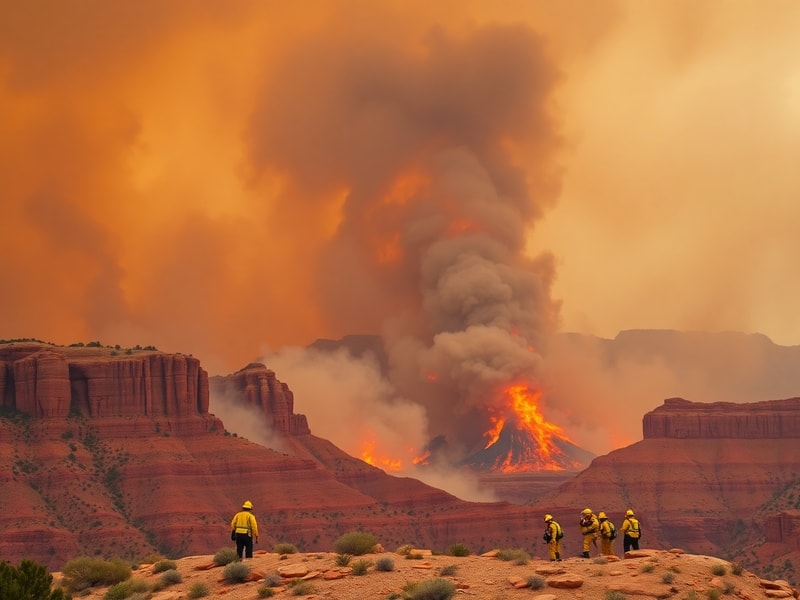
The 2024 wildfire season in Utah arrived early and with unusual intensity, forcing evacuations, charring thousands of acres, and underscoring how climate shifts are redrawing the state’s relationship with fire. From the red-rock canyons of Washington County to the alpine meadows of the Uinta Mountains, no region has been spared. Firefighters, many of them seasonal crews hired from across the West, have been stretched thin, battling flames under record-dry conditions and gusty winds that can turn a small flare-up into a wall of flame in minutes.
What’s driving Utah’s worsening wildfire seasons
Utah’s wildfire problem is not new, but its scale and timing are accelerating. A decade ago, the average start to fire season was late June. Today, red flag warnings often arrive by late April. Scientists point to a combination of factors: hotter, earlier springs that melt snowpack weeks ahead of schedule; invasive cheatgrass spreading like a green carpet that turns to kindling by July; and a growing number of homes built in what’s known as the wildland-urban interface (WUI), where embers can jump from forest to rooftop in a single gust.
Climate data from the National Oceanic and Atmospheric Administration shows that Utah’s average spring temperature has risen nearly 3°F since 1980. That extra heat pulls moisture from soil and vegetation faster, creating tinder-dry conditions even before the hottest months arrive. The feedback loop is clear: drier landscapes burn hotter, and hotter burns release more carbon, which warms the planet further. Utah’s wildfire emissions in 2023 were among the state’s highest on record, adding measurable greenhouse gases to an already strained atmosphere.
Human factors and policy gaps
While climate sets the stage, human decisions amplify the risk. Utah has seen explosive growth in St. George, Cedar City, and Heber, pushing housing developments deeper into fire-prone areas. Local zoning laws often lag behind the reality on the ground, leaving new subdivisions with inadequate defensible space or outdated water access for firefighting aircraft. Meanwhile, federal funding for hazardous fuel reduction—thinning forests and removing dead wood—has not kept pace with the need. In 2023, the U.S. Forest Service reported that only about 15% of Utah’s high-risk areas received treatment, a fraction of what experts recommend.
Another complicating factor is the boom in off-highway vehicle (OHV) use. Utah’s 32,000 miles of trails crisscross fragile desert ecosystems, where a single spark from an ATV exhaust or dragging chain can ignite a blaze. In 2022, state investigators attributed 18% of wildfires to OHV activity. Despite the risks, trail networks continue to expand, and enforcement remains inconsistent, especially on remote public lands.
Recent fires that reshaped Utah’s landscape
The past two years have delivered some of the most destructive and costly fires in Utah’s recorded history. Below are four fires that not only scorched land but also shifted how communities and agencies prepare for the next blaze.
- Mallard Fire (2023) – Started by a lightning strike in the Fishlake National Forest, this blaze burned over 20,000 acres and threatened the town of Loa. Firefighters used a controversial tactic called “backfiring,” intentionally setting controlled burns to starve the main fire of fuel. The strategy worked but left a patchwork of blackened slopes that will take decades to recover.
- Quail Fire (2024) – Ignited near Santaquin during a windstorm, this fire raced uphill at nearly 60 acres per hour, forcing the evacuation of 1,200 residents. Thankfully, no lives were lost, but 47 homes were damaged, and the fire revealed gaps in early-warning systems for rural communities.
- Pack Creek Fire (2021) – Though not the largest, this fire became a symbol of how human behavior can worsen fire outcomes. A campfire left unattended in Arches National Park grew into a 7,000-acre inferno, closing the park for nine weeks and costing $18 million to suppress. The incident led to stricter campfire regulations across Utah’s national parks.
- East Fork Fire (2023) – Burning in the Uinta-Wasatch-Cache National Forest, this fire threatened the Jordanelle Reservoir, a critical water source for Salt Lake City. Firefighters relied heavily on air tankers and drones to map fire spread in real time, a practice that may become standard as fire seasons grow longer and more unpredictable.
Each of these fires left scars that go beyond charred trees. Tourism in southern Utah dipped during the 2023 season, with hotel bookings down 12% in Moab and Springdale. Local economies, which rely heavily on outdoor recreation, felt the pinch as trailheads and campgrounds closed for weeks. Meanwhile, insurance premiums in high-risk areas have spiked, pricing out some longtime residents.
What’s next: mitigation, adaptation, and hard choices
State and federal agencies are scrambling to catch up. Utah’s Division of Forestry, Fire, and State Lands has launched a “Firewise USA” program to help communities reduce risk through better landscaping, roofing materials, and evacuation planning. Over 120 Utah neighborhoods are now certified, but that’s only a fraction of the WUI population. The state is also investing in a new fleet of air tankers and exploring the use of AI-powered fire modeling to predict spread faster.
Yet even with these efforts, experts warn that adaptation may not be enough. Some researchers suggest that managed retreat—gradually relocating homes and infrastructure away from the most fire-prone zones—could become necessary in the coming decades. It’s a radical idea in a state where land ownership is deeply tied to identity and independence. Still, the alternative—repeatedly spending hundreds of millions on suppression—isn’t sustainable either.
For now, the focus remains on prevention. Public education campaigns urge residents to clear gutters of leaves, use fire-resistant building materials, and avoid outdoor burning during red flag warnings. Firefighters, meanwhile, are preparing for what could be another record-breaking season. “We’re seeing fires in places we never expected,” said Utah Fire Marshal Dan Olson in a recent interview. “The old playbook isn’t working anymore.”
How Utahns can stay informed and prepared
Awareness is one of the most powerful tools in wildfire preparedness. Residents in high-risk areas should sign up for local emergency alerts, such as the Utah Emergency Alerts system, which sends real-time warnings via text, email, and phone. The state also maintains an interactive wildfire activity map showing active fires, containment lines, and evacuation zones.
Beyond alerts, there are practical steps everyone can take:
- Create a defensible space around your home: clear vegetation within 30 feet of structures and use gravel or hardscaping near foundations.
- Prepare a go-bag with essentials (medications, documents, three days of food/water) in case of evacuation.
- Know your evacuation routes and have a meeting point in case family members are separated.
- Support local fire departments by volunteering for community wildfire preparedness programs.
As Utah’s fire season grows longer and more intense, the choices made today—about land use, funding, and public education—will determine how well the state can adapt. The flames of 2024 may have been the loudest warning yet. The question now is whether Utahns will listen.