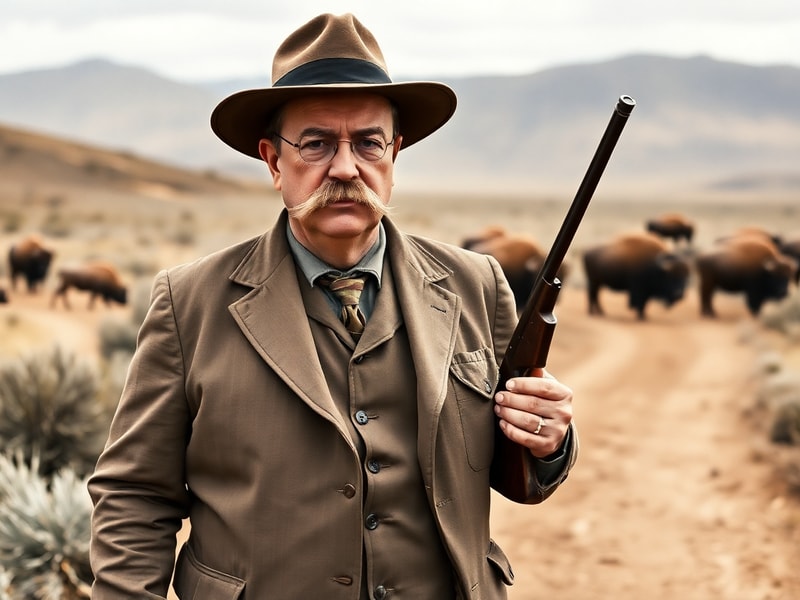
Theodore Roosevelt: The Rough Rider Who Shaped America’s Future
Few figures in American history embody the spirit of relentless energy and transformation as vividly as Theodore Roosevelt. Born in 1858 into a wealthy New York family, Roosevelt overcame childhood frailties to become a soldier, explorer, historian, and the 26th President of the United States. His life was a whirlwind of action, intellect, and reform—a legacy that still echoes in modern governance and conservation. Roosevelt’s presidency (1901–1909) marked a turning point in American politics, shifting the nation from isolationism toward global engagement and from unchecked industrial growth toward progressive regulation.
What truly set Roosevelt apart was his ability to merge rugged individualism with a deep sense of civic duty. He believed in what he called the “strenuous life”—a philosophy that championed physical vigor, moral courage, and public service. This ethos wasn’t just personal; it became the foundation of his political career. From charging up San Juan Hill with the Rough Riders to breaking up corporate monopolies as a trust-buster, Roosevelt lived by his creed. His leadership style was not passive or cautious; it was bold, often controversial, and always forward-looking.
A Life of Relentless Action and Reinvention
Roosevelt’s early years were marked by struggle. As a child, he suffered from severe asthma and poor eyesight, conditions that confined him indoors for long periods. But rather than succumbing to frailty, he turned his home into a gymnasium and a library. He studied natural history obsessively, collected specimens, and wrote his first scientific paper at age nine. His transformation from a sickly boy to a robust outdoorsman set the tone for his lifelong belief in self-improvement through discipline.
After graduating from Harvard, Roosevelt dove into politics, serving in the New York State Assembly and later as a rancher in the Badlands of North Dakota following the tragic deaths of his wife and mother in 1884. The rugged frontier life hardened him both physically and emotionally. He hunted, rode, and lived among cowboys and Native Americans, gaining firsthand experience of the American West’s raw beauty and harsh realities. These years weren’t just a retreat—they were a crucible that forged his character and deepened his connection to the land, a bond that would later shape his conservation policies.
By the 1890s, Roosevelt had returned east, serving as a civil service commissioner, New York City police commissioner, and assistant secretary of the Navy. His energy was unmatched. He wrote books on naval history, organized a volunteer cavalry unit during the Spanish-American War, and led the Rough Riders up Kettle Hill in Cuba—a charge that made him a national hero. When he returned home, his fame catapulted him to the governorship of New York and, eventually, the vice presidency under William McKinley. Fate intervened in 1901 when McKinley was assassinated, thrusting Roosevelt into the Oval Office at age 42—the youngest president in U.S. history.
The Square Deal: Reforming a Gilded Age
Roosevelt’s presidency is often remembered for his domestic policies, collectively known as the “Square Deal.” This agenda aimed to balance the interests of labor, business, and consumers, challenging the laissez-faire economics that had allowed industrialists to amass vast fortunes with little oversight. At its core, the Square Deal was about fairness—ensuring that the benefits of industrialization were shared more equitably across society.
One of Roosevelt’s most significant achievements was his trust-busting campaign. He used the Sherman Antitrust Act to dismantle monopolies that stifled competition and exploited consumers. His administration filed 44 lawsuits against corporations, including a landmark case against the Northern Securities Company, a railroad monopoly backed by J.P. Morgan and James J. Hill. The Supreme Court ruled in favor of the government, signaling a new era of corporate accountability. Roosevelt didn’t oppose big business outright; he opposed its unchecked power and the corruption it bred.
Roosevelt also championed labor rights, mediating the 1902 coal strike—a pivotal moment in U.S. labor history. When mine owners refused to negotiate with striking workers, Roosevelt threatened to send in federal troops to operate the mines. The threat worked. The owners relented, and the workers won modest concessions, including a 10% wage increase and reduced hours. It was the first time a U.S. president had intervened directly on behalf of labor, setting a precedent for future administrations.
Consumer protection also became a hallmark of Roosevelt’s presidency. After reading Upton Sinclair’s novel The Jungle, which exposed unsanitary conditions in meatpacking plants, Roosevelt pushed for the Pure Food and Drug Act and the Meat Inspection Act of 1906. These laws established federal oversight of food and drug production, ensuring safer products for American consumers. The reforms were controversial among industrialists, but Roosevelt’s unwavering stance demonstrated his commitment to public health and transparency.
Conservation as a National Priority
Roosevelt’s most enduring legacy may be his environmental stewardship. As a naturalist and hunter, he understood the fragility of America’s landscapes. During his presidency, he established the U.S. Forest Service and signed into law the creation of 150 national forests, 51 federal bird reserves, 4 national game preserves, and 18 national monuments. He protected approximately 230 million acres of public land—an area larger than Texas. His conservation ethic was revolutionary: he believed that natural resources were not infinite and that their preservation was a public trust.
Roosevelt worked closely with his chief forester, Gifford Pinchot, to promote sustainable use of forests and lands. They advocated for scientific management of natural resources, ensuring that logging, grazing, and mining could occur without depleting ecosystems. Roosevelt also established five national parks, including Crater Lake in Oregon and Wind Cave in South Dakota. His efforts laid the groundwork for the modern environmental movement and influenced generations of conservationists.
Yet Roosevelt’s approach to conservation wasn’t without tension. He supported the “wise use” of resources, which allowed for regulated development alongside preservation. This pragmatic stance sometimes put him at odds with preservationists like John Muir, who advocated for untouched wilderness. Roosevelt believed in balancing conservation with human needs, a philosophy that continues to shape debates over land use and environmental policy today.
In 1908, Roosevelt declined to seek a third term, honoring the two-term tradition set by George Washington. He handpicked his successor, William Howard Taft, but grew disillusioned with Taft’s more conservative policies. In 1912, Roosevelt returned to politics, running as the Progressive Party candidate—nicknamed the “Bull Moose Party”—after a failed attempt to secure the Republican nomination. Though he lost to Democrat Woodrow Wilson, his campaign split the Republican vote and reshaped the political landscape, paving the way for future progressive reforms.
The Man Behind the Myth
Roosevelt’s public persona was one of boundless energy and charisma. He was a prolific writer, publishing over 35 books on topics ranging from history to wildlife. His speeches were electrifying, filled with vivid metaphors and moral urgency. Colleagues often described him as a whirlwind of ideas, jumping from one topic to another with restless enthusiasm. Yet behind the public figure lay a man of deep contradictions. He was both a reformer and a militarist, a conservationist and a big game hunter, a progressive and a nationalist.
Roosevelt’s personal life was marked by tragedy and resilience. In addition to losing his first wife and mother on the same day, he endured the deaths of his eldest son, Quentin, in World War I, and another son, Kermit, in 1943. Despite these losses, he maintained a relentless work ethic, often sleeping only four or five hours a night. His diaries and letters reveal a man deeply introspective, grappling with self-doubt and ambition in equal measure.
He also held complex views on race and immigration, reflecting the contradictions of his time. While he appointed the first Black military officer to serve as a White House steward and supported some civil rights measures, he also expressed racist views and opposed full equality for African Americans. His policies toward Native Americans were similarly mixed; he sought to assimilate Indigenous peoples while also preserving their cultures in national parks. These contradictions remind us that historical figures are rarely one-dimensional, and Roosevelt’s legacy must be examined with nuance.
A Lasting Influence on America and the World
Roosevelt’s impact extends far beyond his presidency. His ideas influenced the New Deal policies of the 1930s, the environmental movement of the 1960s and 70s, and even modern debates over corporate regulation and social welfare. His belief in an active government that intervenes to protect citizens from exploitation remains a cornerstone of progressive thought. Meanwhile, his environmental policies established a framework for conservation that continues to guide federal land management.
Roosevelt also shaped America’s role on the global stage. He brokered the end of the Russo-Japanese War in 1905, earning him the Nobel Peace Prize—the first American to receive the honor. He expanded the U.S. Navy, transforming it into a global force capable of projecting power. His “Big Stick” diplomacy emphasized negotiation backed by military readiness, a principle that influenced 20th-century foreign policy. Roosevelt’s vision helped position the United States as a major player in international affairs, a status it maintains today.
Today, Roosevelt is often ranked among the top five U.S. presidents, a testament to his transformative leadership. His life story—from sickly child to president, from rancher to global statesman—remains a powerful example of how determination and principle can shape history. He challenges us to live with vigor, to stand for justice, and to protect the natural world for future generations.
For those interested in exploring more about Roosevelt’s impact on modern governance, visit our Politics category. To learn about other transformative leaders in American history, check out our History section.
Conclusion: The Legacy of a Man in Motion
Theodore Roosevelt’s life was a testament to the power of action. He believed that character was forged in struggle, that leadership required courage, and that progress demanded persistence. His presidency redefined the role of government, expanded the nation’s global influence, and laid the groundwork for environmental conservation. More than a century later, his ideas continue to resonate in political debates, conservation efforts, and the public imagination.
Roosevelt’s famous words—“Do what you can, with what you have, where you are”—encapsulate his philosophy. He didn’t wait for perfect conditions or ideal circumstances. He acted, adapted, and advanced. In an era of political division and environmental urgency, his example reminds us that leadership is not about avoiding conflict or waiting for consensus—it’s about making tough choices, standing firm, and moving forward with purpose.
To understand America’s past is to understand Theodore Roosevelt. To shape its future, we might do well to follow his lead.