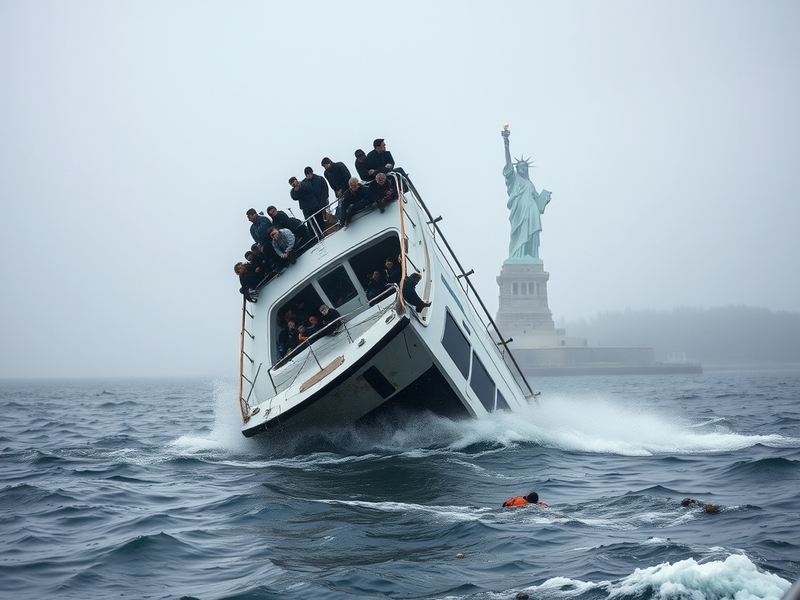
The Liberty Island Charter Boat Capsize: A Wake-Up Call for Waterway Safety
On a clear Tuesday afternoon, the waters around Liberty Island became the center of a tragic incident when a 35-foot charter boat capsized during a routine sightseeing tour. The accident, which occurred just 200 yards from the Statue of Liberty, resulted in multiple injuries and raised serious questions about maritime safety regulations in one of the world’s busiest tourist hubs. While the exact cause remains under investigation, preliminary reports suggest a combination of overcrowding and sudden weather changes may have contributed to the disaster.
Charter boats in New York Harbor operate under some of the strictest regulations in the country, yet this incident underscores the persistent risks associated with commercial water tours. The vessel, operated by a local tour company, had recently passed a safety inspection. However, witnesses reported that the boat appeared overloaded as it set off from Battery Park, with passengers packed tightly along the rails—a common sight during peak tourist season. The weather, initially calm, shifted abruptly, creating waves that overwhelmed the boat’s stability.
Emergency responders arrived within minutes, pulling 12 passengers from the water. Five individuals were rushed to nearby hospitals with non-life-threatening injuries, while three others were treated on-site for hypothermia and minor cuts. The boat’s captain, who suffered a broken arm, later told investigators that he had no prior warning of the sudden wind gusts that preceded the capsize. This raises concerns about the adequacy of weather monitoring systems for small commercial vessels in high-traffic areas.
A Global Perspective on Maritime Safety Risks
The Liberty Island incident is not an isolated case. Every year, commercial water tours worldwide face similar challenges, from overcrowded gondolas in Venice to unstable ferries in Southeast Asia. According to the International Maritime Organization (IMO), small passenger vessels account for nearly 40% of all maritime accidents globally, with human error and inadequate safety measures cited as leading causes. In Europe, stricter enforcement of the European Maritime Safety Agency (EMSA) regulations has reduced incidents by 22% over the past decade. Yet in the U.S., where oversight varies by state, gaps remain—particularly in popular tourist destinations like New York and Miami.
Cultural attitudes toward risk also play a role. In some countries, passengers on sightseeing boats are expected to prioritize experience over safety, leading to relaxed enforcement of weight limits or life jacket requirements. For example, in Thailand, where tourist boat tours are a major industry, accidents are often attributed to “acts of God” rather than operational failures. Meanwhile, in Scandinavia, where maritime safety is deeply ingrained in national identity, even minor infractions can result in steep fines or vessel impoundment.
This disparity highlights a critical issue: while some regions treat waterway safety as a non-negotiable priority, others view it as secondary to tourism revenue. The Liberty Island incident could serve as a catalyst for change, prompting a reevaluation of how commercial boats are certified, loaded, and monitored in high-risk areas.
The Human Cost: Victims and Community Impact
The aftermath of the capsize has left a trail of emotional and financial strain for those involved. Among the injured was Maria Rodriguez, a 62-year-old retiree from Spain who was celebrating her 10-year anniversary with her husband. “We were taking photos near the rail when the boat lurched,” she recalled in a hospital interview. “I remember thinking, This isn’t supposed to happen here.” Her husband, Javier, suffered a fractured rib and was discharged the same day, but Maria’s recovery will take weeks. Their story is one of many that have emerged in the days since, each underscoring the fragility of even the most carefully planned excursions.
The tour company, Harbor Lights Tours, has faced immediate backlash, with calls for a temporary ban on its operations pending a full investigation. Local advocacy groups, such as New York Water Safety Watch, have demanded stricter penalties for operators found in violation of passenger limits or maintenance protocols. “This wasn’t an accident—it was a preventable disaster,” said group spokesperson Elena Vasquez. “The same mistakes happen every summer, and yet nothing changes.”
For the families of the victims, the incident has also raised questions about accountability. Legal experts suggest that the boat’s owners could face negligence claims, particularly if investigators determine that the vessel was overloaded or that the captain lacked proper training. In the U.S., maritime law under the U.S. Coast Guard allows for civil penalties up to $50,000 per violation, though enforcement remains inconsistent.
Could Technology Have Prevented the Disaster?
The capsize has reignited debates about the role of technology in maritime safety. Modern commercial vessels are increasingly equipped with sensors that monitor stability, weather conditions, and passenger distribution in real time. Yet many charter boats, particularly older or budget-operated ones, still rely on manual checks and outdated equipment. The boat involved in the Liberty Island incident, for instance, lacked an automatic bilge pump—a feature now standard on most European ferries.
Several industry experts point to the rise of AI-powered safety systems as a potential solution. Companies like SafeMarine AI have developed algorithms that predict instability risks based on factors like wave height, passenger weight distribution, and wind speed. “We’ve seen a 30% reduction in incidents where these systems are deployed,” said Dr. Amara Patel, a maritime technology researcher. “The technology exists—what’s missing is the mandate to use it.”
Another area of focus is passenger education. Many tourists, especially international visitors, are unaware of basic safety protocols, such as where life jackets are stored or how to brace during rough waters. Some advocates are pushing for mandatory safety briefings before departure, similar to those required on commercial flights. A 2022 study by the National Transportation Safety Board (NTSB) found that 60% of drowning victims in small boat accidents had not worn a life jacket—despite it being readily available.
As the investigation into the Liberty Island incident continues, one thing is clear: change is overdue. Whether through stricter regulations, advanced technology, or cultural shifts in risk perception, the goal must be to ensure that the waters surrounding America’s most iconic landmarks remain safe for all who traverse them.