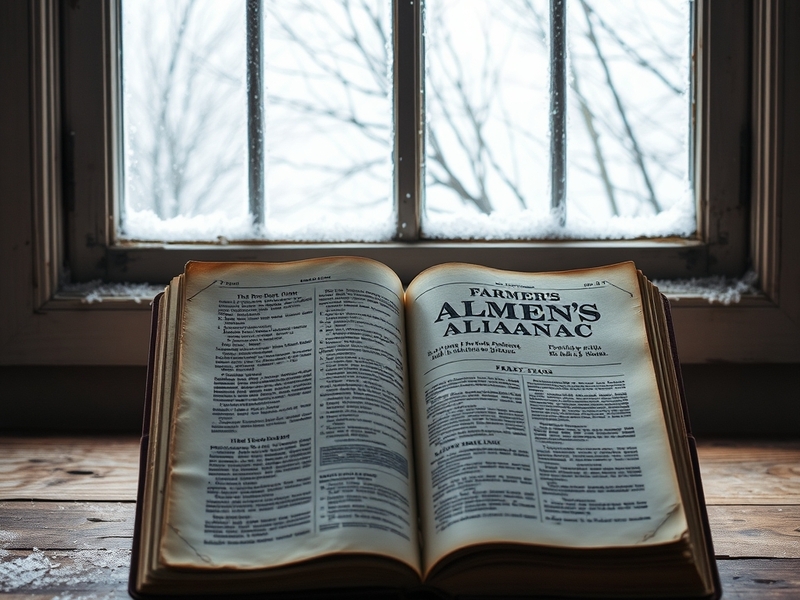
The Old Farmer’s Almanac has released its winter forecast for 2024–2025, and if you’re hoping for a mild season, you might want to start stocking up on shovels. The long-running publication, known for its 80 percent historical accuracy rate, is predicting a winter of extremes across much of the United States. From blizzard conditions in the Midwest to unseasonably warm temperatures in the Southwest, the forecast suggests that this year’s winter could test even the most prepared households.
The almanac’s predictions are based on a combination of solar activity, historical weather patterns, and climate trends. Unlike modern meteorological models that rely on real-time satellite data, the almanac’s methodology has remained largely unchanged since its founding in 1792. While skeptics argue that its accuracy is more folklore than science, millions of readers still turn to it for a rough guide to what lies ahead.
Where the Cold Will Bite Hardest
The Midwest and Great Lakes regions are expected to face the brunt of winter’s fury. The almanac forecasts below-average temperatures and above-average snowfall for states like Minnesota, Wisconsin, and Michigan. Cities such as Chicago and Minneapolis could see multiple polar vortex-style cold snaps, with temperatures dipping well below zero. Residents in these areas should prepare for icy roads, power outages, and the occasional whiteout.
Northern New England is also in for a rough go. Maine, New Hampshire, and Vermont are predicted to receive 20 to 30 percent more snow than usual. Ski resorts in the White Mountains are already celebrating, but commuters may not be as thrilled. The almanac’s editors warn that the snow could arrive early, with the first significant storms possible in late November or early December.
Mild Winters for Some, But Not All
Not every region will shiver through the season. The Southwest and parts of the Southeast are forecast to enjoy milder-than-average temperatures. Arizona, New Mexico, and Texas could see fewer cold snaps than usual, though the almanac notes that occasional Arctic blasts are still possible. In the Southeast, cities like Atlanta and Charlotte might experience a winter closer to normal, with average snowfall and temperatures.
The West Coast presents a mixed picture. California and the Pacific Northwest are expected to see near-normal precipitation, but temperatures can swing wildly. The Sierra Nevada mountains will likely receive heavy snowfall, which is good news for ski resorts but could lead to travel disruptions on Interstate 80. Meanwhile, Southern California may dodge the worst of the rain, though the almanac warns that a surprise atmospheric river could still bring flooding.
How to Prepare for the Unexpected
Regardless of where you live, the almanac’s forecast suggests that this winter will demand preparedness. Power outages are a real risk in regions expecting heavy snow and ice, so having backup generators, extra blankets, and non-perishable food on hand is essential. The almanac also recommends checking your heating system now to avoid mid-winter breakdowns.
For those in the Midwest and Northeast, winterizing your home should be a priority. Insulate pipes, seal drafts, and trim tree branches that could snap under the weight of snow. If you’re planning a trip, book flights early—the almanac predicts that travel disruptions will be common this season.
The almanac’s forecast isn’t just about snow and ice. It also highlights the potential for severe weather events, including ice storms in the Ohio Valley and Nor’easters along the Eastern Seaboard. These storms can paralyze cities for days, so staying informed through local weather services is critical.
Why the Almanac’s Forecast Still Matters
In an era dominated by hyper-accurate weather models and real-time data, the Old Farmer’s Almanac might seem like a relic. Yet its enduring popularity speaks to a desire for simplicity and tradition. While modern forecasts rely on supercomputers crunching terabytes of data, the almanac’s approach is rooted in pattern recognition and historical trends.
Critics argue that the almanac’s accuracy is more myth than science. A 2010 study by the American Meteorological Society found that its forecasts were no more reliable than random chance. However, the publication’s editors maintain that their methods, which include solar activity and lunar cycles, provide a unique perspective.
Whether you take its predictions as gospel or just a fun curiosity, the almanac’s winter forecast offers a useful starting point for planning. It reminds us that winter is unpredictable, and preparation is key. After all, even the most advanced weather models can’t account for every surprise Mother Nature has in store.
The season ahead promises to be one of contrasts—some regions will bask in unusual warmth, while others brace for punishing cold. One thing is certain: winter is coming, and it’s not going to be a walk in the park.