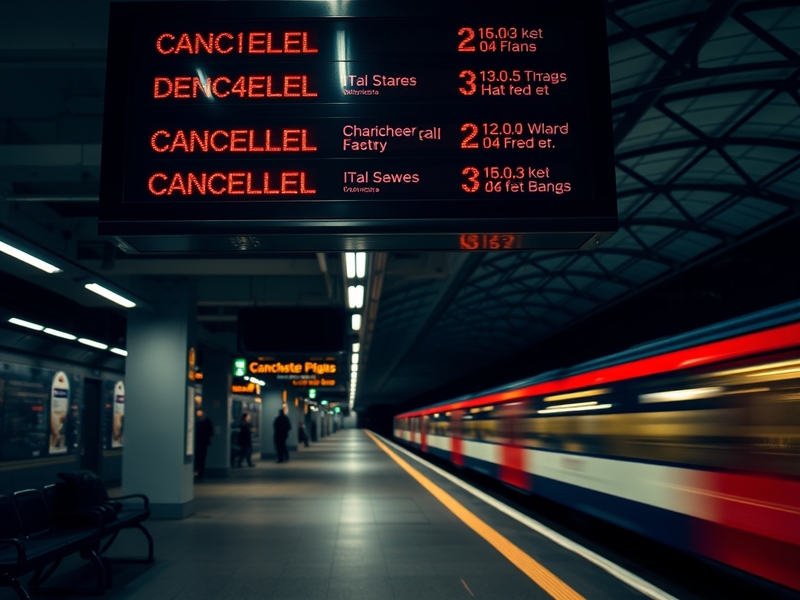
The morning commute into Manchester turned into a logistical nightmare for thousands on Tuesday as a combination of signal failures, driver shortages, and unexpected engineering work led to the cancellation of almost all train services. Passengers arriving at Piccadilly, Victoria, and Oxford Road stations faced the same announcement: “all services suspended until further notice.” The disruption started just after 6 a.m. and continued well into the afternoon, leaving commuters stranded, late for work, and questioning the reliability of the UK’s rail network. With no clear end in sight, the crisis highlighted deeper issues within Network Rail and the broader transport sector.
What caused the cancellations
The immediate trigger was a signal failure near Stockport, which cascaded through the network. Signal failures are not uncommon, but the scale of this outage was amplified by a chronic shortage of train drivers. Greater Manchester has long grappled with driver recruitment, and even minor disruptions now result in widespread cancellations. Additionally, planned engineering work on the West Coast Main Line was accelerated due to safety concerns, further reducing available routes.
Network Rail released a statement acknowledging “unplanned infrastructure issues” but declined to provide a timeline for recovery. Meanwhile, Transport for Greater Manchester urged passengers to avoid non-essential travel, a plea that fell on deaf ears for many who had no alternative. Social media erupted with images of packed platforms and frustrated commuters, some of whom spent hours waiting for replacement buses that never arrived.
The human cost: stories from the platforms
Among the stranded passengers was Sarah, a nurse at Manchester Royal Infirmary. “I usually catch the 7:10 from Altrincham,” she said. “Today, I didn’t get home until 3 p.m. My shift started at 8 a.m.” She’s not alone. A survey by the TSSA union revealed that 68% of rail workers in the North West reported increased stress levels due to service cancellations over the past six months. Burnout and absenteeism are rising, creating a vicious cycle that only worsens punctuality.
For students at the University of Manchester, the cancellations disrupted more than just schedules. International students, many of whom rely on trains for weekend trips, found themselves stranded in halls or forced to book last-minute coaches. “I missed my flight because I couldn’t get to the airport,” said Priya, a second-year student. “It cost me £200 in rebooking fees.”
Small businesses, too, felt the impact. A café owner in Chorlton told us that her morning rush was nonexistent—no commuters meant no foot traffic. “I lost £300 today,” she said. “That’s a week’s wages.”
Systemic failures: why this keeps happening
The Manchester cancellations are not an isolated incident. They reflect systemic weaknesses across the UK rail network. Network Rail’s funding model, reliant on government grants and passenger fares, leaves little room for long-term investment. Meanwhile, train operating companies are under pressure to cut costs, often at the expense of maintenance and staffing. The result is a network that is overstretched and under-resourced.
According to the Office of Rail and Road, punctuality on Northern Rail services dropped to 54% in the first quarter of 2024, down from 70% in 2019. Delays and cancellations are now the norm rather than the exception. The government has pledged £1.5 billion to improve services in the North, but critics argue that the money is being spent on short-term fixes rather than long-term solutions.
Even when infrastructure is upgraded, driver shortages remain a critical bottleneck. Training new drivers takes 18 months, and many fail the final assessments. The industry blames poor working conditions and low wages, but the reality is more complex: a lack of coordination between operators, unions, and regulators has left the system in a state of perpetual crisis.
What’s next for Manchester’s trains
Network Rail has promised a full review of the incident, but passengers are skeptical. In the meantime, alternative transport options are being explored. Greater Manchester Combined Authority is accelerating plans for a new tram-train link to Stockport, while bus operators are increasing services on key routes. However, these solutions will take years to implement.
For now, commuters are advised to check live updates via the Train Travel category on Dave’s Locker, where we track service disruptions and offer practical advice. We also recommend downloading the Trainline app for real-time notifications. The rail industry, meanwhile, must confront its structural issues if it hopes to restore public trust.
As the sun set on Manchester’s stations, one thing was clear: this was more than a bad day for trains. It was a symptom of a transport system at breaking point—and the consequences are being felt far beyond the platform.
- Signal failures near Stockport triggered the cancellations
- Driver shortages and planned engineering work worsened the crisis
- Passengers reported delays of up to 8 hours, missed flights, and lost income
- Network Rail faces criticism for reactive, underfunded maintenance
- Long-term solutions like tram-train links and better staffing remain years away
For ongoing coverage of transport disruptions and their broader impact, visit our Travel section.