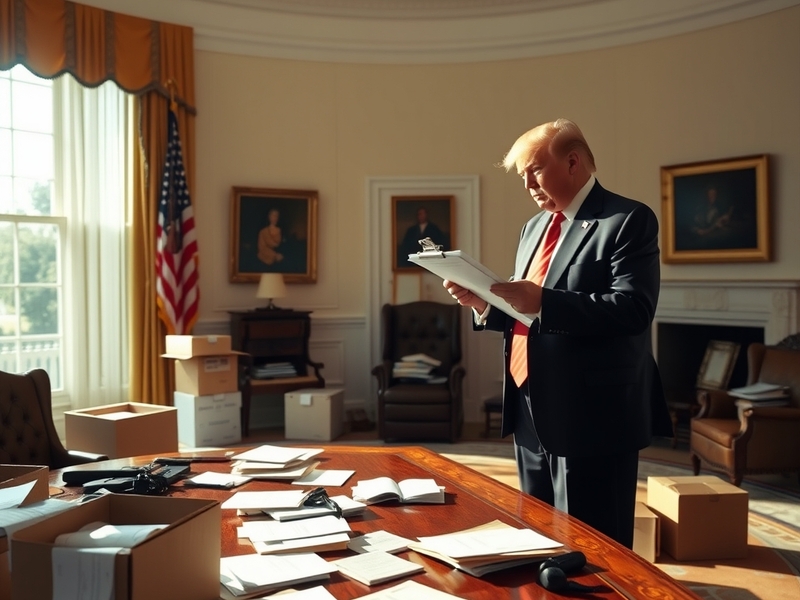
When President Donald Trump took office in January 2017, his administration quickly became known for its unconventional approach to governance. Among the most notable shifts was a sweeping overhaul of the White House’s internal structure, staffing, and operational culture. The changes reflected Trump’s business-oriented leadership style, his skepticism of traditional political norms, and his focus on direct communication with the public. From restructuring key advisory roles to centralizing decision-making under loyalists, the transformation reshaped how the executive branch functioned during his presidency.
This overhaul was not merely administrative—it was ideological. Trump’s team sought to dismantle what they viewed as entrenched bureaucratic inertia within the federal government. The approach mirrored his real estate empire’s top-down management style, where loyalty and results often outweighed institutional experience. Observers noted that the White House under Trump operated with a level of unpredictability that contrasted sharply with the methodical pace of previous administrations. Allies praised its efficiency, while critics warned of chaos and erosion of expertise.
The New Power Structure: Loyalty Over Experience
One of the most visible aspects of Trump’s White House overhaul was the elevation of loyalists over traditional political insiders. Figures like Steve Bannon, Reince Priebus, and later John Kelly became central players in reshaping the administration’s hierarchy. Bannon, in particular, championed a populist, nationalist agenda that clashed with the conventional Republican establishment. His influence extended to policy formation, with a focus on immigration, trade, and deregulation.
The shift extended beyond ideological alignment. Trump frequently bypassed established channels, favoring informal advisors and family members—most notably his daughter Ivanka Trump and son-in-law Jared Kushner—who wielded significant influence despite limited prior government experience. This approach drew criticism from political analysts who argued that it weakened institutional knowledge and created a culture of uncertainty within the White House.
Key roles were redefined to prioritize loyalty and responsiveness to the president’s preferences. The Office of Strategic Communications, for instance, became a critical hub for shaping the administration’s public narrative, often in direct conflict with traditional press operations. Meanwhile, the National Security Council saw its role diminished, with Trump preferring one-on-one briefings with military leaders over formal interagency processes.
The Communication Revolution: Direct to the Public
Trump’s White House overhauled communication strategies in ways that had never been seen before in American politics. His prolific use of Twitter—often bypassing traditional media filters—became a defining feature of his presidency. The platform allowed him to set the news cycle, bypassing journalists and delivering unfiltered messages directly to millions of followers. This approach democratized political messaging but also fueled accusations of misinformation and divisiveness.
The shift had global repercussions. Foreign leaders, diplomats, and international media had to adapt to Trump’s unpredictable communication style. His tweets on trade, alliances, and geopolitical conflicts often created diplomatic headaches, forcing State Department officials and ambassadors to scramble for damage control. Analysts noted that while Trump’s direct communication resonated with his base, it strained relationships with traditional allies and institutions like NATO and the United Nations.
Internally, the White House’s communications team struggled to reconcile Trump’s impulsive style with coherent messaging. Press Secretary Sean Spicer’s early tenure became infamous for its combative tone and factual inaccuracies, setting a precedent for a combative relationship with the press. Later, Sarah Huckabee Sanders and Kayleigh McEnany faced similar challenges, often defending positions that clashed with established facts or diplomatic norms.
The Impact on Global Perceptions
Trump’s White House overhaul didn’t just reshape American governance—it altered how the world viewed U.S. leadership. Traditional allies in Europe and Asia found themselves grappling with an administration that prioritized transactional relationships over long-standing partnerships. The withdrawal from international agreements like the Paris Climate Accord and the Iran Nuclear Deal signaled a retreat from multilateralism, a stance that drew both praise from isolationists and condemnation from globalists.
Abroad, the overhaul was interpreted through the lens of cultural and political divides. In some countries, Trump’s populist rhetoric and rejection of globalist norms resonated with nationalist movements. In others, it fueled concerns about the erosion of democratic norms and the rise of authoritarian-leaning governance. The White House’s approach to issues like migration and trade further strained relations, particularly with nations that relied on U.S. stability and predictability.
A 2018 Pew Research Center survey found that global confidence in U.S. leadership had plummeted under Trump, with only 27% of respondents in 25 surveyed countries expressing confidence in his handling of world affairs. The decline was steepest in Western Europe, where traditional allies viewed the overhaul as a destabilizing force. Meanwhile, leaders in countries like Russia and North Korea saw opportunity in the administration’s unpredictability, exploiting divisions within the U.S. and its alliances.
Legacy and Lessons for Future Administrations
As Trump’s presidency drew to a close, the long-term effects of his White House overhaul remained a subject of intense debate. Supporters argued that it injected much-needed dynamism into a stagnant political system, breaking down bureaucratic barriers and forcing accountability. Critics, however, warned that the erosion of institutional norms and expertise could have lasting consequences for governance and stability.
One undeniable impact was the acceleration of partisan polarization. The White House’s combative approach to media, opposition parties, and even its own bureaucracy deepened divisions within American society. The use of executive orders to bypass congressional gridlock became a tool for future administrations, regardless of party, setting a precedent for centralized power.
The overhaul also highlighted the growing influence of social media in politics. Trump’s ability to dominate the news cycle without relying on traditional gatekeepers demonstrated the power of digital platforms in shaping public discourse. This lesson was not lost on political strategists, who increasingly prioritized viral messaging and direct engagement over traditional campaigning.
As the U.S. moves forward, the Trump White House’s restructuring serves as a case study in the consequences of radical institutional change. Whether future leaders choose to emulate its boldness or learn from its pitfalls may well define the next era of American governance.
For those interested in the broader implications of political restructuring, our Politics section offers deeper analysis on how leadership styles shape national and global dynamics.