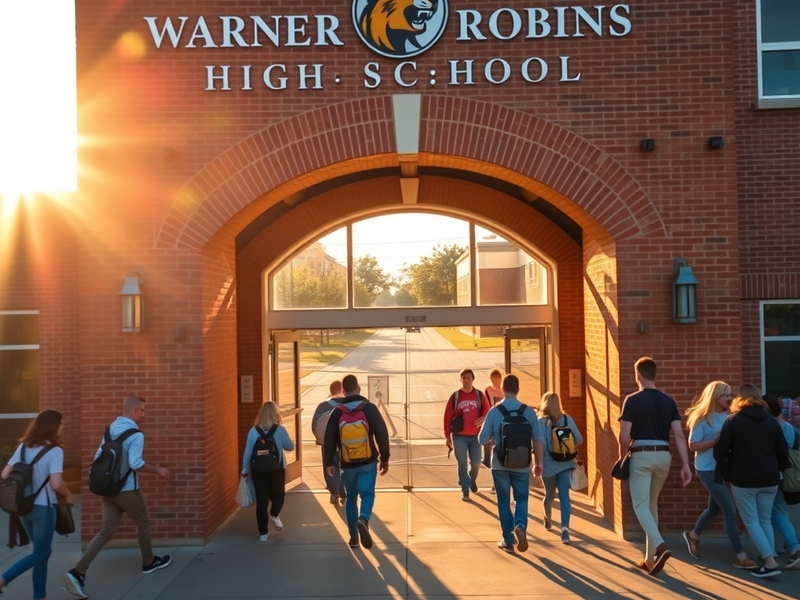
Warner Robins High School stands not just as an educational institution in the heart of Georgia, but as a microcosm of American high school culture—a place where tradition, innovation, and community converge. Since its founding in 1946, the school has grown from a modest local institution into a regional powerhouse, reflecting broader trends in public education across the United States. Its story is one of adaptation, achievement, and the enduring role of high schools as social and cultural anchors in towns and cities nationwide.
Founded in the post-World War II boom era, Warner Robins High School opened its doors during a time of rapid population growth in middle Georgia, fueled by the expansion of Robins Air Force Base. The base’s presence shaped the community’s identity, and the school became a central gathering place for military families and civilian residents alike. Over the decades, the school has evolved from a small-town institution into a modern high school serving nearly 1,800 students, with a curriculum that now includes advanced placement courses, career academies, and fine arts programs.
What makes Warner Robins High School particularly notable is its balance between academic rigor and extracurricular excellence. Like many American high schools, it operates within a broader educational ecosystem shaped by state standards, federal policies, and local priorities. Yet, it has carved out a distinct identity through its strong athletic programs, particularly in football and baseball, which draw attention not only from within Houston County but also from college recruiters across the Southeast. The school’s mascot, the Demon, is a vivid symbol of its competitive spirit—a reflection of a nationwide trend where high school sports serve as both entertainment and a pathway to higher education.
Academics and Programs: A Window Into Modern Public Education
Warner Robins High School offers a comprehensive academic program designed to prepare students for college, careers, and civic life. Its curriculum includes core subjects like mathematics, science, and English, alongside electives in technology, health sciences, and the visual arts. The school’s Career Academy programs, such as the Healthcare Science pathway and the Engineering and Technology program, reflect a growing emphasis in American high schools on career readiness and vocational training.
One of the school’s most significant initiatives is its Advanced Placement (AP) program, which allows students to earn college credit while still in high school. Participation in AP courses has increased nationwide as schools respond to pressure from universities and parents for academic rigor. At Warner Robins High, AP enrollment has risen steadily, mirroring trends seen in suburban and urban schools across the country. This shift highlights a broader transformation in public education, where high schools are increasingly expected to function as college preparatory institutions.
The school also places a strong emphasis on fine arts. Its band, choir, and theater programs have earned local and regional recognition, underscoring the role of the arts in fostering creativity and self-expression. In many American high schools, arts programs serve as vital outlets for students who may not excel in athletics or traditional academics, offering a holistic approach to education that values both discipline and imagination.
Sports and Culture: The Heartbeat of a Community
Few aspects of American high school life are as culturally significant as sports. At Warner Robins High, football is more than a game—it is a communal event that draws hundreds of fans to the Demon Stadium on Friday nights. The team’s success over the years has contributed to the school’s reputation, and like many high school programs across the country, it operates within a system where athletics can shape local identity as much as academic achievement.
Warner Robins High competes in Georgia’s Class 6A division, the second-highest classification in the state’s high school sports system. The school fields teams in football, baseball, basketball, soccer, track and field, and wrestling, among others. Its baseball program has produced several players who went on to play at the collegiate and professional levels, reflecting the broader pipeline from high school to college athletics that exists in communities throughout the United States.
Yet the cultural role of high school sports extends beyond wins and losses. Sporting events serve as social gatherings, bringing together students, families, and alumni in shared celebration. They reinforce school spirit and pride, acting as modern-day equivalents of the town square or community center. In smaller towns, high school sports can be a rare source of collective joy and identity, a phenomenon observed not only in Georgia but in rural communities across America.
Warner Robins High also hosts cultural events such as homecoming parades, talent shows, and academic competitions, each contributing to the school’s vibrant campus life. These traditions reinforce a sense of belonging and continuity, linking current students to generations of alumni who once walked the same halls.
Community and Identity: The Role of High Schools in Modern America
Warner Robins High School exemplifies the evolving role of public high schools in the United States. Once primarily institutions of academic instruction, they have become multifaceted organizations that serve as educational providers, community centers, and cultural hubs. This shift reflects broader changes in American society, where high schools are increasingly expected to address social, economic, and health challenges that extend beyond the classroom.
The school’s location in Warner Robins, a city shaped by military presence and aerospace industry, adds another layer to its identity. Like many towns near military bases, Warner Robins experiences a transient population, with students and families moving in and out due to military transfers. This mobility presents both challenges and opportunities. Schools must adapt to diverse student needs, offering support systems that accommodate varying academic backgrounds and cultural experiences.
Warner Robins High has responded to these challenges by fostering an inclusive environment. Its English for Speakers of Other Languages (ESOL) program supports students from military families and immigrant communities, ensuring that language barriers do not impede academic progress. This commitment to accessibility reflects a national conversation about equity in education, where schools are increasingly tasked with closing achievement gaps and providing resources for underserved populations.
Moreover, the school’s partnerships with local businesses, nonprofits, and institutions like Middle Georgia State University illustrate how high schools are integrating into broader community networks. These collaborations provide students with internships, mentorship opportunities, and real-world learning experiences—preparing them not just for college, but for careers in a rapidly changing economy.
Looking Ahead: The Future of Warner Robins High and American High Schools
As Warner Robins High School looks to the future, it faces challenges common to many American public high schools: funding constraints, evolving educational standards, and the need to prepare students for an uncertain job market. Yet it also embodies the resilience and adaptability that define public education in the United States.
One of the most pressing issues is the integration of technology into the classroom. Like schools nationwide, Warner Robins High has expanded its use of digital learning tools, from online research platforms to virtual labs. The COVID-19 pandemic accelerated this shift, forcing educators to rethink traditional teaching methods. While the crisis posed significant disruptions, it also highlighted the potential of technology to democratize education and provide flexible learning options.
Another challenge is mental health. High school students today face unprecedented pressures, from academic stress to social media influences. Warner Robins High, in line with many U.S. schools, has increased its focus on student wellness, offering counseling services and peer support programs. This reflects a growing recognition that academic success is intertwined with emotional and social well-being.
The school’s ongoing evolution mirrors broader trends in American education. High schools are no longer just stepping stones to adulthood—they are dynamic institutions that reflect the values, challenges, and aspirations of their communities. Warner Robins High, with its blend of tradition and innovation, serves as a compelling example of how public education continues to shape—and be shaped by—the world around it.
For students, parents, and alumni, the school remains a place of memory and pride. For the community, it is a source of strength and continuity. And for anyone studying the role of education in modern society, Warner Robins High offers a vivid case study in how schools adapt, inspire, and endure.