The M9 motorway in Ireland has long been a vital artery for transport and commerce, linking Dublin to Waterford and serving as a key route for both local commuters and heavy goods vehicles. Yet on the morning of January 12, 2024, the M9 near Kilcullen in County Kildare became the site of one of Ireland’s most serious road incidents in recent years. The multi-vehicle collision, which involved a coach, several cars, and a truck, left multiple people injured and raised urgent questions about road safety, infrastructure resilience, and emergency response protocols in an era of increasing traffic volume and unpredictable weather.
What happened on the M9 in Kildare?
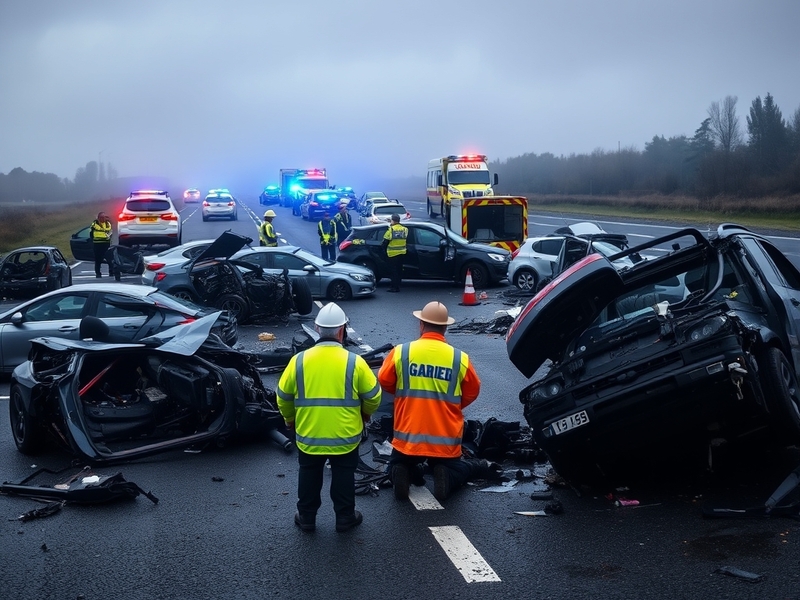
Around 7:30 AM on that winter morning, dense fog combined with high traffic density led to a sudden chain-reaction crash near Junction 7, close to Kilcullen. Witnesses reported visibility dropping to under 50 meters, with vehicles slowing abruptly and unable to stop in time. The initial impact involved a coach carrying commuters from Carlow to Dublin, which swerved to avoid a slower-moving truck and was struck from behind by a car. That collision triggered a domino effect, with at least five more vehicles—including two HGVs—becoming involved in the pile-up.
Emergency services from Kildare County Council, the National Ambulance Service, and An Garda Síochána responded within minutes. Fire crews from Naas, Newbridge, and Athy were deployed to stabilize vehicles and extricate trapped passengers. Local hospitals in Naas, Newbridge, and Dublin’s major trauma centers were placed on high alert. Miraculously, no fatalities were reported, though 23 people sustained injuries ranging from minor whiplash to serious spinal trauma requiring surgical intervention.
The road was closed in both directions for over six hours, causing significant disruption to the morning commute and highlighting the vulnerability of Ireland’s motorway network to sudden weather changes. The incident prompted immediate calls for better fog detection systems and variable speed limit signage along the M9 corridor.
Why did the crash happen? A closer look at the causes
While the immediate trigger was fog, the deeper causes reveal a complex interplay of infrastructure, policy, and environmental factors. Ireland’s motorway system, though modern, was designed with traffic patterns in mind that predate the rise of remote work and increased freight movement. The M9, opened in stages between 2003 and 2010, was built to handle approximately 40,000 vehicles per day. Yet by 2023, daily volumes had risen to over 55,000, with HGVs accounting for nearly 18% of traffic—well above the EU average.
This overcapacity is not unique to Ireland. Across Europe, aging road networks struggle to adapt to increasing traffic, climate volatility, and the demands of a just-in-time economy. In the UK, for example, Highways England has invested heavily in smart motorways with dynamic speed limits and overhead signage. Meanwhile, in Germany, the Plauderer system uses real-time weather stations to adjust warnings on the Autobahn. Ireland, by contrast, relies on a patchwork of static signs and manual alerts via radio traffic bulletins.
Environmental factors also played a role. The winter of 2023–24 was one of the wettest on record in Ireland, with persistent low-pressure systems bringing warm, moist air over the Irish Sea. This created ideal conditions for radiation fog—thick, ground-level mist that forms on clear, calm nights and lingers into the morning. Irish weather services recorded fog advisories for 18 of the 31 days in January 2024, yet only 30% of the M9’s 56-kilometer length is currently equipped with fog detection sensors.
Emergency response: Lessons from the ground
The response to the M9 crash revealed both strengths and weaknesses in Ireland’s emergency infrastructure. Paramedics praised the rapid coordination between fire, ambulance, and Garda units, noting that the National Ambulance Service’s new Evac+ protocol—introduced in 2022—helped streamline patient triage. Under this system, ambulances transmit patient data directly to hospital trauma teams, reducing delays in critical care.
However, logistical challenges emerged. The crash site’s proximity to Kilcullen meant limited access for large emergency vehicles. Several fire engines had to be rerouted via back roads, adding precious minutes to rescue operations. This exposed a gap in rural emergency planning, where motorway incidents are often treated as urban events due to their scale, despite occurring in semi-rural zones.
In the aftermath, Kildare County Council announced plans to install additional CCTV cameras with thermal imaging along the M9. These would detect stalled or slow-moving vehicles in low visibility and automatically trigger warning signs. Similar systems are already in use on the M7 near Portlaoise and have reduced fog-related incidents by 42% since 2021.
International comparisons show that proactive infrastructure adaptation is key. In the Netherlands, Rijkswaterstaat uses AI-powered fog prediction models trained on satellite and ground sensor data. Sweden’s Vägverket employs heated road surfaces in fog-prone areas to prevent ice formation and improve traction. While such technologies remain aspirational for Ireland’s budget-conscious transport sector, the M9 crash has forced a rethink of long-term investment priorities.
Cultural and economic ripple effects
The M9 crash was not just a traffic incident—it became a cultural moment that exposed broader anxieties about mobility, safety, and national identity in a rapidly changing Ireland. Social media erupted with videos of the aftermath, shared under hashtags like #M9Kildare and #SafeOnTheRoad. Local TDs and senators called for an Oireachtas inquiry, while advocacy groups like Road Safety Ireland demanded mandatory fog detection systems on all motorways by 2027.
The crash also highlighted the economic cost of road incidents. According to the Road Safety Authority, road collisions cost Ireland €1.2 billion annually in healthcare, lost productivity, and insurance claims. The M9 crash alone disrupted the supply chains of over 200 businesses in Carlow and Kilkenny, with delays reported in dairy, pharmaceutical, and construction sectors. One logistics company in Carlow reported a 6-hour delay in deliveries, costing €18,000 in overtime and penalties.
Culturally, the incident revived debates about Ireland’s relationship with the car. While Dublin’s Luas and DART systems have expanded, rural and commuter regions remain car-dependent. The crash became a symbol of the tension between progress and tradition—a theme echoed in other post-industrial nations where the automobile still dominates daily life.
It also served as a reminder of how rapidly public sentiment can shift. Just months before, the government had faced criticism for increasing motorway speed limits to 140 km/h on certain stretches of the M7 and M8. The M9 crash forced a temporary rollback on those plans and a national conversation about whether speed should ever take precedence over safety.
What’s next for the M9 and Ireland’s roads?
The Irish government has signaled a multi-phase response. In the short term, variable message signs (VMS) will be installed at 2-kilometer intervals between Junctions 6 and 10, displaying real-time fog warnings. These will be linked to Met Éireann’s weather radar network, allowing automatic activation when visibility drops below 100 meters.
Longer-term, the National Transport Authority is reviewing a €350 million investment plan to upgrade the M9 corridor. Key measures include:
- Installation of 40 fog detection stations with AI-powered alert systems
- Expansion of emergency lay-bys and crash barriers designed to absorb impacts
- Pilot programs for autonomous emergency braking (AEB) systems in HGVs
- Increased penalties for dangerous overtaking in poor visibility conditions
These measures align with the EU’s Vision Zero initiative, which aims to eliminate road deaths by 2050. Ireland, however, lags behind Scandinavian and Baltic states, where road fatalities have fallen by over 60% in the past decade due to integrated safety policies.
The M9 crash also sparked a political reckoning. Opposition parties have accused the government of underfunding road safety in favor of high-profile projects like the Dublin MetroLink. In response, the Minister for Transport announced an independent review of all major motorways, with a focus on climate resilience and traffic surge capacity.
As Ireland looks to the future, the M9 incident has become a cautionary tale about progress. Modern roads are not just physical structures—they are living systems that must adapt to climate change, technological innovation, and human behavior. The challenge for policymakers, engineers, and citizens alike is to build not just faster routes, but safer ones.
For now, the M9 remains open. But the questions it raised—about visibility, speed, and survival—are far from settled. And as fog rolls in again across the Irish midlands, so too does the uneasy realization that the next crisis may already be forming on the horizon.