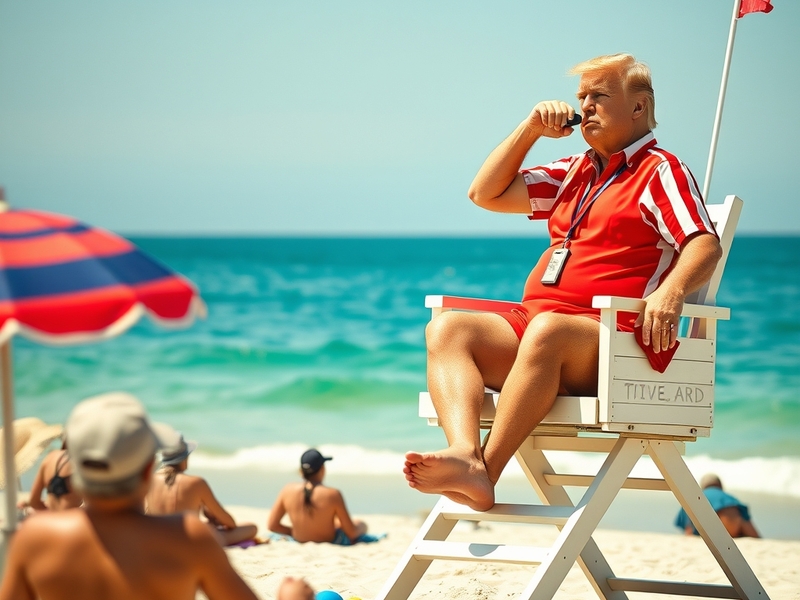
The phrase “Trump lifeguard” first bubbled up on social media as a meme, but it quickly evolved into something far stranger: a political metaphor wrapped in absurdity. The term refers to a person—often an anonymous online figure—who positions themselves as a protector of Donald Trump, ready to intervene in any situation where the former president might face criticism or legal trouble. These self-appointed guardians aren’t affiliated with any official campaign or security detail. Instead, they operate in the fringes of the internet, amplifying conspiracy theories and dismissing scandals with a mix of hyperbole and vitriol.
Where Did the Meme Come From?
The origins of “Trump lifeguard” are murky, but the concept gained traction in early 2024 as Trump’s legal troubles mounted. The meme likely stems from a conflation of two ideas: the literal role of a lifeguard (someone who saves others from danger) and the political culture of perpetual victimhood that surrounds Trump’s base. Social media users began joking that these lifeguards were always on standby, ready to “rescue” Trump from any negative news cycle.
The meme’s spread was accelerated by platforms like X (formerly Twitter), where accounts with large followings—often anonymous or pseudonymous—would flood threads with pro-Trump talking points. These accounts frequently used the term “lifeguard” ironically, as if to suggest they were the last line of defense against mainstream media bias. The humor lies in the exaggeration: no literal lifeguard could ever protect someone from the sheer volume of legal and political challenges Trump faces.
Who Are These Lifeguards, Really?
Identifying the people behind the “Trump lifeguard” phenomenon is difficult by design. Many operate under pseudonyms, using memes and coded language to avoid direct association with any political entity. Some are likely paid operatives working for Trump-aligned media outlets or super PACs, while others are genuine grassroots supporters who see their role as defending Trump at all costs.
A closer look reveals a few common traits among these figures:
- Anonymity: Most avoid using their real names, instead hiding behind handles like “TrumpLifeguard69” or “MAGAShield.”
- Hyperbolic rhetoric: They often frame Trump as the victim of a vast, coordinated conspiracy, using phrases like “deep state lifeguards” to describe his opponents.
- Meme warfare: Their tactics rely heavily on viral images, catchphrases, and absurdist humor to spread their message.
- Financial incentives: Some monetize their activism through platforms like Rumble, Telegram, or Patreon, where they sell exclusive content or merchandise.
The most vocal lifeguards aren’t just defending Trump—they’re weaponizing the meme itself. By embracing the absurdity, they turn criticism into a joke, making it harder for opponents to engage seriously with their claims. It’s a form of trolling that doubles as political strategy, blurring the line between performance and sincerity.
The Broader Implications of the Meme
The rise of the “Trump lifeguard” isn’t just a quirky internet trend—it reflects deeper shifts in how politics operates in the digital age. For one, it highlights the erosion of traditional gatekeeping in media. In the past, political narratives were shaped by journalists, pundits, and party officials. Today, anonymous actors with memes and viral content can dictate the conversation just as effectively.
This trend also underscores the growing polarization of American politics. The lifeguards’ rhetoric isn’t designed to persuade undecided voters; it’s meant to reinforce the beliefs of the already converted. By framing every criticism of Trump as part of a coordinated attack, they deepen the divide between his supporters and opponents. It’s a feedback loop: the more outrageous the claims, the more the base rallies behind him, and the more the opposition digs in.
There’s a financial dimension as well. The lifeguard economy—built on donations, subscriptions, and merchandise—has created a cottage industry for pro-Trump content creators. Some of these figures have amassed significant followings, turning their activism into full-time careers. This raises questions about the long-term sustainability of such movements. If the lifeguards’ primary role is to generate engagement, what happens when the news cycle moves on?
Finally, the meme serves as a case study in how irony and absurdity can be weaponized in politics. By embracing the ridiculous, the lifeguards make it difficult for critics to engage with their arguments on their own terms. It’s a tactic borrowed from internet trolls and applied to political warfare, and it’s proving surprisingly effective.
Why This Matters Beyond Trump
The “Trump lifeguard” phenomenon is a microcosm of a larger trend: the blending of entertainment and politics. As traditional media struggles to retain audiences, politicians and their supporters are increasingly turning to viral content, memes, and absurdist humor to stay relevant. This isn’t unique to Trump or the Republican Party. Figures on the left, from Alexandria Ocasio-Cortez to Bernie Sanders, have also leveraged internet culture to amplify their messages.
However, the lifeguard meme stands out for its sheer unapologetic absurdity. It’s not just about winning an argument; it’s about dominating the cultural conversation, even if that means embracing the ridiculous. In an era where attention spans are short and algorithms favor outrage, this approach has undeniable appeal.
For journalists and observers, the challenge is separating the signal from the noise. The lifeguards’ rhetoric is often hyperbolic, but it’s rooted in real frustrations felt by a significant portion of the electorate. Ignoring it entirely risks missing the broader disillusionment that fuels it. Yet engaging with it on its own terms can legitimize the absurd, turning serious issues into punchlines.
Ultimately, the “Trump lifeguard” meme is a symptom of a political landscape that has grown increasingly fragmented and performative. It’s a reminder that in the digital age, power doesn’t just come from policy or persuasion—it comes from clicks, shares, and memes. Whether that’s a healthy development for democracy is another question entirely.
The lifeguards may not be able to save Trump from his legal troubles, but they’re certainly keeping the conversation—and the outrage—alive. And in the world of internet-driven politics, that might be just as valuable.