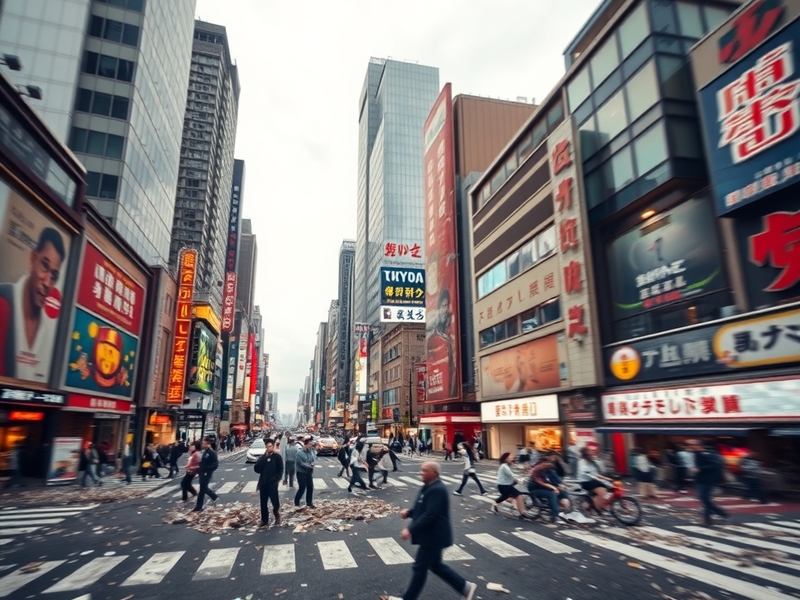
Tokyo’s skyline, a blend of neon and tradition, trembled briefly today as a magnitude 4.8 earthquake rattled central Japan. The tremor struck at 2:17 p.m. local time, its epicenter located roughly 40 kilometers southwest of central Tokyo, according to the Japan Meteorological Agency. While no immediate damage or injuries were reported, the quake served as a sharp reminder of the island nation’s perpetual dance with seismic risk—a dance woven into daily life, architecture, and cultural memory.
Japan sits atop the Pacific Ring of Fire, a horseshoe-shaped belt of volcanoes and tectonic faults encircling the Pacific Ocean. This volatile zone accounts for about 90 percent of the world’s earthquakes. Tokyo, home to over 14 million people, is particularly vulnerable due to its location near the intersection of three major tectonic plates: the Pacific, Philippine Sea, and North American plates. The city has endured devastating quakes in the past, including the Great Kanto Earthquake of 1923, which killed more than 140,000 people and reshaped the city’s social and physical landscape.
How Tokyo Responds to the Unexpected
Within minutes of today’s quake, emergency protocols swung into action. The Tokyo Metropolitan Government activated its Disaster Management Center, dispatching real-time updates to residents via smartphone alerts and local news broadcasts. Public transit systems, including the iconic Yamanote Line and Shinkansen bullet trains, temporarily halted service as a precaution, causing ripple effects across commuter schedules. Schools and offices followed standard safety drills, with students ducking under desks and workers securing heavy objects.
Such preparedness is second nature in Japan. From childhood, citizens undergo regular earthquake drills. Buildings are engineered with base isolators and dampers to absorb seismic shocks. Even convenience stores and restaurants stock emergency supplies—bottled water, canned food, and first-aid kits—within arm’s reach. This culture of readiness reflects a collective understanding: earthquakes are not if, but when.
“It’s like checking the weather before leaving the house,” said Aiko Tanaka, a 34-year-old marketing professional in Shinjuku. “You don’t panic. You assess, react, and move on.” Her calm demeanor mirrors the broader societal response, where resilience is embedded in the national psyche.
Global Connections: When Tokyo Shakes, the World Listens
While today’s quake was relatively minor, its occurrence resonates far beyond Japan’s borders. Tokyo is a global financial hub, home to the Tokyo Stock Exchange and headquarters of multinational corporations. Even brief disruptions can ripple through international markets. Within hours of the quake, analysts at financial institutions in London and New York monitored supply chain reports and currency fluctuations, assessing indirect impacts on global trade.
Japan’s role in technology and automotive industries adds another layer of global interdependence. Major automakers like Toyota and Honda, with production plants across the country, rely on just-in-time manufacturing. A prolonged shutdown due to a larger quake could disrupt car deliveries worldwide, affecting dealerships from Los Angeles to Berlin.
Moreover, Japan’s scientific community plays a pivotal role in earthquake research. Agencies like the Japan Agency for Marine-Earth Science and Technology (JAMSTEC) and international collaborations, such as the Global Seismographic Network, collect data that helps predict and model seismic activity. Today’s event provided yet another data point in an ongoing effort to understand Earth’s restless energy.
“Every quake teaches us something new,” said Dr. Kenji Nakamura, a seismologist at the University of Tokyo. “Whether it’s the behavior of aftershocks or the performance of retrofitted buildings, these events are part of a larger conversation about living safely on a dynamic planet.”
Cultural Reflections: Earthquakes in Art and Memory
Earthquakes have long been a recurring theme in Japanese art, literature, and folklore. From the woodblock prints of Hokusai to the haunting prose of Kobo Abe, seismic events are depicted not only as physical phenomena but as metaphors for human fragility and impermanence. The concept of mono no aware—the pathos of things—often surfaces in these works, capturing the transient beauty of life in the face of nature’s unpredictability.
Even modern pop culture reflects this relationship. Anime series like Tokyo Magnitude 8.0 and films such as Ring and Battle Royale weave earthquakes into their narratives, sometimes as catalysts for disaster, other times as metaphors for societal collapse. These stories serve as both entertainment and catharsis, allowing audiences to process collective anxieties.
In traditional Shinto belief, earthquakes are sometimes attributed to the movements of namazu, a giant catfish whose thrashing causes the ground to shake. The god Kashima restrains the fish using a stone, but when he loosens his grip, tremors occur. While modern science has replaced myth, the symbolic power remains—a reminder that humans are not the sole arbiters of their fate.
Lessons from Tokyo: What Other Cities Can Learn
Tokyo’s ability to absorb today’s quake with minimal disruption offers valuable lessons for other earthquake-prone cities, such as Los Angeles, Istanbul, or Manila. A closer look reveals several key strategies:
- Integrated Early Warning Systems: Japan’s Earthquake Early Warning (EEW) system detects primary waves and sends alerts seconds before the more destructive secondary waves arrive. This brief window allows people to take cover and automated systems to shut down gas lines and elevators.
- Strict Building Codes: Japan enforces rigorous seismic standards, requiring buildings to withstand strong tremors. Retrofitting older structures is a continuous process, ensuring that even historic districts remain safe.
- Public Education and Drills: From schools to offices, regular earthquake drills are mandatory. These exercises ensure that evacuation routes are second nature and that the public knows how to respond without panic.
- Community Resilience Programs: Local governments and NGOs conduct workshops on disaster preparedness, teaching residents how to secure furniture, create emergency kits, and assist neighbors during crises.
- Cross-Sector Coordination: Collaboration between government agencies, private companies, and international partners ensures a swift and organized response, minimizing economic and social fallout.
“Tokyo’s preparedness is not accidental,” said Dr. Elena Vasquez, a disaster risk reduction specialist based in Barcelona. “It’s the result of decades of investment, innovation, and cultural adaptation. Other cities can replicate this model, but it requires long-term commitment and political will.”
Looking Ahead: The Next Big One
Despite today’s minor tremor, seismologists warn that Tokyo remains overdue for a major earthquake. The government’s long-term projections suggest a 70 percent chance of a magnitude 7.0 or greater quake striking the region within the next 30 years. Such an event could dwarf the damage of the 2011 Tohoku earthquake, which triggered a devastating tsunami and the Fukushima nuclear disaster.
Preparations are already underway. The Tokyo Metropolitan Government has unveiled a $12 billion resilience plan, focusing on strengthening infrastructure, enhancing emergency communication, and expanding green spaces as evacuation zones. Private companies are investing in AI-driven risk modeling and blockchain-based supply chain tracking to ensure continuity during disruptions.
Yet, the human element remains the most critical factor. “Technology can only go so far,” said Masato Fujita, a disaster relief volunteer. “What matters most is how communities come together—neighbors helping neighbors, strangers sharing supplies, and everyone remembering that resilience is a shared responsibility.”
As dusk settled over Tokyo today, the city exhaled a collective breath. The quake had passed, leaving behind no major scars—only a quiet reminder of nature’s power and humanity’s ingenuity. In a place where the ground has shaken countless times before, the rhythm of life continues, steady and unbroken.