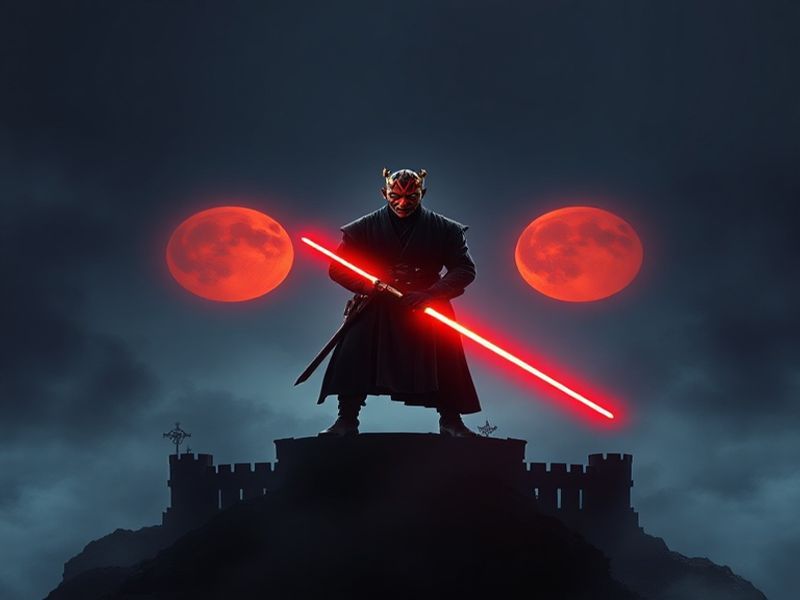
star wars darth maul shadow lord
The Star Wars saga is rich with complex villains, but few cast as long and dark a shadow as Darth Maul. Once a mere apprentice to Darth Sidious, Maul’s evolution into the Shadow Lord reshaped the galaxy’s power dynamics long before the events of the Skywalker saga. His return in Star Wars: The Clone Wars and Solo: A Star Wars Story cemented his place not just as a Sith assassin, but as a dark force capable of manipulating entire factions.
Maul’s story is one of survival, vengeance, and ultimately, self-destruction. It is a narrative that transcends the typical hero-vs-villain dichotomy, offering a tragic arc that resonates with fans of dark fantasy and political intrigue. His journey from silent killer to warlord reveals much about the nature of power in the Star Wars universe—and why evil, once unleashed, rarely stays confined.
The Rise of a Shadow Lord
Darth Maul was forged in the fires of the Sith’s secret revival. Trained under Darth Sidious in the shadows of Naboo, Maul was not merely a weapon—he was an experiment in pure Sith philosophy. Unlike traditional Sith apprentices, Maul was denied a traditional Sith name (a title bestowed only upon proven masters), which underscored his role as an expendable enforcer.
His first and only mission as Sidious’ apprentice was to eliminate the Jedi on Naboo. The duel with Qui-Gon Jinn and Obi-Wan Kenobi on Naboo’s hangar floor ended his physical dominance, but not his legacy. Severed in body yet unbroken in spirit, Maul survived through sheer force of will, clinging to the dark side even as his broken legs left him crippled.
During his exile on Lotho Minor, Maul was rebuilt—not just physically, but psychologically. His transformation into the Shadow Lord began when he abandoned his Sith identity entirely. He discarded the title of Darth, embraced the mantle of warlord, and built his own criminal empire. This shift marked a critical evolution: Maul no longer served the Rule of Two. He sought to forge his own empire through fear and bloodshed.
Key Turning Points in Maul’s Transformation
- Naboo Duel (Episode I): Maul’s defeat by Obi-Wan Kenobi left him broken but not defeated. His survival became a symbol of Sith resilience.
- Reconstruction on Lotho Minor: A black-market cybernetic rebuild restored his body—and his rage.
- Return to the Living Force: Maul’s discovery of his brother Savage Opress and the Nightbrothers gave him a new family, one rooted in vengeance.
- Corruption of the Black Sun:
- Siege of Mandalore: His failed coup during the Clone Wars exposed his ambition—and his fatal flaw: overreach.
Maul seized control of the criminal syndicate, turning it into a personal army.
Maul’s Empire: Crime, War, and the Illusion of Control
By the time of the Clone Wars, Maul had become a warlord in his own right. He was no longer just a Sith assassin; he was a warlord commanding thousands, controlling hyperspace routes, and challenging the Republic’s authority. His takeover of the Black Sun syndicate demonstrated his strategic mind. He didn’t just kill his enemies—he absorbed their power.
Yet, Maul’s empire was built on a paradox. He sought absolute control, but his methods were inherently chaotic. He ruled through fear, not loyalty. His underlings—including Savage Opress and later Ezra Bridger—were bound not by ideology, but by violence and manipulation. This made his empire fragile. When Obi-Wan Kenobi finally faced him again on Mandalore, Maul’s downfall was not just physical—it was existential.
His final moments, whispering to Obi-Wan about “the shadow of the past,” reveal a deep understanding of Sith philosophy. Maul knew that darkness never truly dies—it waits, it adapts, it returns. But he also understood that power, unchecked, consumes itself. His empire collapsed not because of Jedi intervention, but because his own ambition blinded him to the shifting tides of war.
The Legacy of Darth Maul: Why the Shadow Endures
Maul’s greatest victory was not on any battlefield—it was in the imagination of Star Wars fans. He became a symbol of the Sith’s enduring threat, a reminder that evil is not a single event, but a cycle. His return in The Clone Wars and Solo wasn’t just fan service; it was narrative necessity. The galaxy needed to see that the Sith never truly faded. They lurked in the shadows, waiting for their moment.
Moreover, Maul’s arc forces us to reconsider what it means to be a villain in Star Wars. He was not a puppet of the dark side—he was a co-conspirator. He chose darkness, not once, but repeatedly. His fall was not tragic because he was innocent, but because he was free—and chose slavery to rage over redemption.
This theme resonates beyond Star Wars. It speaks to the nature of extremism, radicalization, and the cost of unchecked power. Maul’s story is a dark mirror of Anakin Skywalker’s: both were trained in the dark side, both were broken, and both sought control. But where Anakin found meaning in love, Maul found only emptiness in domination.
Broader Implications in Star Wars Canon
Maul’s existence challenges the traditional Sith doctrine. The Rule of Two demands silence, patience, and secrecy. Maul defied it by screaming his name across the galaxy. He turned the Sith into a spectacle—a brand of terror. This shift foreshadowed the rise of the First Order, a movement built not on secrecy, but on spectacle and nostalgia for power.
Additionally, Maul’s control of Mandalore—even if briefly—introduced the planet as a major player in the Clone Wars, setting the stage for its later role in Rebels. His actions rippled through time, influencing events long after his death.
Ultimately, Darth Maul is more than a villain. He is a cautionary tale about what happens when ideology replaces identity, when vengeance replaces purpose, and when power replaces meaning. His shadow stretches across the entire saga—not just as a memory, but as a warning.
Conclusion: The Shadow That Never Fades
Darth Maul’s journey from Sith apprentice to Shadow Lord is one of the most compelling arcs in Star Wars. It is a story of survival, transformation, and self-destruction. Maul’s legacy endures not because he won battles, but because he embodied the dark side’s most dangerous truth: that evil, once unleashed, never truly dies—it waits, it adapts, and it returns.
In a galaxy where hope often feels fragile, Maul reminds us that darkness is not just a force to be defeated, but a shadow to be vigilant against. His story is not over. It lingers in the dark corners of the galaxy, in the whispers of the Force, and in the hearts of those who dare to listen.
For fans of Star Wars, Maul’s tale is a reminder that the saga is not just about light and dark—it’s about the choices we make in the shadows. And sometimes, the greatest battles are fought not with lightsabers, but with the will to resist the darkness within.
Explore more Star Wars films and lore to see how Maul’s shadow shaped the saga over time.
Watch how Maul’s story evolved in Star Wars animation across three decades.