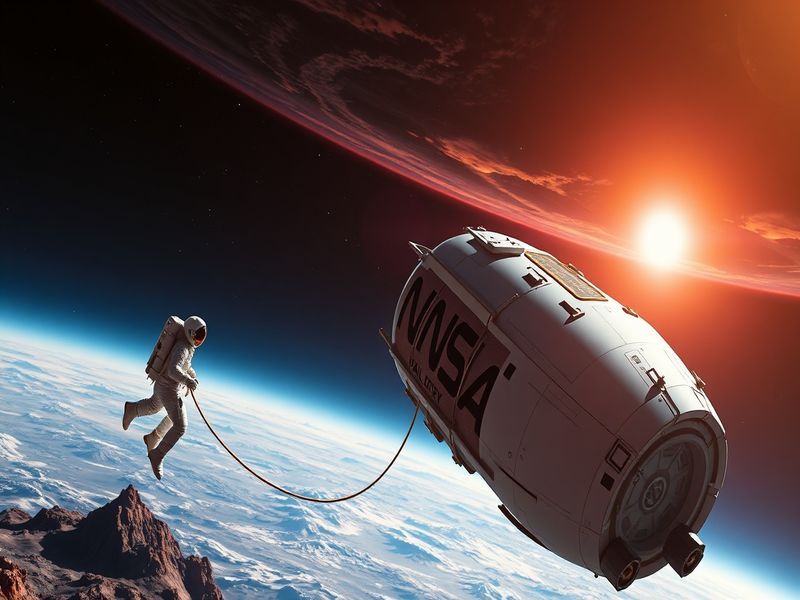
Project Hail Mary: The Science Behind Andy Weir’s Space Epic
Andy Weir’s Project Hail Mary arrived in 2021 to immediate acclaim, cementing its place as a modern science fiction classic. The novel follows Ryland Grace, a high school science teacher awakening from a coma to discover he’s the sole survivor of a desperate mission to save humanity. With Earth’s sun dimming and all life at risk, Grace must rely on his scientific ingenuity—and an unexpected alien ally—to pull off what seems impossible.
The story blends hard science with gripping narrative tension, a formula Weir perfected in The Martian. But Project Hail Mary distinguishes itself through its interstellar stakes and the depth of its scientific speculation. It’s not just about survival; it’s about collaboration across cosmic divides, where the fate of humanity hinges on understanding an alien biology and physics entirely foreign to our own.
The Science That Powers the Story
Weir’s genius lies in grounding Project Hail Mary in real scientific principles while pushing them to plausible extremes. The novel’s central premise—the sun is dying—is rooted in astrophysics. Stars like our sun follow predictable life cycles, and while a sudden dimming isn’t realistic, gradual solar decline is well-documented. This anchors the urgency of the plot in real-world science.
The protagonist’s reliance on chemistry, physics, and even astrobiology reflects Weir’s meticulous research. Grace’s problem-solving mirrors the challenges faced by real astronauts and scientists, from calculating orbital mechanics to understanding enzyme reactions. The novel even introduces a fictional element—“astrophage”—a microscopic organism consuming solar energy, which serves as the catalyst for the crisis. While entirely speculative, the concept is presented with enough internal logic to feel scientifically credible.
Key Scientific Concepts in Project Hail Mary
- Solar Luminosity Decline: The idea that the sun’s energy output could decrease over time is grounded in stellar evolution models, though the timescale is exaggerated for dramatic effect.
- Astrophysical Engineering: The mission’s reliance on precise orbital mechanics and propulsion technologies reflects real concepts like the Oberth effect and nuclear propulsion.
- Alien Biochemistry: The novel’s extraterrestrial life forms operate on principles of chemistry foreign to Earth, yet the interactions are logically consistent within their own framework.
- Cryogenic Suspension: Grace’s induced coma is a speculative but plausible extension of current medical and spaceflight technologies.
Weir doesn’t just drop scientific jargon into the narrative; he weaves it into the fabric of the story. Readers learn alongside Grace, making the science accessible without sacrificing accuracy. This approach has earned the novel praise from both literary critics and working scientists, a rare feat in genre fiction.
Why Project Hail Mary Resonates Beyond the Page
Project Hail Mary isn’t just a thrilling adventure; it’s a meditation on human ingenuity and cooperation. In an era marked by division and mistrust, Grace’s journey underscores the power of collaboration—even with an alien species. The novel’s climax hinges on bridging an enormous cultural and biological divide, a metaphor that feels particularly resonant today.
The story also reflects broader anxieties about humanity’s future. From climate change to technological disruption, the novel taps into existential fears while offering a hopeful counterpoint: that science and reason can prevail. This duality makes Project Hail Mary more than a space opera; it’s a story about what it means to be human when faced with oblivion.
The novel’s success has sparked renewed interest in space exploration and astrobiology. It arrives at a time when governments and private companies are racing to return to the moon, send humans to Mars, and even search for extraterrestrial life. Project Hail Mary doesn’t just imagine these possibilities—it makes them feel urgent and tangible.
The Broader Implications of Weir’s Vision
Project Hail Mary raises provocative questions about our place in the universe. If humanity ever does encounter intelligent life, would we be able to communicate? Could we collaborate on a scale that saves both species? The novel suggests that science might be the universal language, a radical idea in a world where diplomacy often fails.
It also challenges readers to consider the role of education and scientific literacy. Grace’s ability to solve crises stems from his deep understanding of fundamental principles. In an age of misinformation, the novel implicitly argues for the value of rigorous education and critical thinking—tools that could one day save the world.
Furthermore, Project Hail Mary has implications for the future of space travel. The novel’s propulsion systems, while fictional, are inspired by real research into nuclear and fusion drives. As private companies like SpaceX and Blue Origin push the boundaries of what’s possible, stories like Weir’s serve as both inspiration and cautionary tale. They remind us that space exploration is not just about technology; it’s about human resilience and adaptability.
What’s Next for Space Exploration?
Weir’s work arrives at a pivotal moment for space science. NASA’s Artemis program aims to return humans to the moon by 2025, while missions like the James Webb Space Telescope are peering deeper into the cosmos than ever before. Private companies are developing reusable rockets, and concepts like space elevators and orbital habitats are moving from sci-fi to engineering challenges.
Yet, Project Hail Mary also highlights the gaps in our knowledge. The novel’s alien life forms are biologically plausible but remain speculative. The search for extraterrestrial life continues, with projects like SETI scanning the skies and Mars rovers searching for signs of past or present microbial life. If we ever do make contact, will we be ready?
The novel’s release coincided with a surge in public interest in space, fueled by documentaries, podcasts, and even video games like Kerbal Space Program. This cultural moment suggests that stories like Project Hail Mary are not just entertaining—they’re shaping how we think about our future among the stars. Technology and Science enthusiasts have embraced the novel as both a gateway to deeper learning and a call to action.
Conclusion: A Story That Transcends Genre
Project Hail Mary is more than a gripping sci-fi adventure; it’s a testament to the power of storytelling to inspire, educate, and provoke thought. Andy Weir has crafted a narrative that entertains while challenging readers to look beyond our planet and consider our place in the cosmos. The novel’s blend of hard science, emotional depth, and cosmic stakes ensures its relevance for years to come.
As humanity stands on the brink of new discoveries, Project Hail Mary serves as both a mirror and a telescope. It reflects our fears and hopes while inviting us to gaze at the stars with curiosity rather than dread. In a world where division often overshadows collaboration, Grace’s journey reminds us that the greatest achievements are those we pursue together—no matter how far apart we may be.
For anyone who’s ever looked up at the night sky and wondered what lies beyond, Project Hail Mary is a must-read. It’s a story that doesn’t just imagine the future; it challenges us to help build it.