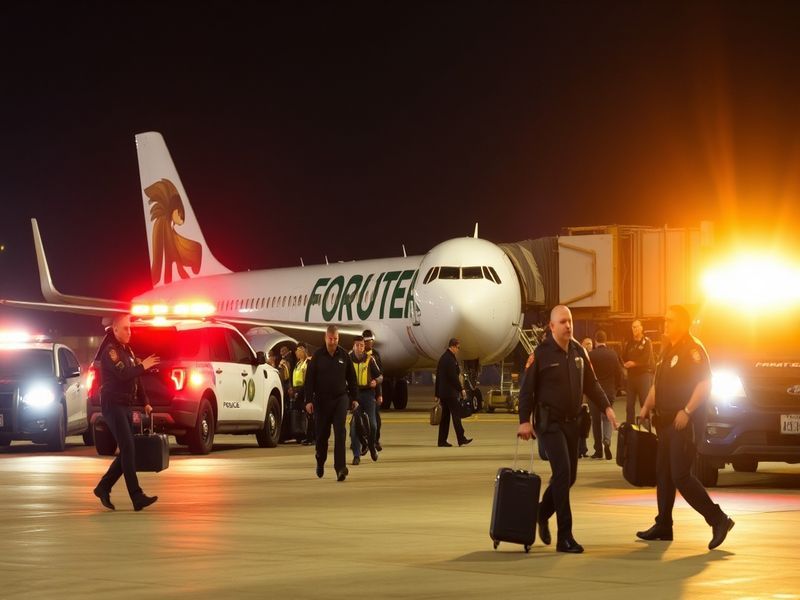
On a routine Tuesday afternoon, a Frontier Airlines flight from Orlando to Las Vegas became the center of a high-stakes emergency when a bomb threat forced an unscheduled landing in Albuquerque, New Mexico. The incident unfolded just 90 minutes into the flight, sending passengers and crew into a state of heightened alert.
According to preliminary reports, the threat was called in to air traffic control by an unidentified individual. The message, received shortly after takeoff, prompted the crew to initiate emergency protocols. Passengers were instructed to remain calm as the aircraft diverted to the nearest suitable airport, Albuquerque International Sunport.
Upon landing, authorities conducted a thorough search of the aircraft. Bomb-sniffing dogs and bomb disposal units were deployed, but no explosive devices were found. The plane and its 145 passengers were held for several hours while investigators complied with standard security procedures. The flight eventually resumed its journey to Las Vegas after clearance from the FBI and local law enforcement.
Timeline of Events: How the Bomb Threat Unfolded
The sequence of events highlights the rapid response required in aviation security threats. Here’s a breakdown of what transpired:
- 1:45 PM (EST): The threat is called in to air traffic control, citing a bomb on board Frontier Airlines Flight 1252.
- 1:50 PM (EST): The crew notifies passengers of the diversion and begins emergency procedures.
- 2:15 PM (EST): The aircraft lands safely at Albuquerque International Sunport.
- 2:30 PM (EST): Local law enforcement and the FBI arrive to assess the situation.
- 3:45 PM (EST): Bomb-sniffing dogs and a bomb disposal unit begin searching the plane.
- 5:30 PM (EST): No explosives are found, and the flight resumes after a thorough inspection.
- 7:15 PM (EST): The aircraft arrives in Las Vegas, nearly five hours behind schedule.
While the threat turned out to be a false alarm, the incident underscores the vulnerabilities in air travel security and the challenges of responding to real-time threats. Aviation experts note that even hoax calls can have significant operational and financial repercussions.
The Broader Implications for Air Travel Security
This incident is not an isolated case. In recent years, bomb threats and other security alerts have become a growing concern for airlines worldwide. According to the Federal Aviation Administration (FAA), there were over 4,000 reported security incidents in U.S. airspace in 2023, a 15% increase from the previous year.
For Frontier Airlines, the event raises questions about the effectiveness of current threat assessment protocols. While the airline followed standard procedures, the fact that the threat originated from an unidentified caller suggests gaps in how such information is verified. Aviation security analyst Mark Thompson notes, “The challenge isn’t just responding to threats—it’s determining their credibility quickly enough to minimize disruptions.”
Passengers, too, are increasingly aware of these risks. Social media reactions to the incident reflected a mix of frustration and anxiety, with many questioning the ease with which threats can be made and the subsequent delays they cause. One passenger tweeted, “We spent hours on the tarmac waiting for a threat that didn’t even exist. How many more times will this happen?”
The economic impact of such incidents is also significant. Airlines incur costs from diversions, passenger rebooking, and increased security measures. Frontier Airlines has not yet released an estimate of the financial toll, but industry experts suggest it could run into tens of thousands of dollars per incident.
How Airlines Are Adapting to Rising Threats
In response to the growing number of threats, airlines and aviation authorities are exploring new technologies and strategies to enhance security. Some of the key measures being considered include:
- AI-Powered Threat Detection: Airlines are testing artificial intelligence systems that can analyze calls and messages for patterns indicative of real threats. These systems aim to reduce false positives and speed up response times.
- Enhanced Passenger Screening: New scanners and biometric identification tools are being deployed to improve the accuracy of security checks. These technologies can detect hidden weapons or explosives more effectively than traditional methods.
- Improved Communication Protocols: Airlines are working with law enforcement to streamline the process of verifying threats. This includes real-time data sharing and clearer guidelines for when to divert flights.
- Public Awareness Campaigns: Airlines are educating passengers on how to report suspicious activity and what to expect during security alerts. This helps reduce panic and ensures smoother responses to incidents.
Frontier Airlines has not publicly detailed any changes to its security protocols following the incident. However, the airline did issue a statement emphasizing its commitment to passenger safety and cooperation with law enforcement.
What’s Next for Frontier Airlines and Its Passengers?
As Frontier Airlines continues its investigation into the bomb threat, passengers are left wondering about the reliability of air travel security. While the incident was ultimately resolved without harm, it serves as a reminder of the ever-present risks in aviation.
For now, Frontier Airlines has resumed normal operations, but the incident may prompt a review of its threat assessment procedures. Passengers traveling on the airline in the coming weeks are likely to see additional security measures in place, at least temporarily.
Beyond Frontier, the broader aviation industry will likely face increased scrutiny over how such threats are handled. With the rise of remote work and the normalization of online threats, the pressure is on airlines and authorities to adapt quickly.
The Albuquerque incident may have been a false alarm, but it highlights a critical challenge: balancing security with efficiency in an era where threats—real or imagined—are becoming more common.
For now, passengers can only hope that the lessons learned from this event will lead to safer skies in the future.
For more insights into airline security and travel safety, visit our Travel category on Dave’s Locker.
Disclaimer: The views expressed in this article are those of the author and do not necessarily reflect the official policy or position of any agency or organization.