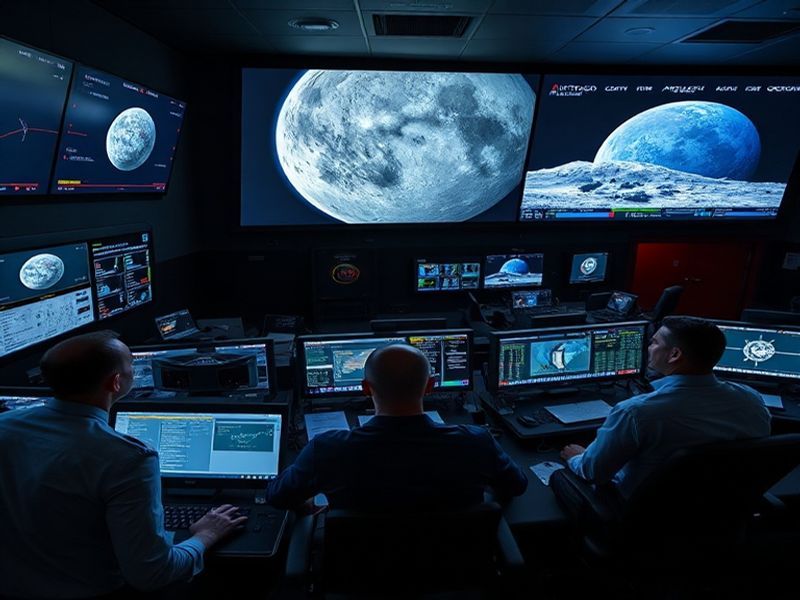
As the countdown to humanity’s return to the Moon continues, NASA’s Artemis II mission stands at the forefront of space exploration. Scheduled for no earlier than September 2025, this landmark mission will send four astronauts on a historic journey around the Moon, marking the first crewed lunar flyby since Apollo 17 in 1972. But Artemis II is more than a technical milestone—it’s a cultural and geopolitical statement, reflecting shifting power dynamics in space and a renewed global ambition to extend humanity’s reach beyond Earth.
The mission builds on the uncrewed Artemis I, which successfully tested NASA’s Space Launch System (SLS) and Orion spacecraft in late 2022. While Artemis I proved the hardware could survive the harsh environment of deep space, Artemis II will demonstrate that humans can operate safely in that same environment. Success here paves the way for Artemis III, which aims to land the first woman and the next man on the lunar surface in 2026.
Mission Overview: From Earth to Lunar Orbit and Back
Artemis II is a 10-day mission designed to validate the Orion spacecraft’s life support, navigation, and communication systems during a crewed lunar flyby. Unlike Apollo missions, which landed on the Moon, Artemis II will not enter lunar orbit. Instead, the Orion capsule will perform a “hybrid free-return trajectory,” swinging around the far side of the Moon and using lunar gravity to slingshot back toward Earth. This trajectory ensures the spacecraft can return safely even if propulsion systems fail, a critical safety feature.
The crew, announced in April 2023, includes NASA astronauts Reid Wiseman (commander), Victor Glover (pilot), Christina Koch (mission specialist), and Canadian Space Agency astronaut Jeremy Hansen (mission specialist). Their diverse backgrounds—spanning military aviation, engineering, and long-duration spaceflight—reflect NASA’s commitment to inclusivity and global collaboration. This mission also marks the first time a Canadian astronaut has ventured beyond low Earth orbit, underscoring Canada’s growing role in space exploration.
The spacecraft will launch from Kennedy Space Center in Florida aboard the SLS rocket, the most powerful rocket ever built. Once in space, Orion will separate from the upper stage and begin its journey to the Moon. Along the way, the crew will test systems like radiation shielding, artificial gravity via rotational motion, and emergency abort procedures. The mission will culminate in a high-speed re-entry into Earth’s atmosphere, testing the heat shield’s ability to withstand temperatures of nearly 5,000 degrees Fahrenheit.
Global Collaboration: How the World Is Joining the Artemis Program
The Artemis program is not just a NASA endeavor—it’s a coalition of international partners, commercial entities, and scientific institutions. The Artemis Accords, a set of principles for responsible lunar exploration, have been signed by 40 nations, including key players like Japan, India, and the United Arab Emirates. These agreements emphasize transparency, resource sharing, and peaceful cooperation, setting a new standard for space governance in the 21st century.
Japan, for instance, is contributing the advanced lunar rover for Artemis III, while the European Space Agency (ESA) is providing the service module for Orion, which supplies power, propulsion, and life support. Canada’s contribution of the Canadarm3 robotic system for the Lunar Gateway—a small space station orbiting the Moon—further solidifies its position as a leader in space robotics. Even private companies like SpaceX and Blue Origin are involved, with SpaceX’s Starship expected to play a role in landing astronauts on the Moon.
This international collaboration reflects a broader shift in space exploration. Unlike the Cold War-era space race, today’s efforts are characterized by cooperation and shared ambition. Countries that once viewed space as a domain of competition now see it as a platform for scientific discovery, economic growth, and diplomatic engagement. The Artemis program, with its emphasis on inclusivity and sustainability, could redefine humanity’s relationship with space.
Commercial Partnerships: The Rise of the Private Space Sector
NASA’s shift toward commercial partnerships has been one of the most transformative aspects of the Artemis program. By leveraging the innovation and efficiency of private companies, NASA has reduced costs and accelerated timelines. SpaceX’s contract to develop the Human Landing System (HLS) for Artemis III is a prime example. The company’s Starship lunar lander, currently under development in Texas, aims to ferry astronauts from lunar orbit to the surface and back. If successful, this will be the first time a commercial vehicle has landed humans on another celestial body.
Other companies are also playing key roles. Aerojet Rocketdyne provides the propulsion systems for the SLS, while Lockheed Martin builds the Orion spacecraft. These partnerships not only drive technological advancements but also create jobs and stimulate economic growth in the aerospace sector. The commercial space industry, once a niche market, is now a driving force in space exploration, with implications for industries ranging from telecommunications to mining.
Cultural and Scientific Impact: Why Artemis II Matters Beyond Spaceflight
Artemis II is more than a technical achievement—it’s a cultural milestone. The mission will inspire a new generation of scientists, engineers, and dreamers, much like the Apollo missions did in the 1960s. For many, the sight of four astronauts—including the first woman and a person of color—flying around the Moon will be a powerful symbol of progress and inclusion. It will also reignite public interest in space exploration, potentially boosting STEM education and scientific literacy worldwide.
Scientifically, Artemis II will gather critical data on the effects of deep space radiation on humans, a key concern for long-duration missions to Mars. The crew will also conduct experiments in microgravity, test new life support systems, and study the Moon’s environment from a distance. These insights will be invaluable for future missions, including the establishment of a sustainable lunar base and eventual human missions to Mars.
The mission also carries symbolic weight. The Moon, once a symbol of Cold War rivalry, is now a destination for cooperation and discovery. Artemis II reflects a global consensus that space is not just a frontier for exploration but also a platform for addressing Earth’s challenges, from climate change to sustainable energy. By bringing together nations and industries, the Artemis program could set a precedent for how humanity tackles the existential challenges of the 21st century.
Challenges and Controversies: The Road Ahead for Artemis
Despite its promise, the Artemis program faces significant challenges. Budget constraints, technical delays, and political uncertainties could impact timelines. The SLS rocket, for example, has faced criticism for its high cost and reliance on legacy technology. Critics argue that commercial alternatives, like SpaceX’s Starship, could achieve similar goals more efficiently. Meanwhile, geopolitical tensions—particularly between the U.S. and China—raise questions about the sustainability of international cooperation in space.
China’s rapid advancements in lunar exploration, including its Chang’e missions and plans for a lunar base, have intensified the competition. While NASA and its partners emphasize cooperation, the reality is that space exploration is becoming increasingly geopoliticized. The Artemis Accords, for instance, exclude China, reflecting broader tensions in U.S.-China relations. This could lead to a bifurcated space program, with different nations pursuing their own agendas on the Moon and beyond.
Another challenge is public perception. Space exploration is often seen as a luxury in an era of global crises, from pandemics to climate disasters. Critics question whether the billions spent on Artemis could be better used elsewhere. However, proponents argue that space exploration drives innovation, creates jobs, and inspires solutions to Earth’s problems. The technologies developed for Artemis—from advanced materials to life support systems—could have applications in medicine, energy, and environmental science.
Ultimately, the success of Artemis II will depend not just on technical excellence but also on political will and public support. If the mission captures the world’s imagination, it could galvanize further investment and cooperation. If not, it may face increased scrutiny and calls for reform. Either way, Artemis II represents a pivotal moment in humanity’s journey beyond Earth.
What’s Next After Artemis II?
Following Artemis II, the focus will shift to Artemis III, which aims to land astronauts near the Moon’s south pole. This region is of particular interest because it contains water ice, a critical resource for future lunar bases and deep-space missions. Subsequent missions will expand infrastructure, including the Lunar Gateway and surface habitats, laying the groundwork for a sustainable human presence on the Moon.
Beyond the Moon, Artemis serves as a stepping stone for Mars. The technologies and experiences gained from lunar missions will inform the design of spacecraft and habitats for the Red Planet. NASA’s goal is to send humans to Mars by the late 2030s or early 2040s, and Artemis II is a crucial milestone on that path.
For now, all eyes are on the crew of Artemis II. Their mission is a testament to human ingenuity, collaboration, and ambition. As they embark on their journey, they carry with them the hopes of a planet watching from afar—a reminder that space exploration is not just about reaching new worlds, but also about understanding our place in the universe.
Conclusion: A New Era of Space Exploration
NASA’s Artemis II mission is more than a step toward the Moon—it’s a leap into a new era of space exploration. By combining technical innovation, global cooperation, and scientific ambition, the mission embodies the best of what humanity can achieve. Whether viewed through the lens of science, culture, or geopolitics, Artemis II represents a defining moment in our journey beyond Earth.
As the crew prepares for their historic flight, the world watches with anticipation. Their mission will not only advance our understanding of the Moon but also redefine our relationship with space. In an age of division and uncertainty, Artemis II offers a vision of what we can accomplish when we dare to dream together.
For more on space exploration and its cultural impact, visit our Science and Technology sections.