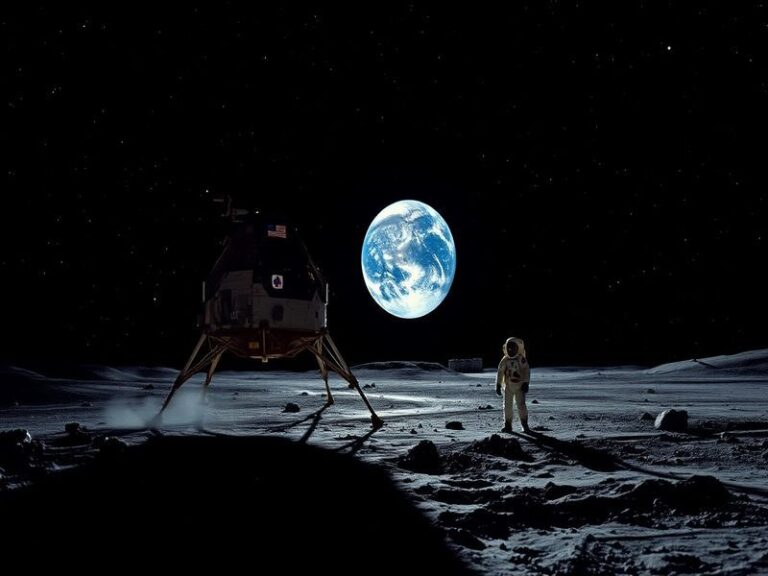
Artemis 3: NASA’s 2026 Moon Mission and Its Broader Impact
“`html
Artemis 3: NASA’s Next Giant Leap Toward Lunar Return
NASA’s Artemis program isn’t just another space mission—it’s a carefully orchestrated return to the Moon with a clear goal: sustainable human presence. Artemis 3, the third mission in this ambitious initiative, will mark humanity’s first crewed lunar landing since Apollo 17 in 1972. Scheduled for no earlier than September 2026, this mission represents more than a technological achievement; it’s a stepping stone toward deeper space exploration.
The Mission: Objectives and Innovations
Artemis 3’s primary objective is straightforward: land astronauts near the Moon’s south pole, an area rich in water ice and permanently shadowed regions. But the mission’s significance lies in its preparation and technical innovations. Unlike the Apollo landings, which focused on equatorial regions, Artemis 3 targets a location that could provide critical resources for future missions.
The mission will utilize SpaceX’s Starship Human Landing System (HLS) as the lunar lander, a departure from the Apollo-era Lunar Module. Starship’s design allows for larger crews and more cargo, enabling extended surface stays. NASA has also emphasized the use of advanced spacesuits developed by Axiom Space, designed for better mobility and life support in the harsh lunar environment.
The crew of Artemis 3 will spend up to six days on the Moon’s surface, conducting experiments and collecting samples. These activities are designed to test technologies for future missions, including the eventual goal of establishing a sustainable lunar base. The mission will also serve as a critical testbed for NASA’s Artemis Accords, an international framework for responsible lunar exploration.
Key Objectives of Artemis 3
- First crewed lunar landing since 1972, targeting the Moon’s south pole
- Testing of SpaceX’s Starship HLS and Axiom’s next-generation spacesuits
- Collection of lunar samples and in-situ resource utilization (ISRU) experiments
- Demonstration of advanced navigation and communication systems
- Preparation for sustainable lunar habitats and future Mars missions
Broader Implications: Beyond the Moon
Artemis 3 is more than a lunar mission—it’s a catalyst for broader space exploration ambitions. The mission’s success will validate technologies and strategies that could be applied to future Mars missions, including life support systems, in-space manufacturing, and long-duration crew operations. By targeting the lunar south pole, NASA is also addressing one of the most pressing challenges of deep-space exploration: resource utilization.
The presence of water ice in permanently shadowed regions offers a potential source of drinking water, oxygen, and even rocket fuel. Extracting and utilizing these resources will be a game-changer for sustainable space exploration, reducing the need to transport supplies from Earth. Artemis 3 will test key technologies for mining and processing lunar water, paving the way for future infrastructure.
Beyond technology, Artemis 3 has significant geopolitical and economic implications. The mission reinforces the United States’ leadership in space exploration while fostering international collaboration through the Artemis Accords. Countries like Canada, Japan, and the European Union are contributing critical components, such as the Lunar Gateway’s habitation module and advanced robotics.
Commercially, Artemis 3 signals a new era of space economy. Companies like SpaceX, Axiom Space, and others are playing pivotal roles, demonstrating the growing synergy between government and private sector innovation. This collaboration could accelerate the development of space tourism, lunar mining, and even off-world manufacturing.
Challenges and Risks
Despite its promise, Artemis 3 faces substantial challenges. The mission’s timeline is ambitious, with delays possible due to technical hurdles or funding constraints. Starship’s development, in particular, has faced scrutiny, with multiple test flights ending in explosions or failures. Ensuring the lander’s reliability before crewed missions is paramount.
Another challenge is the lunar environment itself. The south pole’s rugged terrain, with its steep slopes and rocky outcrops, poses risks for landing and surface operations. Communications with Earth can also be challenging due to the Moon’s orientation, requiring robust autonomous systems for navigation and hazard avoidance.
Human factors are equally critical. The crew will face radiation exposure, extreme temperature fluctuations, and the psychological strain of isolation. NASA’s research into these risks, including analogs like the HERA (Human Exploration Research Analog) and CHAPEA (Crew Health and Performance Exploration Analog) missions, will be essential for mission success.
Preparing for the Future
Artemis 3 is part of a larger strategy that includes the Lunar Gateway, a small space station orbiting the Moon, and subsequent missions like Artemis 4 and 5. These missions will build on Artemis 3’s achievements, testing new technologies and expanding humanity’s reach on the lunar surface. The ultimate goal is to establish a sustainable presence, including habitats, rovers, and power systems.
For space enthusiasts and industry observers, Artemis 3 offers a glimpse into the future of exploration. It’s a mission that blends cutting-edge technology with human ambition, pushing the boundaries of what’s possible. As NASA prepares for this historic journey, the world watches, ready to celebrate the next giant leap for humanity.
For more insights into space exploration and technology, visit our Technology and Science categories on Dave’s Locker.