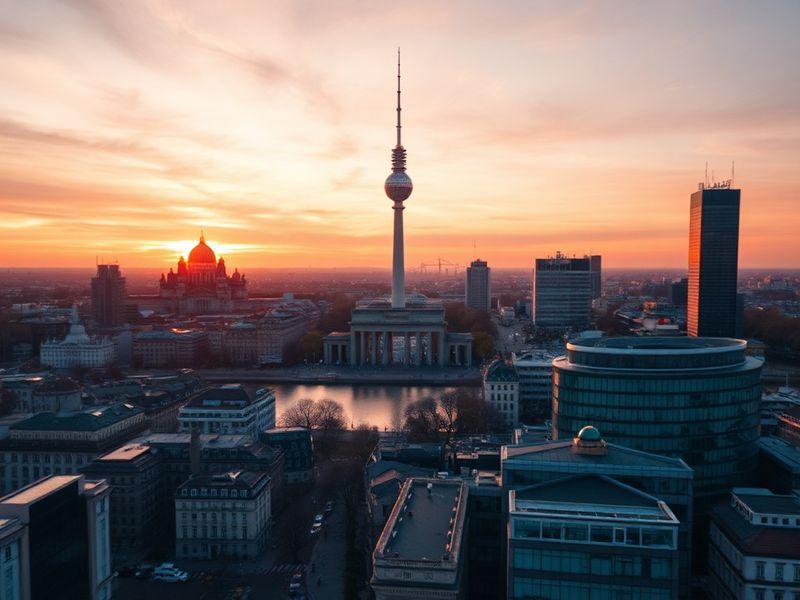
Berlin isn’t just a city—it’s a living experiment in reinvention. More than three decades after the fall of the Berlin Wall, the German capital continues to evolve at a pace rarely seen in Europe. From its gritty post-industrial neighborhoods to its gleaming government district, Berlin defies easy definition. It’s a place where history is written in layers, not lines, and where creativity thrives amid uncertainty. This is a city that refuses to stay the same, constantly reshaping itself through art, migration, technology, and politics.
The City That Never Stops Changing
Berlin’s transformation since reunification has been nothing short of remarkable. Once divided by a 155-kilometer wall, the city has rebuilt itself into a unified metropolis that embraces its scars as much as its triumphs. The Brandenburg Gate, once a symbol of division, now stands as a gateway to modern Germany. Potsdamer Platz, leveled during World War II and later isolated by the Wall, has become a hub of glass skyscrapers and corporate towers. Yet, even in its most polished corners, Berlin resists becoming a standard European capital. Construction cranes dot the skyline not just for luxury apartments or office blocks, but for cultural spaces, startups, and community centers—projects that reflect the city’s experimental spirit.
This relentless change isn’t without tension. Gentrification has pushed long-time residents from central districts like Kreuzberg and Friedrichshain into outer neighborhoods. Rents have doubled in some areas over the past decade, straining the city’s famously affordable housing market. Protests against displacement and rising costs are common, turning Berlin into a battleground between tradition and progress. Yet, unlike many global cities where history is preserved in amber, Berlin wears its transformations openly. Abandoned factories become art studios. Empty lots become urban gardens. The city’s DNA is written in its impermanence.
Culture Without Borders
Berlin’s cultural scene is as diverse as its population. Over 30% of residents were born outside Germany, a reflection of decades of immigration from Turkey, the Middle East, Eastern Europe, and beyond. This diversity fuels a creative ecosystem unlike any other in Europe. The city hosts more than 170 museums, from the iconic Pergamon to niche galleries in former East Berlin warehouses. The Berlin Philharmonic and Staatsoper are world-renowned, yet so too are the underground clubs that define the city’s nightlife. Techno culture, born in Berlin’s squats and abandoned buildings, has become a global export—with Berghain, the infamous nightclub, drawing pilgrims from across the planet.
Berlin’s art scene thrives in the margins. The East Side Gallery, a 1.3-kilometer stretch of the Berlin Wall covered in murals, remains the largest open-air gallery in the world. The RAW-Gelände in Friedrichshain, a former railway repair yard, hosts flea markets, concerts, and techno parties in repurposed industrial spaces. Meanwhile, institutions like the Hamburger Bahnhof and KW Institute for Contemporary Art anchor Berlin’s place on the global art map. What ties these spaces together is their DIY ethos. In Berlin, culture isn’t something you watch—it’s something you create, often with little more than a borrowed space and a shared vision.
- Berghain: A temple of techno and architectural minimalism, where entry depends as much on attitude as on the bouncer’s whim.
- Teufelsberg: A Cold War-era spy station turned artist retreat, offering panoramic views of the city and a hauntingly beautiful graffiti-covered ruin.
- Kunsthaus Tacheles: Though demolished in 2012, its spirit lives on in Berlin’s squat-turned-cultural centers, where art and protest intertwine.
- Berlin Biennale: A contemporary art festival that challenges norms, often sparking controversy with politically charged installations.
A Tech Hub with a Social Conscience
Berlin has quietly become one of Europe’s leading tech hubs. The city is home to more than 3,000 startups, from global players like Zalando and Delivery Hero to groundbreaking projects in AI and biotech. What sets Berlin’s tech scene apart is its focus on social impact. Companies like Ecosia, the search engine that plants trees, and Too Good To Go, which fights food waste, were founded here. The city’s universities and research institutions collaborate closely with startups, creating a pipeline of innovation that prioritizes people over profits.
Yet, Berlin’s tech boom isn’t without contradictions. The city’s startup success has attracted venture capital and corporate interest, leading to concerns about the erosion of its grassroots ethos. Critics argue that the same forces gentrifying neighborhoods are now pricing out the next generation of entrepreneurs. Still, Berlin’s tech community remains resilient. Co-working spaces like Factory Berlin and WeWork Labs provide affordable hubs for collaboration. Events like the Berlin Web Week and NOAH Conference bring together founders, investors, and policymakers to debate the future of technology—and its role in society.
Berlin’s approach to tech also reflects its broader values: accessibility, transparency, and a willingness to experiment. The city’s digital administration initiatives, like the Berlin Open Data Portal, aim to make government more open and participatory. Meanwhile, projects like the Tech for Good movement are redefining what it means to build a business in the 21st century.
The Green Heart of a Concrete Jungle
Amid its urban density, Berlin is surprisingly green. The city is home to over 2,500 parks, more than any other European capital. Tiergarten, the city’s largest park, is a vast green lung in the heart of the city, while smaller spaces like the Tempelhofer Feld—a former airport turned public park—offer car-free zones for cycling, picnicking, and kite-flying. Berlin’s commitment to green spaces isn’t just aesthetic; it’s a response to the climate crisis. The city aims to be carbon-neutral by 2050, and initiatives like the “Berlin summt!” (Berlin buzzes!) project encourage urban beekeeping to support biodiversity.
Berlin’s relationship with nature extends beyond its parks. The city has a thriving urban farming scene, with projects like Prinzessinnengärten and Farm:Bot demonstrating how food can be grown in limited spaces. Meanwhile, the Spree River, once a polluted industrial waterway, is being restored as a vital ecosystem. These green initiatives are not just about sustainability—they’re about reclaiming the city as a space for people, not cars or corporations.
- Tempelhofer Feld: A 386-hectare park on the site of a decommissioned airport, where locals bike, barbecue, and protest against development.
- Plänterwald: Home to the city’s second-largest urban forest and the decommissioned Spreepark, a surreal abandoned amusement park.
- Mauerpark: A Sunday flea market and karaoke hotspot that blends nature, commerce, and community in a single space.
- Urban Nation: A museum dedicated to street art, proving that even the city’s concrete canvases are part of its green identity.
Berlin’s Global Pulse: More Than Just a City
Berlin’s influence extends far beyond its borders. The city is a magnet for artists, entrepreneurs, and dreamers from around the world. Its universities, like the Freie Universität and Humboldt-Universität, attract international students seeking affordable education and a vibrant cultural scene. Berlin’s startup ecosystem has become a model for cities from Amsterdam to Nairobi. And its history—of division, resilience, and reunification—offers lessons for nations grappling with their own divides.
Yet, Berlin’s global impact isn’t just about exporting its culture or ideas. The city is also a place where global challenges are confronted head-on. Refugees arriving in Berlin have transformed neighborhoods like Neukölln into multicultural hubs. The city’s tech community is tackling issues like digital privacy and climate change. And Berlin’s artists continue to push boundaries, using their work to challenge authority and inspire change.
This is why Berlin matters. It’s not just a city of the past or the future—it’s a city of the present, where the struggles and triumphs of today shape the possibilities of tomorrow. Whether you’re drawn to its history, its creativity, its tech scene, or its green spaces, Berlin offers something for everyone. But more than that, it offers a reminder: cities don’t have to be polished or perfect to be powerful. Sometimes, the messiest places are the ones that change the world.
As Berlin continues to evolve, one thing is certain: it will never stop surprising us. And in a world that often feels divided, Berlin remains a place where the future is still being written—one graffiti tag, one tech startup, and one techno beat at a time.