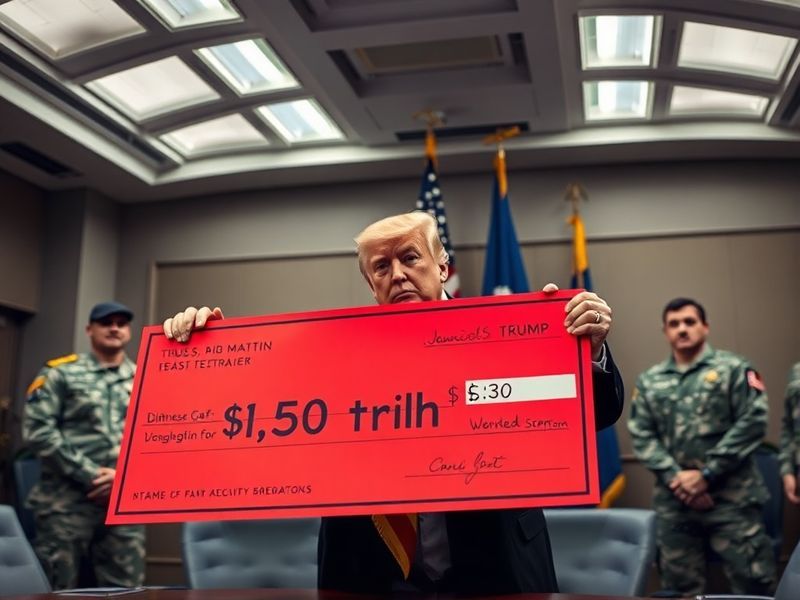
The Trump administration’s proposed $1.5 trillion defense budget—spanning fiscal years 2025 and 2026—has sparked intense debate across political and military circles. This unprecedented allocation reflects a strategic pivot toward modernization, deterrence, and global military dominance. But what does it signify for the United States and its allies, as well as its adversaries?
At its core, the budget represents a 3% increase from previous allocations, prioritizing technological advancement, space warfare capabilities, and nuclear arsenal upgrades. The proposal also earmarks significant funds for expanding troop deployments in the Pacific and bolstering cybersecurity infrastructure. Critics argue the move risks escalating global tensions, while supporters contend it’s a necessary response to rising threats.
The Strategic Vision Behind the Budget
The administration frames the $1.5 trillion expenditure as a response to what it describes as a “decades-long erosion of American military superiority.” Key pillars of the plan include:
- Nuclear Modernization: A $150 billion investment to upgrade the U.S. nuclear triad—land-based ICBMs, submarine-launched ballistic missiles, and strategic bombers.
- Space Force Expansion: Over $30 billion allocated to the newly formed U.S. Space Force, focusing on satellite defense and anti-satellite weaponry.
- Pacific Deterrence Initiative: $10 billion to counter China’s growing influence, including new missile deployments in Guam and Japan.
- AI and Hypersonic Weapons: $12 billion for next-generation defense technologies, including artificial intelligence-driven warfare systems and hypersonic missile development.
Analysts note that the budget’s emphasis on space and cyber capabilities marks a significant shift from traditional land and sea warfare. “This isn’t just about tanks and jets anymore,” said Dr. Elena Vasquez, a military strategist at the Center for Strategic and International Studies. “The future of conflict is digital, and the U.S. is positioning itself to dominate in that domain.”
Global Reactions: Allies, Adversaries, and Neutral Parties
The international response to the budget has been mixed. NATO allies, while supportive of increased U.S. military engagement, have expressed concerns over burden-sharing. European nations, already grappling with economic instability, worry about being overshadowed by America’s Pacific-focused strategy.
In contrast, Japan and South Korea have welcomed the budget, seeing it as a critical step in countering North Korea’s nuclear ambitions. “The U.S. presence in the Pacific is not just a strategic choice; it’s a guarantee of regional stability,” said Japanese Prime Minister Fumio Kishida in a recent statement.
China, however, has condemned the budget as “provocative” and “aggressive.” Foreign Ministry spokesman Wang Wenbin stated, “The U.S. is fueling an arms race under the guise of defense. This will destabilize global security.” The Chinese government has responded by accelerating its own military modernization, including the expansion of its nuclear arsenal and development of hypersonic glide vehicles.
Russia, meanwhile, has adopted a more measured tone. While Moscow has criticized the budget’s scale, it has also signaled a willingness to engage in arms control negotiations. “We are watching closely,” said Russian Deputy Foreign Minister Sergei Ryabkov. “But we will not be intimidated.”
Economic and Political Implications
The $1.5 trillion defense budget comes at a time of economic uncertainty. The U.S. national debt exceeds $34 trillion, and critics argue that such massive military spending could exacerbate fiscal imbalances. “We are spending money we don’t have on weapons we may never use,” said Senator Mark Warner (D-VA) during a Senate Armed Services Committee hearing.
Proponents counter that the investment will stimulate domestic industries, particularly in aerospace, defense contracting, and technology. Companies like Lockheed Martin, Boeing, and Northrop Grumman stand to benefit significantly from the budget’s allocations. “This is not just about national security; it’s about economic security,” said Heather Wilson, former U.S. Air Force Secretary and current CEO of defense firm ShotSpotter.
The budget also carries political weight. With the 2024 election looming, defense spending has become a partisan battleground. Republicans largely support the increases, framing them as essential to maintaining U.S. global leadership. Democrats, while not opposed to modernization, advocate for more diplomatic engagement and reduced spending on certain high-cost programs, such as the F-35 fighter jet.
Cultural Shifts: How the Budget Reflects Societal Priorities
Beyond the geopolitical and economic dimensions, the defense budget reflects broader cultural attitudes toward security and militarism. In an era marked by cyber threats, climate-induced conflicts, and great-power competition, the U.S. is redefining what it means to be “secure.”
The budget’s focus on space and cyber warfare, for instance, mirrors a society increasingly reliant on digital infrastructure. “We are no longer fighting wars with bullets and bombs alone,” said cultural anthropologist Dr. Lisa Nakamura. “The battles of the 21st century are fought in code, in data streams, and in the silent void of space.”
This shift also resonates with a younger generation that has grown up in a world shaped by 9/11, the War on Terror, and the rise of China. Polls indicate that while millennials and Gen Z support strong defense policies, they are also more skeptical of traditional military interventions. The budget, then, represents a balancing act between honoring the past and preparing for an uncertain future.
Moreover, the budget’s emphasis on technological superiority aligns with America’s self-image as a nation of innovation. Silicon Valley’s contributions to defense—through AI, drones, and cybersecurity—highlight the intersection of civilian and military technology. This fusion is reshaping not just warfare, but also American identity.
What’s Next for the $1.5 Trillion Budget?
As the budget moves through Congress, debates are intensifying. The House Armed Services Committee has already begun hearings, with lawmakers questioning the feasibility of such large-scale spending. Meanwhile, defense contractors are ramping up lobbying efforts to secure lucrative contracts.
One of the biggest hurdles will be reconciling the budget with other pressing national priorities, such as infrastructure, healthcare, and education. “We cannot fund our military at the expense of our people,” argued Rep. Alexandria Ocasio-Cortez (D-NY) in a recent op-ed.
Yet, the administration remains steadfast. “We will not shrink from our responsibilities,” stated Defense Secretary Lloyd Austin. “The world is becoming more dangerous, and America must lead.”
The final outcome of the budget remains uncertain. However, its implications—geopolitical, economic, and cultural—will reverberate for decades to come. Whether it strengthens global stability or accelerates an arms race may well depend on the choices made in the years ahead.
For now, the world watches, waits, and weighs the consequences of a $1.5 trillion gamble on America’s future.
For more on global military trends, explore our News section. To understand the intersection of technology and defense, visit our Technology category.