space exploration
“`html
Space Exploration: A Global Journey Beyond Earth
For millennia, humanity has gazed upward, tracing the movements of celestial bodies and weaving stories around the cosmos. Today, space exploration has evolved from myth and wonder into a tangible, collaborative endeavor that unites nations, cultures, and disciplines. From the launch pads of Kazakhstan to the control centers of Houston, Tokyo, and Moscow, the quest to understand and conquer space has become a defining feature of the 21st century.
This global pursuit is not merely about reaching new frontiers—it’s about redefining what it means to be human. It blends science, engineering, philosophy, and even art, reflecting our deepest aspirations and fears. As we stand on the shoulders of pioneers like Yuri Gagarin, Neil Armstrong, and Valentina Tereshkova, we continue to push boundaries, driven by curiosity and the shared dream of a future among the stars.
The Historical Roots of Space Exploration
The journey beyond Earth began long before the first rocket left the ground. Ancient civilizations observed the heavens with reverence and precision. The Babylonians tracked planetary motion, the Greeks proposed heliocentrism, and Chinese astronomers recorded supernovae nearly a thousand years before Europeans did. These early observations laid the foundation for modern astronomy and, eventually, spaceflight.
The 20th century marked the true dawn of space exploration. In 1957, the Soviet Union launched Sputnik 1, the first artificial satellite, sending shockwaves through the Western world and igniting the Space Race. This Cold War-era competition between the U.S. and USSR accelerated technological breakthroughs, culminating in 1969 when Apollo 11 astronauts Neil Armstrong and Buzz Aldrin became the first humans to walk on the Moon.
But space exploration was never solely a Western or Eastern project. India’s Chandrayaan missions have mapped the Moon’s surface with unprecedented detail, while Japan’s Hayabusa2 spacecraft returned samples from an asteroid. These achievements highlight how space exploration has become a truly global enterprise—one that transcends geopolitical divides.
The Science Behind the Mission
At its core, space exploration is a scientific endeavor driven by the desire to answer fundamental questions: How did the universe begin? Are we alone? Can humans live beyond Earth? These questions fuel missions that study everything from the atmospheres of distant exoplanets to the behavior of microbes in microgravity.
Here are some of the key scientific goals driving modern space exploration:
- Planetary Science: Missions like NASA’s Perseverance rover and the European Space Agency’s Mars Express are searching for signs of past or present life on Mars. The discovery of liquid water beneath the Martian surface has reignited hopes for microbial life.
- Astrobiology: Projects such as the James Webb Space Telescope (JWST) analyze the atmospheres of exoplanets for biosignatures like oxygen and methane, which could indicate the presence of life.
- Planetary Defense: Programs like NASA’s Double Asteroid Redirection Test (DART) aim to protect Earth from potential asteroid impacts by testing deflection technologies.
- Human Spaceflight: The International Space Station (ISS) serves as a laboratory for studying the effects of long-duration spaceflight on the human body, preparing for future missions to the Moon and Mars.
- Cosmology: Observatories like the Atacama Large Millimeter Array (ALMA) in Chile peer into the early universe, helping scientists understand the formation of galaxies and the nature of dark matter.
These missions are not conducted in isolation. They represent decades of international collaboration, with countries sharing data, technology, and expertise. The ISS, a joint project involving NASA, Roscosmos, JAXA, ESA, and CSA, is a prime example of how space exploration can foster diplomacy and mutual understanding.
Cultural Impact: From Sci-Fi to Reality
Space exploration has always been as much about culture as it is about science. It has inspired countless works of literature, film, music, and art, shaping our collective imagination. From H.G. Wells’ The War of the Worlds to Stanley Kubrick’s 2001: A Space Odyssey and the recent success of Interstellar, science fiction has often predicted—or inspired—real-world advancements in space technology.
But the cultural influence of space exploration extends beyond entertainment. It has influenced language, fashion, and even daily life. Terms like “rocket science” and “launch window” have entered everyday vocabulary, while innovations like memory foam, freeze-dried food, and GPS technology originated from space research and now benefit millions.
Different cultures interpret space exploration in unique ways. In Japan, the concept of wa (harmony) is reflected in their approach to international space cooperation. India’s space program, led by the Indian Space Research Organisation (ISRO), is often seen as a symbol of national pride and self-reliance. Meanwhile, in the West, space exploration is frequently tied to ideas of exploration, discovery, and Manifest Destiny—echoing the narratives of the Age of Discovery.
Art and music have also played a role in shaping our relationship with the cosmos. The Golden Record aboard the Voyager spacecraft, containing sounds and images from Earth, was designed to communicate the diversity of human culture to potential extraterrestrial life. Similarly, NASA’s Sounds of Earth project transformed radio emissions from planets and moons into haunting musical compositions, bridging science and art.
The Future: Challenges and Opportunities
The next frontier of space exploration promises to be even more ambitious. NASA’s Artemis program aims to return humans to the Moon by 2026, establishing a sustainable presence there as a stepping stone to Mars. Private companies like SpaceX and Blue Origin are developing reusable rockets and lunar landers, reducing the cost of access to space and opening new possibilities for commercial ventures.
Yet, these advancements come with significant challenges. Space debris, a growing concern, threatens satellites and future missions. The militarization of space, highlighted by the creation of the U.S. Space Force and similar initiatives in other nations, raises ethical and geopolitical questions. And as we venture further, we must grapple with the environmental impact of rocket launches and the potential contamination of other worlds with Earth microbes.
Despite these hurdles, the opportunities are vast. Space tourism is no longer a fantasy—companies like SpaceX and Virgin Galactic are already selling seats to civilians. Mining asteroids for rare metals and water could revolutionize industries on Earth. And the search for extraterrestrial life, whether microbial or intelligent, could redefine humanity’s place in the universe.
As we look toward the future, one thing is clear: space exploration is not the domain of a single nation or corporation. It is a global endeavor that requires cooperation, innovation, and vision. The challenges are immense, but so too are the rewards. By continuing to explore the cosmos, we are not just discovering new worlds—we are discovering new aspects of ourselves.
For those inspired by the final frontier, opportunities abound. Whether through education, advocacy, or direct involvement in the space industry, anyone can contribute to this grand adventure. The next chapter of human history is being written among the stars, and it’s a story that belongs to all of us.
For more insights into how space exploration intersects with technology and innovation, visit our Technology section.
To explore how space has influenced global culture and media, check out our Entertainment category.
—
METADATA
{
“title”: “Space Exploration: How Humanity Reaches for the Stars”,
“metaDescription”: “From historical milestones to future missions, discover how space exploration unites the world and pushes the boundaries of human ambition.”,
“categories”: [“Science”, “Technology”],
“tags”: [“space exploration”, “NASA”, “international space station”, “Mars missions”, “space technology”],
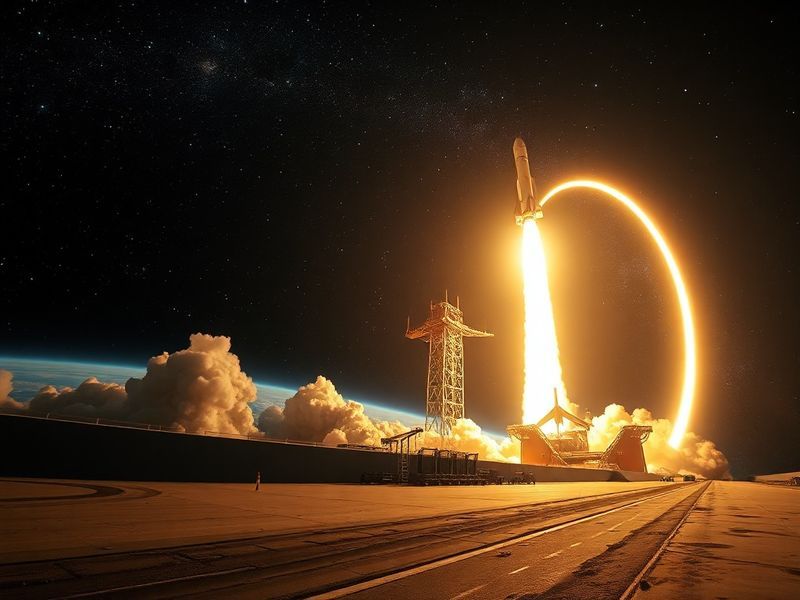
“imageDescription”: “A panoramic view of a modern rocket launch at night, with the rocket ascending into a star-filled sky, reflecting off a nearby body of water. The scene includes silhouettes of control towers and spectators, capturing both the technological achievement and the awe-inspiring moment of liftoff.”
}
—END METADATA—
“`