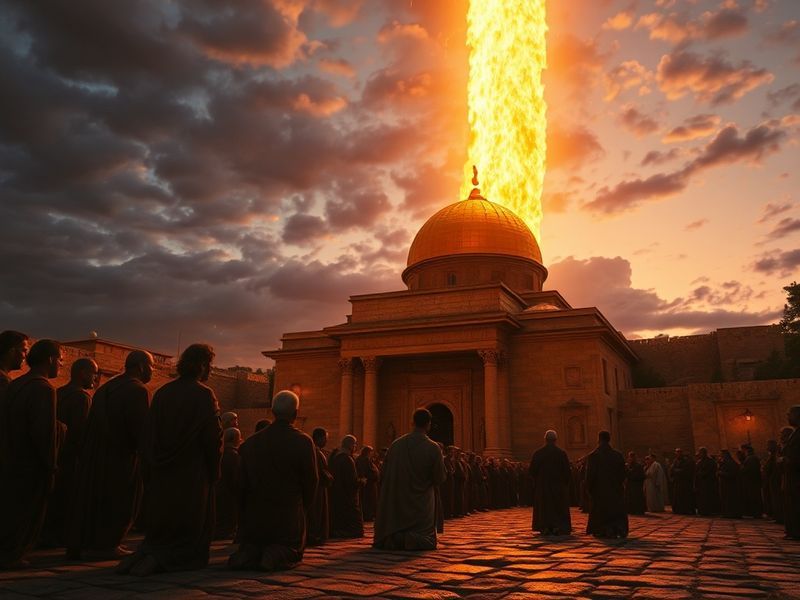
Solomon’s Dedication and God’s Response
In 2 Chronicles 7:11–22, the narrative shifts from the grandeur of Solomon’s temple dedication to a pivotal moment of divine response. After Solomon completed the temple and his palace, the Lord appeared to him at night, affirming the dedication and outlining the conditions for His presence and blessing. This passage is more than a historical account; it reflects a timeless dialogue between the divine and the human, offering lessons that resonate across cultures and centuries.
The text begins with Solomon’s completion of the temple and his palace, a feat of architectural and spiritual significance. The grandeur of these structures symbolized not only Solomon’s wealth and wisdom but also the centrality of worship in ancient Israelite society. The temple, in particular, was the focal point of religious life, where heaven and earth intersected. Its completion marked a new chapter for the Israelites, one where God’s presence was tangibly manifest in their midst.
God’s Affirmation and the Promise of Presence
The Lord’s appearance to Solomon at night underscores the intimacy of their relationship. Unlike the thunderous declarations at Sinai, this moment is quiet and personal, emphasizing that God’s promises are not distant or abstract but immediate and relational. The affirmation in verse 12—“I have chosen this place for myself as a house of sacrifice”—highlights God’s active role in selecting and sanctifying a physical space for worship.
This divine affirmation was not just for the Israelites of Solomon’s time. It reflects a universal principle: God meets people where they are, in the places they dedicate to Him. Whether in ancient Jerusalem or modern megachurches, the idea that God inhabits the praises of His people (Psalm 22:3) remains a cornerstone of faith across many traditions. The temple’s dedication serves as a model for how sacred spaces are meant to function—as beacons of God’s presence and vehicles for communal worship.
The Conditions for Blessing and Consequences
Verses 13–14 present a conditional promise that has echoed through generations. God outlines what He will do if His people humble themselves, pray, seek His face, and turn from their wicked ways. The promise is sweeping: He will hear from heaven, forgive sins, and heal the land. This passage has often been cited in times of national crisis, from plagues to wars, as a call to repentance and renewal.
The conditions are clear and actionable:
- Humility: Acknowledging dependence on God rather than self-reliance.
- Prayer: Seeking God’s intervention and guidance.
- Repentance: Turning away from sin and aligning with God’s will.
This framework transcends the Old Testament context. In many cultures, rituals of humility and repentance are embedded in spiritual practices. For example, in Hinduism, the festival of Paryushana emphasizes forgiveness and self-purification. Similarly, in Islam, the act of istighfar (seeking forgiveness) is a daily practice. The universality of these themes underscores a shared human need for reconciliation with the divine.
The consequences of disobedience are equally stark. Verses 19–22 warn that if the people reject God’s law and serve other gods, the temple—once a symbol of His glory—will become a heap of ruins. This serves as a cautionary tale about the fragility of human devotion and the cost of idolatry. The destruction of the temple by the Babylonians centuries later would fulfill this prophecy, illustrating the sobering reality that spiritual fidelity is not a one-time event but an ongoing choice.
A Global Lens: Temples, Tabernacles, and Sacred Spaces
The concept of a divinely ordained sacred space is not unique to ancient Israel. Across the globe, cultures have built structures to honor the divine, each reflecting their unique theological and cultural frameworks:
- Mecca (Saudi Arabia): The Kaaba, a cube-shaped building, is the holiest site in Islam and the direction toward which Muslims pray. Its origins trace back to the prophet Ibrahim (Abraham), who dedicated it to the worship of one God.
- The Parthenon (Greece): Originally a temple to Athena, it embodied the city-state’s civic and religious identity. Its architectural precision reflected the Greeks’ pursuit of divine harmony.
- Angkor Wat (Cambodia): Built as a Hindu temple dedicated to Vishnu, it later became a Buddhist site. Its vast complex symbolizes the cosmic order and the interplay between the divine and earthly realms.
- St. Peter’s Basilica (Vatican City): As the centerpiece of Catholicism, it represents the global reach of the Church and the continuity of Christian worship from ancient Rome to the modern era.
These examples illustrate how sacred spaces serve as more than architectural marvels. They are living symbols of a people’s relationship with the divine, their cultural identity, and their aspirations. The temple in Jerusalem, with its rich symbolism and history, stands as a prototype for understanding how such spaces function in the collective consciousness of believers.
Modern Applications: From Ancient Promises to Contemporary Faith
The principles in 2 Chronicles 7:11–22 remain relevant today, particularly in how communities engage with faith and spirituality. The call to humility and repentance is a countercultural message in an era dominated by individualism and materialism. Yet, it offers a pathway to healing—whether for nations, communities, or individuals—by emphasizing dependence on something greater than oneself.
In times of global crisis, such as pandemics or natural disasters, people often turn to sacred spaces or spiritual practices for solace and guidance. The COVID-19 pandemic, for instance, saw a resurgence in virtual worship and prayer groups, demonstrating how faith communities adapt while holding onto core principles. The temple’s dedication reminds us that sacred spaces—whether physical or digital—are not just about grandeur but about creating environments where people can encounter the divine.
Moreover, the passage challenges modern believers to reflect on their own “temples”—the spaces and practices they dedicate to God. For some, this might be a church or mosque; for others, it could be nature, art, or acts of service. The key is intentionality: creating spaces where God’s presence is invited and honored.
Conclusion: A Legacy of Faith and Responsibility
2 Chronicles 7:11–22 is more than a historical footnote; it is a theological and cultural touchstone that bridges ancient and modern expressions of faith. The temple’s dedication and God’s response underscore the reciprocity inherent in spiritual life: God initiates, but humanity must respond with devotion and obedience. This dynamic has shaped religious traditions for millennia, offering a model for how people engage with the divine across cultures and eras.
The passage also serves as a reminder of the fragility of human institutions, including religious ones. The temple’s eventual destruction highlights the transient nature of earthly structures and the eternal nature of God’s promises. In a world where physical churches and mosques face decline in some regions, this passage invites reflection on what truly constitutes a “house of God”—is it the building, the community, or the heart of the believer?
Ultimately, 2 Chronicles 7:11–22 calls readers to consider their own role in sustaining a relationship with the divine. Whether through prayer, repentance, or the creation of sacred spaces, the principles outlined here remain a guide for those seeking meaning, healing, and connection in an ever-changing world.