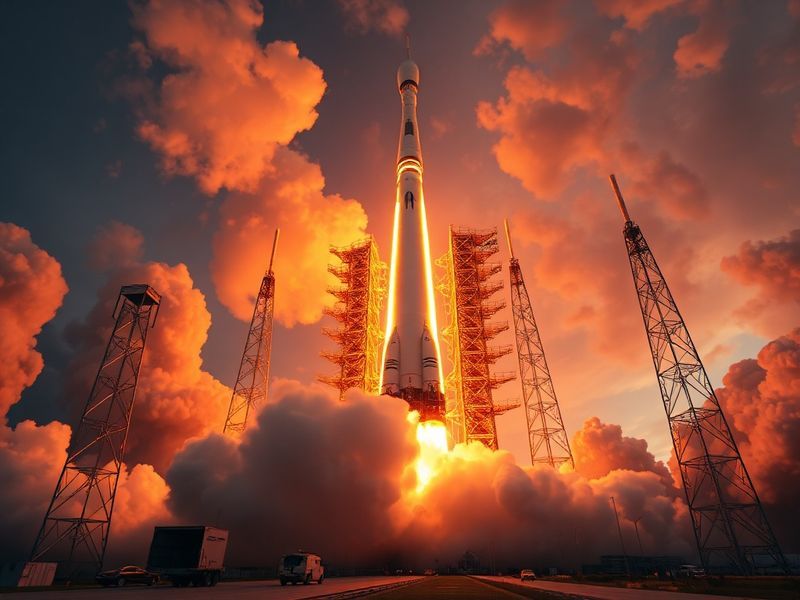
Falcon Heavy Launch: SpaceX’s Powerful Leap Toward Mars
“`html
Falcon Heavy Launch: SpaceX’s Ambitious Step Toward Mars
The Falcon Heavy, SpaceX’s most powerful rocket to date, has redefined the boundaries of space exploration since its maiden voyage in February 2018. Designed to carry large payloads to Earth orbit and beyond, this launch vehicle has demonstrated the company’s commitment to reducing the cost of space travel while pushing the limits of technological innovation. The Falcon Heavy’s success is not just a milestone for SpaceX but a pivotal moment for the entire aerospace industry, proving that reusable rockets can deliver both heavy payloads and cost efficiency.
At the heart of the Falcon Heavy’s design is its ability to carry up to 64 metric tons to low Earth orbit—more than double the capacity of its closest competitor. This capability opens new possibilities for scientific missions, satellite deployments, and even crewed missions to the Moon and Mars. The rocket’s three cores, each powered by nine Merlin engines, work in unison to generate over 5 million pounds of thrust at liftoff, making it one of the most powerful operational rockets in the world.
The Evolution of the Falcon Heavy
SpaceX’s journey to the Falcon Heavy began with the Falcon 1, the company’s first privately developed liquid-fueled rocket. Launched in 2008 after multiple setbacks, the Falcon 1 became the first privately funded rocket to reach orbit. This achievement laid the groundwork for the Falcon 9, which debuted in 2010 and introduced the concept of reusable rocket technology. The Falcon 9’s success validated SpaceX’s approach, paving the way for the development of the Falcon Heavy.
The Falcon Heavy was conceived as a way to maximize the potential of SpaceX’s existing technology. By strapping three Falcon 9 first-stage boosters together, engineers created a rocket that could handle significantly heavier payloads. The central core was reinforced to withstand the immense forces generated during launch, while the two side boosters were designed to separate and return to landing sites, much like the Falcon 9’s first stage. This reusability is a cornerstone of SpaceX’s strategy to reduce the cost of space access.
One of the most notable aspects of the Falcon Heavy’s development was its inaugural launch. On February 6, 2018, the rocket carried Elon Musk’s personal Tesla Roadster into space, complete with a mannequin dubbed “Starman” seated in the driver’s seat. The payload, which was sent on a trajectory toward Mars, served as a dramatic demonstration of the rocket’s capabilities. The launch was broadcast live, captivating audiences worldwide and showcasing the potential of commercial spaceflight.
Technical Innovations and Challenges
The Falcon Heavy’s design presented several technical challenges, particularly in managing the forces exerted on the rocket during launch and ascent. The three cores, each with nine engines, required precise synchronization to ensure stable flight. Engineers at SpaceX developed advanced algorithms to control the engines’ thrust and gimbaling, allowing the rocket to maintain stability even as the side boosters separated and the central core continued to burn.
Another critical innovation was the rocket’s payload fairing, which protects the payload during launch and is jettisoned once the rocket reaches space. The Falcon Heavy’s fairing is the largest in operation today, measuring 13.1 meters in height and 5.2 meters in diameter. Its size allows for the deployment of large satellites or even components for future space stations. SpaceX has also designed the fairing to be reusable, further reducing the cost of each mission.
Despite its successes, the Falcon Heavy has faced its share of challenges. The first launch in 2018 experienced an anomaly when the central core failed to land successfully on a drone ship, crashing into the ocean instead. SpaceX attributed the failure to a fuel shortage caused by the high reentry forces. Subsequent launches have refined the landing process, with all three cores successfully returning to Earth in later missions. These improvements highlight the iterative nature of SpaceX’s development process, where each launch provides valuable data to enhance future missions.
Payload Capabilities and Mission Profiles
The Falcon Heavy is capable of a wide range of missions, from deploying large constellations of satellites to sending payloads on interplanetary trajectories. Its payload capacity makes it ideal for launching heavy communications satellites, which are often too large for smaller rockets. Additionally, the Falcon Heavy has been considered for missions to the Moon and Mars, including NASA’s Artemis program, which aims to return humans to the lunar surface.
One of the rocket’s most ambitious missions to date was the launch of the Psyche spacecraft in October 2023. Psyche, a NASA mission to explore the metallic asteroid 16 Psyche, was the heaviest payload ever launched by the Falcon Heavy at the time. The mission demonstrated the rocket’s ability to handle complex scientific payloads, opening new avenues for exploration beyond Earth’s orbit.
For commercial customers, the Falcon Heavy offers a unique advantage: the ability to launch multiple payloads on a single mission. SpaceX has developed a rideshare program that allows smaller satellites to hitch a ride on larger missions, significantly reducing the cost of access to space. This approach has attracted interest from companies and organizations around the world, further solidifying the Falcon Heavy’s role in the commercial space industry.
The Future of Space Exploration with the Falcon Heavy
The Falcon Heavy is more than just a rocket; it represents a shift in how humanity approaches space exploration. By reducing the cost of heavy-lift launches, SpaceX has made it feasible to pursue ambitious projects that were once considered financially out of reach. This includes not only scientific missions but also the potential for human colonization of Mars, a long-term goal for Elon Musk and SpaceX.
Looking ahead, the Falcon Heavy is expected to play a key role in NASA’s Artemis program, which aims to land the first woman and the next man on the Moon by 2025. The rocket’s heavy-lift capacity will be crucial for transporting the Lunar Gateway, a small space station that will orbit the Moon and serve as a staging point for lunar missions. Additionally, the Falcon Heavy could be used to launch components for future lunar bases or even Mars missions.
SpaceX is also working on the Starship, a fully reusable super heavy-lift launch vehicle that will eventually replace the Falcon Heavy. While the Starship is still in development, it represents the next step in SpaceX’s vision for interplanetary travel. The Falcon Heavy, however, will remain a critical asset in the company’s fleet, filling the gap between the Falcon 9 and the Starship in terms of payload capacity and mission flexibility.
Environmental and Economic Impact
The Falcon Heavy’s reusable design has significant environmental and economic benefits. By recovering and refurbishing rocket stages, SpaceX has drastically reduced the amount of debris left in orbit and minimized the environmental impact of each launch. Traditional expendable rockets generate tons of debris with each flight, contributing to the growing problem of space junk. The Falcon Heavy’s ability to land its boosters back on Earth helps mitigate this issue.
Economically, the Falcon Heavy has disrupted the space launch industry by offering a cost-effective alternative to traditional heavy-lift rockets. The rocket’s price point, estimated at around $90 million per launch, is significantly lower than that of its competitors, such as the United Launch Alliance’s Delta IV Heavy, which costs over $300 million per launch. This cost advantage has made the Falcon Heavy an attractive option for governments, private companies, and research institutions alike.
In addition to its commercial success, the Falcon Heavy has inspired a new generation of space enthusiasts. The sight of the rocket’s massive boosters returning to Earth in a synchronized landing has become a symbol of innovation and progress. It has also sparked interest in STEM fields, with many young people now aspiring to careers in aerospace engineering and space science.
Conclusion: A New Era of Spaceflight
The Falcon Heavy’s launch marked a turning point in the history of space exploration. By demonstrating the feasibility of reusable heavy-lift rockets, SpaceX has opened new possibilities for scientific discovery, commercial ventures, and human exploration beyond Earth. The rocket’s success is a testament to the power of innovation and the relentless pursuit of ambitious goals.
As SpaceX continues to refine its technology and expand its capabilities, the Falcon Heavy will remain a vital part of the company’s mission to make life multiplanetary. Whether it’s launching satellites, supporting lunar missions, or paving the way for Mars colonization, the Falcon Heavy is at the forefront of humanity’s journey into the cosmos. For those who witnessed its first launch or followed its subsequent missions, the rocket stands as a symbol of what is possible when vision, determination, and ingenuity come together.
For more insights into the latest developments in space exploration, visit our Science and Technology sections. Stay tuned for updates on upcoming Falcon Heavy missions and the future of commercial spaceflight.