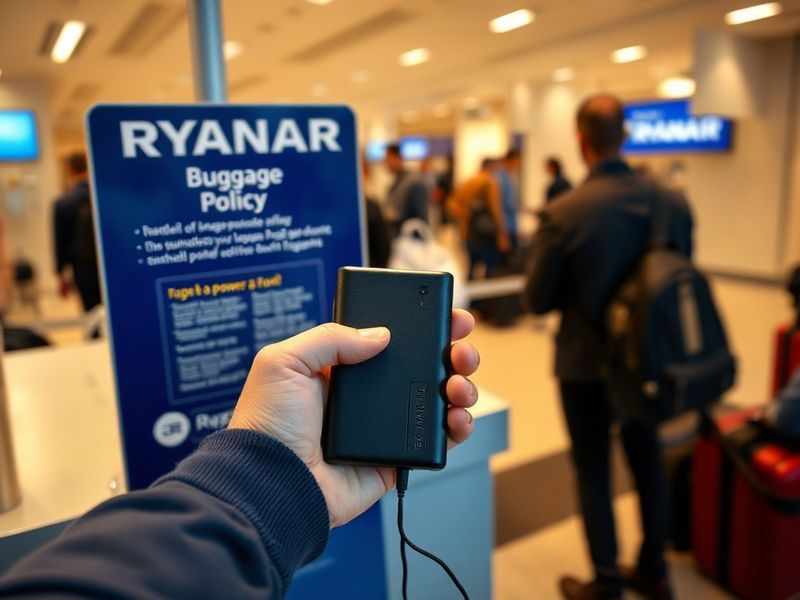
Travelers flying with Ryanair often overlook one critical detail before packing their carry-on essentials: the airline’s strict power bank restrictions. These rules aren’t just bureaucratic red tape—they’re designed to ensure safety while accommodating the modern traveler’s reliance on electronic devices. Understanding these guidelines can save passengers from last-minute bag repacking or, worse, having to surrender their portable chargers at the gate.
Ryanair’s policies align with aviation safety regulations, particularly those set by the European Union Aviation Safety Agency (EASA) and the International Air Transport Association (IATA). While the rules may seem stringent, they exist to mitigate risks associated with lithium batteries, which are known to pose fire hazards if damaged or improperly stored. For passengers accustomed to packing every convenience gadget, these restrictions require careful planning.
Understanding Ryanair’s Power Bank Capacity Limits
Ryanair permits passengers to bring power banks in their carry-on luggage only. The airline enforces a strict capacity limit: power banks must not exceed 100Wh (watt-hours) per unit. To put this into perspective, most standard power banks sold for travel fall within this range, but larger models—often marketed for extended trips or multiple device charging—can easily surpass this threshold.
The 100Wh limit isn’t arbitrary. It’s a threshold established by aviation authorities to minimize risk while still allowing travelers to stay connected. For context, here’s how power banks compare:
- Small power banks (5,000mAh to 10,000mAh): Typically under 100Wh and permitted.
- Medium power banks (15,000mAh to 20,000mAh): Often exceed 100Wh and may be confiscated.
- Large power banks (25,000mAh and above): Almost always prohibited on Ryanair flights.
Passengers carrying power banks between 100Wh and 160Wh must obtain prior approval from Ryanair’s Special Assistance Team. This involves contacting the airline in advance—often via email—with the power bank’s specifications. Approval isn’t guaranteed, and requests must be submitted at least 48 hours before departure. Requests for power banks over 160Wh are typically denied outright.
Where Power Banks Are (and Aren’t) Allowed on Ryanair
The location of your power bank in your luggage isn’t just a matter of convenience—it’s a regulatory requirement. Ryanair explicitly prohibits power banks in checked baggage due to the heightened risk of damage, compression, or exposure to extreme temperatures in the cargo hold. Lithium batteries can overheat or short-circuit if mishandled, making the cargo area an unsuitable storage location.
All power banks must be carried in the cabin, either in your hand luggage or on your person. This ensures they remain under your supervision and can be quickly accessed or removed during security checks. Passengers who mistakenly pack power banks in their checked luggage risk having them confiscated at the airport or, in some cases, their entire bag held until the battery is removed.
Security screening adds another layer of complexity. Power banks must be presented separately from other electronics during X-ray screening. This means removing them from your bag when requested by security personnel. Failure to do so can result in delays or additional inspection, particularly in European airports where security protocols are strictly enforced.
Common Misconceptions and How to Avoid Them
One of the most pervasive misconceptions among travelers is that all power banks are treated equally. In reality, capacity isn’t the only factor—brand, quality, and even the presence of counterfeit labels can trigger scrutiny. Counterfeit power banks, often sold at bargain prices online or in street markets, frequently lack proper safety certifications and may exceed their labeled capacity. These pose a particular risk and are more likely to be confiscated, even if they appear to meet the 100Wh limit.
Another frequent mistake is assuming that airline staff will always recognize a power bank. Some passengers pack their chargers in opaque cases or among other cables, making it difficult for security to identify them during screening. To avoid confusion, store power banks in clear, accessible pouches or cases labeled with their watt-hour rating. This not only speeds up the screening process but also demonstrates compliance with Ryanair’s policies.
Passengers traveling with multiple devices often try to circumvent the rules by carrying several small power banks instead of one large one. While this strategy technically complies with the 100Wh limit per unit, it can still draw unwanted attention. Security personnel may question why a traveler needs multiple chargers, leading to additional checks. If you must bring more than one power bank, ensure each is clearly labeled and within the capacity limit.
What Happens If You Violate the Rules?
Ryanair’s enforcement of power bank restrictions is consistent, though the consequences vary depending on the severity of the violation. For passengers carrying power banks that exceed 100Wh without prior approval, the most likely outcome is confiscation at the gate or during boarding. In some cases, passengers may be allowed to repack their bags and remove the offending item, but this often results in missed flights or rushed decisions.
The airline’s terms and conditions explicitly state that passengers are responsible for ensuring their carry-on items comply with safety regulations. Ignorance isn’t considered a valid defense, and staff are not obligated to allow exceptions. Passengers who refuse to surrender non-compliant power banks may be denied boarding, as the airline prioritizes safety and regulatory compliance above all else.
For those who contact Ryanair in advance and receive approval for a power bank between 100Wh and 160Wh, documentation is key. Presenting the approval email at security or boarding can prevent delays, but it’s still advisable to allow extra time for verification. Without proper documentation, even an approved power bank may be confiscated if the airline’s staff are unaware of the prior approval.
Practical Tips for Travelers
Navigating Ryanair’s power bank restrictions doesn’t have to be a headache. With a few practical strategies, travelers can ensure they stay powered up without running afoul of the rules. Start by checking the watt-hour rating of your power bank, which is typically printed on the device or its packaging. If the rating isn’t visible, use the formula: (mAh × voltage) ÷ 1,000 = Wh. For example, a 20,000mAh power bank with a 3.7V output equals 74Wh, which is within the limit.
If your power bank is close to the limit or you’re unsure, consider purchasing a new one that explicitly states its compliance with airline regulations. Many reputable brands, such as Anker, Xiaomi, and Zendure, offer power banks that meet the 100Wh requirement and include safety certifications. These are widely available online and in electronics stores, often at reasonable prices.
For international travelers connecting through multiple airports, it’s worth noting that Ryanair’s restrictions are stricter than some other airlines. For instance, Emirates allows power banks up to 160Wh in carry-on luggage, while American Airlines permits up to 100Wh. If your itinerary includes multiple carriers, research each airline’s policy to avoid confusion. A quick call to the airline or a visit to their website can save you from having to repack mid-journey.
Finally, always pack a backup plan. If your power bank is confiscated or you realize it exceeds the limit at the airport, consider whether you truly need it. Many airports and lounges offer charging stations, and some hotels provide complimentary charging services. Alternatively, purchasing a compliant power bank at your destination may be more cost-effective than risking a delay.
For frequent flyers, investing in a high-quality, compact power bank that meets Ryanair’s requirements is a smart long-term solution. Not only will it prevent last-minute stress, but it will also ensure you’re always prepared for the inevitable low battery warning. With the right preparation, power banks can remain a reliable travel companion—without turning your journey into a logistical challenge.
For more information on Ryanair’s baggage policies, visit our Budget Airlines Guide. If you’re looking for alternatives to power banks, check out our recommendations for travel accessories that keep your devices charged without the hassle.
Understanding and adhering to Ryanair’s power bank restrictions isn’t just about avoiding confiscation—it’s about ensuring a smooth, stress-free journey. By planning ahead and staying informed, travelers can keep their devices powered and their trips on track.