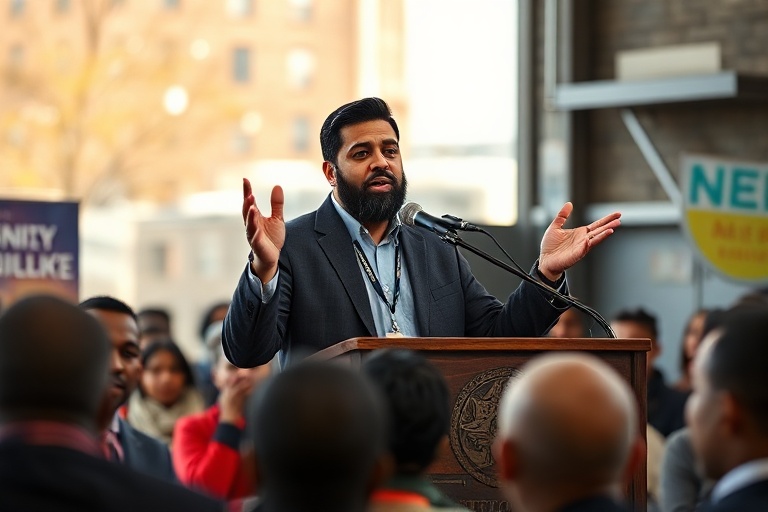
Abdul El-Sayed: How One Leader is Redefining Progressive Politics
Abdul El-Sayed: A Rising Voice in Progressive Politics
Abdul El-Sayed’s career reflects a blend of academic rigor, grassroots activism, and a commitment to redefining American politics. As a physician, policy expert, and former gubernatorial candidate, he has emerged as a prominent figure among progressive leaders seeking to bridge healthcare reform, economic justice, and social equity. His work challenges conventional political narratives, particularly in Michigan, where he has left a lasting impact on public health and state governance.
The Early Years: Education and Advocacy
Born in 1984 to Egyptian immigrant parents, El-Sayed grew up in East Lansing, Michigan. His upbringing in a working-class household shaped his perspective on systemic inequities, fueling his early interest in social justice. He attended the University of Michigan, where he earned degrees in political science and public health, before completing a Rhodes Scholarship at Oxford University. His academic journey laid the foundation for his later work in public health policy and political leadership.
During his time at the University of Michigan, El-Sayed became involved in advocacy efforts focused on healthcare access and immigrant rights. His experiences working with underserved communities in Detroit and Flint reinforced his belief in the need for policy-driven solutions to systemic problems. These formative years were critical in shaping his approach to governance—a blend of data-driven decision-making and community-centered activism.
Public Health Leadership: Fighting for Michigan
El-Sayed’s most notable role prior to his political campaigns was as the executive director of the Detroit Health Department from 2015 to 2017. In this position, he spearheaded initiatives to combat the opioid epidemic, improve maternal health outcomes, and address lead contamination in the city’s water supply. His leadership during the Flint water crisis earned him widespread recognition for his efforts to prioritize public health despite bureaucratic hurdles.
His approach to public health was rooted in transparency and accountability. El-Sayed pushed for data transparency in city health reports and worked to rebuild trust between Detroit residents and local government. These efforts were not without controversy, particularly when his policies clashed with state officials over funding and resource allocation. Yet, his willingness to challenge the status quo set him apart as a leader unafraid to confront entrenched interests.
The 2018 Gubernatorial Campaign: A Progressive Platform
In 2018, El-Sayed ran for governor of Michigan as a Democratic candidate, positioning himself as a progressive alternative to establishment politics. His campaign emphasized a “Medicare for All” healthcare plan, a $15 minimum wage, and investments in public education. While he ultimately lost the primary to Gretchen Whitmer, his campaign galvanized young voters and energized Michigan’s progressive base.
The race was marked by high-profile endorsements from figures like Bernie Sanders and Alexandria Ocasio-Cortez, who saw El-Sayed as a standard-bearer for the party’s left flank. However, his campaign also faced criticism for its ambitious policy proposals and the challenge of competing against a well-funded establishment candidate. Despite the loss, El-Sayed’s run demonstrated the growing influence of progressive ideas in Michigan politics.
El-Sayed’s gubernatorial bid also highlighted the tensions within the Democratic Party. While his platform resonated with grassroots activists, some moderates questioned the feasibility of his proposals in a swing state like Michigan. The campaign’s internal dynamics, including staffing challenges and strategic disagreements, further complicated his path to victory. Yet, the race cemented his reputation as a thought leader in progressive circles.
Post-Campaign Work: Media, Policy, and Thought Leadership
Since his 2018 campaign, El-Sayed has remained a vocal advocate for progressive policies through media appearances, writing, and public speaking. He hosts the podcast America Dissected, where he examines healthcare policy and its societal impacts. The show has become a platform for dissecting complex issues like pharmaceutical pricing, rural healthcare access, and the intersection of race and health outcomes.
His writing has appeared in outlets like The Atlantic and The Guardian, where he critiques both Republican and Democratic approaches to healthcare. El-Sayed has also been a frequent commentator on cable news networks, offering insights on topics ranging from pandemic response to economic inequality. His ability to distill policy into accessible narratives has made him a sought-after voice in national discussions.
In addition to his media work, El-Sayed has consulted on healthcare initiatives and served as a fellow at institutions like the Roosevelt Institute. His focus remains on translating policy research into actionable strategies for communities. Whether through his podcast or op-eds, he continues to challenge conventional wisdom on healthcare reform and economic justice.
The Future of Progressive Politics in Michigan
El-Sayed’s trajectory suggests he will remain a key figure in Michigan’s political landscape. While he has not ruled out future runs for office, his current work prioritizes long-term influence over electoral cycles. His emphasis on healthcare reform and economic equity aligns with the priorities of younger voters, who are increasingly driving the Democratic Party’s agenda.
Looking ahead, Michigan’s progressive movement faces both opportunities and challenges. The state’s shift toward renewable energy and worker protections reflects some of El-Sayed’s core priorities. Yet, the political climate remains polarized, with progressive policies often clashing with conservative resistance at the state level. El-Sayed’s role may evolve into mentoring the next generation of activists and policymakers who share his vision.
For those interested in the intersection of healthcare policy and political activism, El-Sayed’s career offers valuable lessons. His ability to merge academic expertise with grassroots organizing demonstrates the potential for policy-driven leadership to create tangible change. Whether through his public health initiatives or his media presence, he continues to push for a more equitable and just society.
To explore more about progressive political movements and their impact on public policy, visit our Politics category page. For deeper analysis on healthcare reform efforts across the country, check out our Health section.
Abdul El-Sayed’s journey underscores the power of combining expertise with activism. In an era where political divides often overshadow substantive debate, his work stands out for its clarity and commitment to addressing root causes of inequality. As Michigan—and the nation—grapples with healthcare disparities and economic challenges, leaders like El-Sayed remind us that policy can be both a tool for change and a mirror reflecting our values.
His story is far from over. Whether through elected office, media, or advocacy, El-Sayed’s influence will likely continue shaping the conversation around what it means to govern with justice at the forefront. For those watching the evolution of progressive politics, his career serves as both an inspiration and a case study in the challenges of turning ideals into reality.