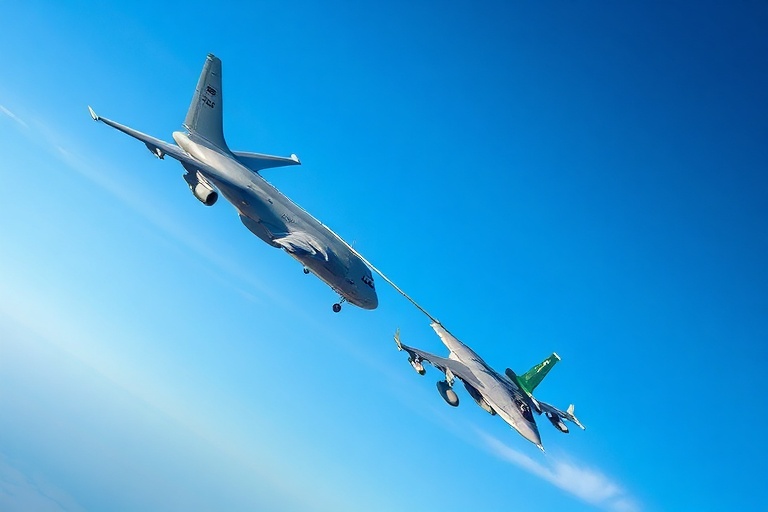
Boeing KC-135 Stratotanker: 60+ Years of Aerial Refueling Dominance
The Boeing KC-135 Stratotanker has silently shaped modern aerial warfare for over six decades. Designed during the Cold War era, this aerial refueling tanker remains the backbone of the U.S. Air Force’s air mobility fleet. While not as flashy as stealth bombers or hypersonic missiles, the KC-135’s operational versatility continues to make it indispensable in military and humanitarian missions worldwide.
With more than 800 aircraft produced since its 1957 debut, the Stratotanker has outlasted multiple generations of combat aircraft. Its longevity is unmatched in military aviation history, proving that sometimes the simplest designs endure the longest. The KC-135’s story is one of quiet competence rather than headline-grabbing innovation.
A Legacy of Aerial Refueling Innovation
The KC-135 traces its origins to a 1954 U.S. Air Force requirement for an aerial tanker to extend the range of strategic bombers like the B-52 Stratofortress. Boeing won the contract by adapting its commercial 707 airliner into a military platform, creating a jet-powered successor to the piston-engine KC-97 Stratofreighter.
The aircraft entered service in 1957 and immediately revolutionized air operations. Unlike its propeller-driven predecessors, the KC-135 could refuel jet aircraft at their operational speeds and altitudes. This capability transformed global power projection, allowing bombers to reach targets anywhere without relying on forward bases.
The Stratotanker introduced several key innovations:
- Flying Boom System: A rigid metal tube extended from the tanker to mate with receiving aircraft, enabling faster fuel transfer than hose-and-drogue systems
- Jet Engine Power: Four Pratt & Whitney J57 turbojets provided the power needed to keep pace with jet fighters and bombers
- Modular Fuel Tanks: Internal compartments could be reconfigured for different mission requirements
- High-Altitude Operations: The KC-135 typically operated between 30,000 and 40,000 feet, matching bomber and fighter cruise altitudes
By the time production ended in 1965, Boeing had delivered 732 KC-135As to the Air Force. The type’s success led to numerous variants, including the KC-135E, KC-135Q, and KC-135R, each optimized for specific mission profiles.
From Cold War Deterrence to Modern Combat
The Stratotanker’s primary Cold War mission involved keeping America’s nuclear bomber fleet airborne on continuous alert. These “Looking Glass” missions maintained a survivable command post in the event of a Soviet first strike, with KC-135s providing the fuel needed for extended airborne operations.
As the nature of warfare evolved, so did the KC-135’s role. During the Vietnam War, Stratotankers flew more than 194,000 sorties, delivering 853 million gallons of fuel to combat aircraft. These operations demonstrated the tanker’s critical importance in sustained air campaigns.
Operation Desert Storm in 1991 saw KC-135s fly 18,700 sorties, delivering 278 million pounds of fuel to coalition aircraft. The tankers supported every major combat mission, from fighter escorts to strategic airlift coordination. Their presence ensured American airpower could operate deep into enemy territory without forward refueling bases.
In more recent conflicts, the KC-135 has supported operations in Afghanistan, Iraq, and Syria. The aircraft’s ability to operate from forward bases while extending the range of fighters and bombers has remained crucial in counterterrorism operations. Even as stealth aircraft like the F-22 and F-35 entered service, the Stratotanker’s role in enabling their operations became more important than ever.
Technical Evolution and Modernization Efforts
Maintaining a 60-year-old aircraft requires constant innovation. The Air Force has invested billions in keeping the KC-135 fleet viable through mid-century. The most significant upgrade program, the KC-135R/T re-engining effort, replaced the original J57 turbojets with more efficient CFM56 engines.
These new engines provide several advantages:
- 30% Fuel Savings: The CFM56 consumes significantly less fuel than the original J57, extending the tanker’s range and endurance
- Increased Payload: The more efficient engines allow for greater fuel offload capacity
- Lower Operating Costs: Reduced fuel consumption and maintenance requirements decrease lifecycle costs
- Improved Reliability: Modern turbine engines require less maintenance than their 1950s counterparts
The Air Force also upgraded the aircraft’s avionics systems with modern glass cockpits, GPS navigation, and digital communication systems. These improvements maintain compatibility with modern fighter aircraft while reducing crew workload.
Despite these upgrades, the Stratotanker faces challenges. The fleet is aging, with some aircraft approaching 70 years of service. The Air Force has explored potential replacements, including the KC-46 Pegasus, but the KC-135’s unique capabilities and lower operating costs have delayed its complete retirement.
Beyond Military Operations: Humanitarian and Scientific Missions
The KC-135’s versatility extends beyond combat operations. The aircraft has played crucial roles in humanitarian assistance and disaster response missions around the globe.
During the 2010 Haiti earthquake response, KC-135s delivered critical supplies and medical personnel to Port-au-Prince. The tankers’ ability to operate from austere airfields and their long-range capabilities made them ideal for this mission.
The Stratotanker has also supported scientific research. NASA modified several KC-135s (dubbed “Vomit Comets”) to provide reduced-gravity environments for astronaut training and microgravity research. These aircraft flew parabolic arcs to create brief periods of weightlessness, enabling crucial experiments.
In environmental monitoring missions, the KC-135 has carried specialized equipment to track atmospheric conditions and pollution levels. Its ability to loiter for extended periods at high altitudes makes it ideal for scientific observation missions.
The Future of the Stratotanker
As the U.S. Air Force modernizes its fleet, the KC-135’s future remains secure for the near term. The service plans to keep the Stratotanker operational through at least 2040, with ongoing service life extension programs maintaining aircraft availability.
The Air Force is exploring potential upgrades to further extend the aircraft’s capabilities. These may include:
- Advanced sensor suites for improved situational awareness
- Enhanced communication systems for better coordination with fifth-generation fighters
- Autonomous refueling capabilities for reduced crew requirements
- Hybrid electric propulsion concepts for future upgrades
While newer tankers like the KC-46 offer advanced features, the KC-135’s proven reliability and massive fleet size provide a cost-effective solution for many mission profiles. The Stratotanker’s ability to operate from short, unimproved runways gives it unique advantages over larger, more sophisticated tankers.
The KC-135 Stratotanker represents a rare success story in military aviation. Born during the Cold War, it has adapted to every conflict and crisis since. Its longevity proves that sometimes the most effective solutions aren’t the newest or most expensive, but the ones that simply work.
As military strategists plan for future conflicts, the Stratotanker’s role remains clear. In an era of hypersonic weapons and artificial intelligence, the humble tanker continues to provide the essential service that makes global power projection possible. The Boeing KC-135 doesn’t just extend aircraft ranges—it extends the reach of American military power across the globe.
For more on military aviation technology, visit our Technology section.