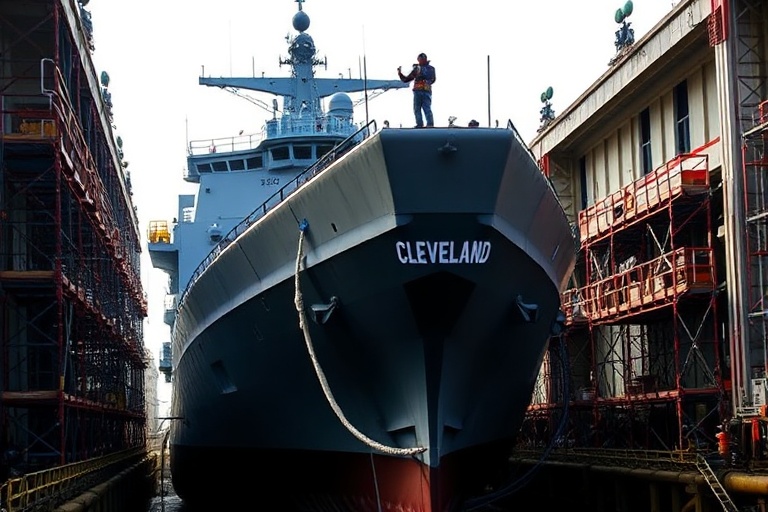
USS Cleveland: A Legacy of Naval Innovation and Service
The USS Cleveland, a name synonymous with resilience and adaptability, has played a pivotal role in the United States Navy’s history. Commissioned during the critical years of World War II, this Cleveland-class light cruiser served as a cornerstone of naval operations, contributing to key campaigns in the Pacific Theater. Beyond its wartime service, the USS Cleveland’s legacy extends to its post-war roles, including operations during the Cold War and its eventual transition into museum ship status. This article explores the ship’s origins, its operational history, and its enduring impact on naval warfare and American maritime heritage.
A Brief History and Design
The USS Cleveland (CL-55) was launched on November 1, 1941, just weeks before the attack on Pearl Harbor. Designed as part of the Cleveland-class cruisers, it was built to balance speed, firepower, and armor—a necessity for the evolving demands of modern naval warfare. The ship measured 610 feet in length and displaced 10,000 tons, making it a formidable presence on the high seas. Its armament included a primary battery of 15 five-inch guns, complemented by a robust secondary battery of anti-aircraft weapons, which proved crucial in defending against aerial threats.
One of the most distinctive features of the Cleveland-class was its compact and efficient design, which allowed for improved maneuverability without sacrificing firepower. The USS Cleveland’s hull was reinforced to withstand the rigors of Pacific combat, where ships often faced kamikaze attacks and intense artillery duels. Its radar and communication systems were state-of-the-art for the era, providing the crew with a tactical advantage in coordinating operations with other fleet units. This combination of innovation and practicality set the stage for the USS Cleveland’s distinguished service.
Operational Highlights During World War II
The USS Cleveland entered service in June 1942, just months after the attack on Pearl Harbor. Its first major engagement came during the Guadalcanal Campaign, where it provided critical fire support to Marine and Army forces ashore. The ship’s guns pounded Japanese positions, disrupting enemy supply lines and contributing to the Allies’ foothold in the Solomon Islands. The USS Cleveland also played a role in the Battle of Empress Augusta Bay, where it helped repel a Japanese naval force attempting to reinforce their troops on Bougainville.
As the war progressed, the USS Cleveland participated in numerous island-hopping campaigns across the Pacific, including operations in the Marshall Islands, the Marianas, and the Philippines. Its anti-aircraft capabilities were put to the test during the Battle of the Philippine Sea, often referred to as the “Great Marianas Turkey Shoot,” where U.S. forces decimated Japanese air power. The ship’s crew earned a reputation for precision and reliability, earning the ship multiple battle stars and commendations for its contributions to the war effort.
By the war’s end, the USS Cleveland had not only survived the harsh conditions of the Pacific but had also established itself as a reliable workhorse of the fleet. Its service record included supporting amphibious landings, conducting shore bombardments, and providing escort for aircraft carriers. The ship’s crew of over 1,200 sailors demonstrated remarkable adaptability, transitioning from one mission to the next with professionalism and resolve.
Post-War Service and Transition to Museum Ship
After World War II, the USS Cleveland’s service continued during the Cold War era. The ship was modernized in the late 1950s to serve as a guided missile cruiser, reflecting the Navy’s shift toward technological advancement. Renamed USS Cleveland (CL-55) to CG-55 in 1975, it operated as part of the Pacific Fleet, participating in exercises and patrols that underscored America’s naval dominance. Its later years included roles in training exercises and as a testbed for new radar and missile systems, cementing its place in the evolution of naval warfare.
Decommissioned in 1979, the USS Cleveland faced an uncertain future. However, a dedicated effort by veterans, historians, and preservationists ensured its legacy would endure. In 1986, the ship was donated to the Inland Seas Maritime Museum in Vermilion, Ohio, where it remains a floating museum. Today, visitors can tour the USS Cleveland to gain insight into life aboard a World War II cruiser, exploring its gun turrets, crew quarters, and operational spaces. The ship serves as a tangible link to the past, offering a firsthand look at the challenges and triumphs of naval service.
Notable Crew Members and Their Stories
The USS Cleveland’s legacy is also shaped by the individuals who served aboard her. Among them was Rear Admiral Richard W. Bates, who commanded the ship during critical operations in the Pacific. Bates later rose to prominence as a naval strategist, contributing to the development of post-war naval doctrine. Another notable figure was Chief Petty Officer John F. Kennedy, who served aboard the USS Cleveland in the early 1940s before his rise to political prominence. These stories highlight the diverse backgrounds of the crew and their collective impact on the ship’s history.
For many sailors, serving aboard the USS Cleveland was a defining experience. Life at sea was grueling, with long hours, cramped conditions, and the ever-present threat of combat. Yet, the camaraderie and shared purpose forged bonds that lasted a lifetime. Veterans often recount tales of resilience, humor, and the unique culture that defined their time on the ship. These personal narratives add depth to the USS Cleveland’s history, illustrating the human dimension of naval service.
Why the USS Cleveland Matters Today
The USS Cleveland stands as a testament to the ingenuity and determination of the U.S. Navy during some of its most challenging periods. Its service during World War II and the Cold War reflects the broader narrative of American military history, where innovation and adaptability were key to success. Today, the ship serves as an educational resource, offering insights into naval technology, tactics, and the daily lives of sailors. For historians and enthusiasts alike, the USS Cleveland provides a tangible connection to the past, bridging the gap between generations.
Preserving the USS Cleveland is not just about honoring a single ship; it’s about safeguarding a piece of history for future generations. Museums and preservation efforts ensure that the stories of the USS Cleveland and its crew are not forgotten. These efforts also highlight the importance of maintaining historical artifacts, which serve as reminders of the sacrifices and achievements that shaped the modern world.
Visiting the USS Cleveland
For those interested in exploring the USS Cleveland, the museum ship in Vermilion, Ohio, offers a comprehensive tour experience. Visitors can walk the decks, examine the ship’s armament, and even peer into the engine rooms that powered her through countless miles of open ocean. Special events, such as veterans’ reunions and educational programs, provide additional opportunities to engage with the ship’s history. The USS Cleveland is more than just a relic; it’s a living museum that invites curiosity and reflection.
Planning a visit is straightforward, with the museum offering guided tours and access to archival materials. Whether you’re a history buff, a naval enthusiast, or simply looking for a unique experience, the USS Cleveland promises an unforgettable journey into the past. Its preservation ensures that the legacy of the men and women who served aboard her will continue to inspire and educate.
Conclusion
The USS Cleveland’s story is one of service, innovation, and resilience. From its commissioning in the shadow of World War II to its modern-day role as a museum ship, the Cleveland-class cruiser has left an indelible mark on naval history. Its contributions to the war effort, its adaptation to the challenges of the Cold War, and its enduring legacy as a historical artifact all underscore its significance. The USS Cleveland is not just a ship; it’s a symbol of the enduring spirit of the U.S. Navy and the countless individuals who have served aboard her.
As we reflect on the USS Cleveland’s history, we are reminded of the importance of preserving our maritime heritage. The ship’s continued existence as a museum ensures that future generations can learn from its past, drawing lessons of courage, ingenuity, and service. The USS Cleveland stands as a proud reminder of America’s naval prowess and the legacy of those who sailed her.