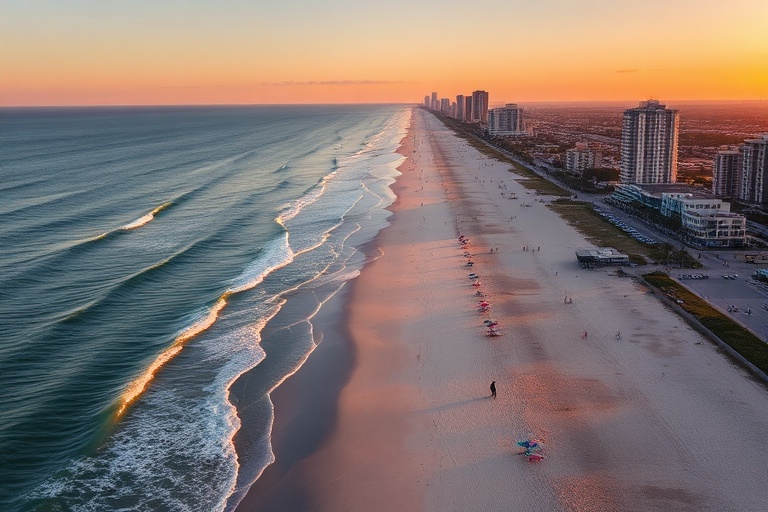
Stretching along Florida’s Atlantic coast, Daytona Beach is more than a sun-soaked vacation spot. It’s a living museum of speed, a stage for music legends, and a crossroads where cultures blend against a backdrop of saltwater and sand. From the roar of engines at the Daytona International Speedway to the silent twilight of marine sanctuaries, this city pulses with energy that transcends its coastal borders.
What began as a quiet winter retreat for wealthy northerners in the late 1800s transformed into a global icon through two defining forces: motorsports and music. Today, Daytona Beach stands as a testament to how a single destination can shape identity, tourism, and cultural expression far beyond its shores.
The Birth of a Speed Capital
Long before it hosted NASCAR races, Daytona Beach was already a proving ground for velocity. In the early 20th century, the hard-packed sand of its wide beaches became the world’s fastest natural raceway. Drivers from Europe and America flocked here to set land-speed records, including Alexander Winton in 1903 and Sir Malcolm Campbell in the 1930s, who pushed limits with machines like the Bluebird.
By 1936, the sport had outgrown the beach. The construction of the Daytona Beach Road Course marked a turning point, blending public roads with controlled speed. Yet it wasn’t until 1959, with the opening of the Daytona International Speedway, that the city cemented its place in racing history. The first Daytona 500 drew 41,000 spectators—a modest crowd by today’s standards, but one that ignited a tradition still celebrated worldwide.
Today, the Speedway is a global brand. Its tri-oval shape and steep banking are instantly recognizable, not just in the Sports world, but in pop culture, fashion, and even video games. The roar of 40 cars on Speedweeks each February is broadcast to over 200 countries, making Daytona Beach a pilgrimage site for motorsports fans from Tokyo to Toronto.
A Cultural Crossroads on the Sand
Daytona Beach’s identity isn’t built on speed alone. Its boardwalk, stretching from the pier to the Speedway, has long been a stage for music, rebellion, and youth culture. In the 1950s and 60s, the beach became a magnet for rock ‘n’ roll pioneers. DJs like Zenas “Daddy-O” Sears broadcast live from the beach during spring break, turning Daytona into a launchpad for artists like Elvis Presley and Jerry Lee Lewis.
By the 1980s, spring break culture had exploded. The city hosted over 300,000 students annually, transforming its shoreline into a global party zone. While critics decried the excess, defenders pointed to the economic boom and the cultural exchange it fostered. College students from Brazil, Germany, and Japan mingled on the sand, exchanging slang, music, and fashion—creating a microcosm of global youth identity.
Today, the city balances preservation with evolution. The Boardwalk still hums with live music and arcades, while events like the Daytona Beach Bike Week draw over half a million bikers from around the world. It’s a place where leather-clad riders and families with children share the same stretch of sand, each finding their own rhythm in the sun.
Beyond the Beach: Ecology and Resilience
Daytona Beach’s story isn’t just one of engines and festivals. It’s also a narrative of survival. The city faces constant pressure from hurricanes, coastal erosion, and rising sea levels. Yet it has become a laboratory for resilience. The Marine Science Center, for instance, leads initiatives in sea turtle conservation and coral reef restoration, turning environmental challenges into global lessons.
The Halifax River and nearby estuaries support over 300 species of birds, fish, and mammals. The nearby Education programs at Bethune-Cookman University and Embry-Riddle Aeronautical University integrate environmental science with community engagement, training the next generation of coastal stewards.
In many ways, Daytona Beach mirrors the world’s coastal cities—caught between progress and preservation. Yet its approach is unique. Rather than retreating from the water, it adapts. Elevated homes, dune restoration, and eco-tourism are becoming as much a part of the skyline as the Speedway’s grandstands.
The Global Appeal of a Local Icon
Daytona Beach’s influence radiates far beyond Florida. In Japan, miniature replicas of the Speedway are built in model train parks. In Europe, racing simulators use Daytona’s track data to train digital drivers. Even in fashion, the city’s aesthetic—striped shirts, nautical colors, and racing stripes—has seeped into global streetwear collections.
It’s a place where blue-collar mechanics and Grammy-winning musicians have rubbed shoulders. Where a 19-year-old college student from Ohio might share a wave with a retired engineer from Sweden. Where a single weekend can feature a bass fishing tournament, a classic car show, and a reggae concert—all within a mile of each other.
This diversity isn’t accidental. It’s engineered into the city’s DNA. Daytona Beach doesn’t just welcome visitors; it invites them to participate. Whether you’re timing a lap at the track, learning to surf at dawn, or dancing at a beachside festival, you’re not just a tourist. You’re part of a narrative that’s still being written.
A Timeline of Transformation
- 1870s: Wealthy northerners establish winter retreats.
- 1903: Alexander Winton sets a land-speed record on the beach.
- 1936: Daytona Beach Road Course opens.
- 1959: Daytona International Speedway debuts.
- 1960s: Spring break culture peaks; Elvis films “Girls! Girls! Girls!” on location.
- 1980s: Spring break tourism reaches over 300,000 visitors annually.
- 2000s: Eco-tourism and resilience initiatives expand.
- 2020s: Hybrid events blend motorsports, music, and sustainability.
Why Daytona Beach Matters Now
In an era of digital overload, Daytona Beach offers something rare: tangible, shared experience. It’s a place where people unplug—not out of necessity, but choice. Where the rhythm of the ocean still sets the pace. Where a family from Georgia and a solo traveler from Australia can bond over a shared plate of fish tacos at a beachside shack.
It’s also a reminder of how destinations evolve. Daytona Beach has reinvented itself repeatedly—from a health retreat to a speed capital, from a party zone to an eco-conscious community. Its ability to adapt reflects a broader truth: places, like people, are not fixed. They are shaped by history, but defined by imagination.
As climate change reshapes coastlines and digital culture redefines connection, Daytona Beach stands as both a relic of the past and a model for the future. It shows how a city can honor its roots while embracing change. How speed and serenity can coexist. How a single stretch of sand can be so much more than it appears.
Perhaps that’s why, decades later, people still flock to Daytona Beach. Not just for the races, the sunsets, or the music—but for the feeling of possibility it carries. The sense that here, on this sand, anything can happen.