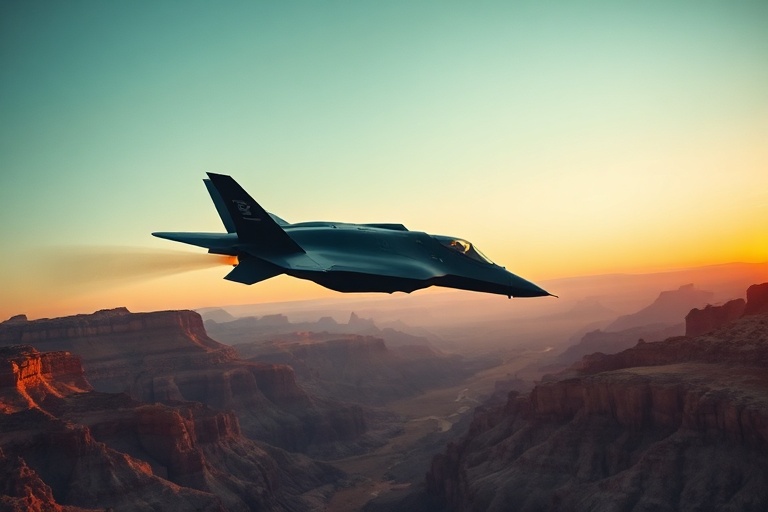
In the shadows of modern aerial warfare, a select group of aircraft operates with an almost supernatural ability: they remain undetected. These are the stealth aircraft, designed not just to fly, but to slip through the very fabric of radar detection. Their existence has redefined military strategy, forcing adversaries to rethink air defense systems that were once considered impenetrable.
The development of stealth technology has been one of the most closely guarded secrets in defense engineering. What began as a theoretical concept in the 1970s has evolved into a cornerstone of aerial dominance, with platforms like the F-22 Raptor, F-35 Lightning II, and B-2 Spirit pushing the boundaries of what’s possible in aviation. Yet, the principles behind their invisibility remain shrouded in classified detail, leaving much to speculation.
The Evolution of Stealth: From Theory to Dominance
Stealth aircraft didn’t emerge overnight. The concept traces back to the early days of radar, when engineers realized that certain shapes and materials could scatter or absorb radar waves, reducing an aircraft’s signature. The breakthrough came in the 1970s, when the U.S. government launched classified programs to explore these ideas. The first operational stealth aircraft, the F-117 Nighthawk, entered service in 1983, proving that radar evasion was not just possible but operationally viable.
The F-117’s angular design, coated in radar-absorbent materials, demonstrated that an aircraft could slip past enemy radar with minimal detection. This was a game-changer, as it allowed for precision strikes without the need for overwhelming air superiority. The subsequent development of the B-2 Spirit bomber and the F-22 Raptor further refined these principles, incorporating advanced avionics, thrust vectoring, and low-observable coatings to create aircraft that are nearly invisible to radar.
Today, stealth is no longer confined to the U.S. military. Russia and China have invested heavily in their own stealth programs, with aircraft like the Su-57 and J-20 challenging Western dominance in the skies. The global arms race has shifted from sheer firepower to technological sophistication, where invisibility is as valuable as speed or maneuverability.
How Stealth Works: The Science of Staying Hidden
At its core, stealth is about minimizing an aircraft’s radar cross-section (RCS), the measure of how detectable it is to radar. This is achieved through a combination of design, materials, and tactics. Here’s how it works:
- Shape and Geometry: Stealth aircraft are designed with smooth, angular surfaces that deflect radar waves away from the source. Curved surfaces, like those on older aircraft, tend to reflect radar waves directly back, making them easier to detect. The F-35, for example, uses a blended wing-body design to minimize radar reflections.
- Radar-Absorbent Materials (RAM): These materials, often composed of carbon composites or ferrite-based paints, absorb radar waves instead of reflecting them. The B-2 Spirit’s distinctive black coating is not just for aesthetics—it’s a layer of RAM that helps reduce its RCS.
- Engine and Exhaust Design: Jet engines and exhaust nozzles are major sources of radar and infrared signatures. Stealth aircraft use serpentine air intakes and shielded exhausts to mask these emissions. The F-22’s engines, for instance, are buried deep within the airframe to reduce their visibility.
- Electronic Warfare and Sensors: Stealth isn’t just about hiding from radar—it’s also about outsmarting it. Advanced electronic warfare systems, like the AN/ASQ-239 on the F-35, can jam or spoof enemy radar, further complicating detection. Additionally, stealth aircraft rely on passive sensors and data fusion to operate without emitting their own signals.
These innovations don’t come cheap. The F-35 program, for example, has cost over $1.7 trillion, making it one of the most expensive weapons systems in history. Yet, the investment is justified by the aircraft’s ability to penetrate heavily defended airspace, conduct surveillance, and deliver precision strikes without being detected.
Beyond Radar: The Broader Implications of Stealth Technology
The impact of stealth technology extends far beyond the battlefield. It has reshaped military doctrine, forcing nations to rethink their air defense strategies. Countries like Russia and China have invested billions in developing counter-stealth technologies, including advanced radar systems, hypersonic missiles, and AI-driven air defense networks. The result is a new arms race, where the goal is not just to build the fastest or most heavily armed aircraft, but the most invisible one.
Stealth has also influenced civilian aviation. While commercial aircraft don’t need to evade radar in the same way, the materials and design principles developed for stealth programs have found their way into modern airliners. Composite materials, for example, are now common in aircraft like the Boeing 787 and Airbus A350, reducing weight and improving fuel efficiency.
Moreover, stealth technology has implications for cybersecurity and electronic warfare. The same principles used to mask an aircraft’s radar signature can be applied to protecting sensitive communications and data networks. As cyber threats become more sophisticated, the techniques developed for stealth aircraft may offer new ways to secure critical infrastructure.
The Future of Stealth: What’s Next?
The next frontier in stealth technology is likely to focus on two key areas: adaptability and integration. Modern stealth aircraft are already highly capable, but they are not invincible. Advances in quantum radar and AI-driven detection systems could one day render current stealth designs obsolete. To counter this, future stealth aircraft may incorporate adaptive materials that can change their radar signature in real-time, or even deploy decoys and countermeasures to confuse enemy sensors.
Another trend is the integration of stealth with other advanced technologies. The U.S. military’s Next Generation Air Dominance (NGAD) program, for example, aims to develop a sixth-generation fighter that combines stealth with AI, directed-energy weapons, and networked operations. These aircraft won’t just fly—they’ll operate as part of a larger, interconnected system where data sharing and autonomous decision-making are as important as raw performance.
Finally, the democratization of stealth technology is a growing concern. While only a handful of nations currently possess operational stealth aircraft, the proliferation of advanced radar and missile systems means that even non-state actors could eventually gain the ability to detect and counter stealth platforms. This raises questions about the long-term viability of stealth as a strategic advantage and underscores the need for continued innovation.
For now, stealth remains a critical component of modern military power. But as technology evolves, so too must the strategies that underpin it. The invisible war machines of today may one day face a world where invisibility is no longer enough.
Key Takeaways
- Stealth is a combination of design, materials, and tactics: It’s not just about hiding from radar—it’s about outsmarting the entire spectrum of detection systems.
- The arms race has shifted to stealth vs. counter-stealth: Nations are investing heavily in technologies to detect and defeat stealth aircraft, creating a new era of technological competition.
- Stealth technology has civilian and cybersecurity applications: The materials and techniques developed for military use are finding their way into commercial aviation and cybersecurity.
- The future of stealth is about adaptability: Future aircraft will need to evolve to stay ahead of advancing detection technologies, integrating AI, adaptive materials, and networked operations.
For further reading on military technology and its broader implications, explore our Technology and News sections.