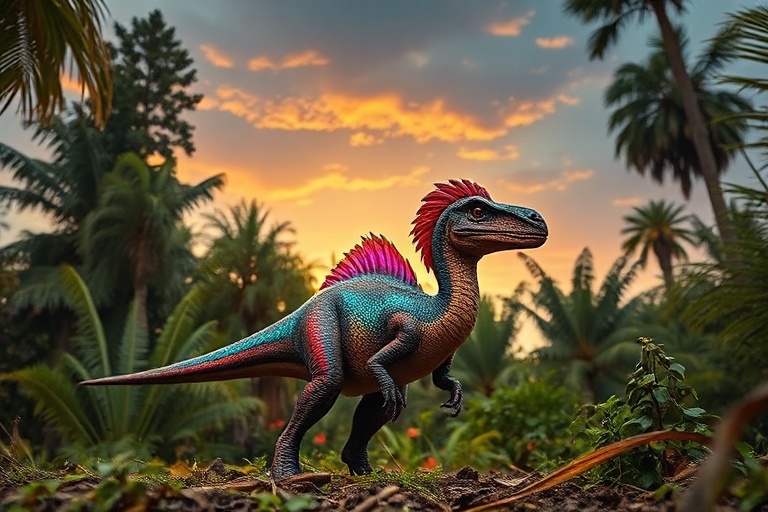
Thailand’s Paleontological Surprise: A New Dinosaur Era Uncovered
In a discovery that has sent ripples through the global paleontological community, Thai and international researchers have identified a new species of dinosaur in the northeastern region of Isan. The fossil, dated to approximately 113 million years ago during the Early Cretaceous period, belongs to the iguanodontian group, a family of herbivorous dinosaurs that once roamed vast swaths of Asia and Europe.
This find is not merely another addition to the dinosaur family tree—it challenges long-held assumptions about the geographic distribution and evolutionary timeline of these creatures. The specimen, named Sirindhorna khoratensis in honor of Princess Maha Chakri Sirindhorn of Thailand for her contributions to science, provides fresh insight into the biodiversity of prehistoric Southeast Asia. It also underscores the region’s growing significance in global paleontology, a field long dominated by North American and European discoveries.
The Discovery: From Local Excavation to Global Significance
The remains were first unearthed in 2012 near the Phu Kradung Formation, a sedimentary rock layer known for its rich fossil deposits. Local geologists, working with teams from the Sirindhorn Museum and the Japan-Thailand Dinosaur Project, painstakingly excavated the partial skeleton over several field seasons. The most striking feature was a nearly complete lower jawbone, equipped with distinctive tooth rows that set it apart from known iguanodontians.
Detailed analysis, published in the journal Acta Palaeontologica Polonica in 2023, confirmed that Sirindhorna khoratensis represents a previously unknown genus. Its closest relatives appear to have lived in China and Mongolia, suggesting that dinosaurs migrated across ancient land bridges that once connected Asia. The discovery highlights how Southeast Asia served not just as a geographic crossroads, but as a crucible for evolutionary innovation.
“This is a landmark find,” said Dr. Varavudh Suteethorn, lead paleontologist on the project. “It shows that Thailand is not just a modern tourist destination, but a repository of ancient life with stories still being told.”
Cultural and Scientific Impact: Why This Discovery Matters Beyond the Lab
The announcement of Sirindhorna khoratensis has resonated far beyond academic circles. In Thailand, it has become a source of national pride, featured prominently in school curricula and museum exhibits. The naming of the species after Princess Sirindhorn—who has long supported paleontological research in the country—elevated the find to a symbol of scientific progress tied to cultural heritage.
Internationally, the discovery has sparked renewed interest in Asian dinosaur paleontology. Historically, dinosaurs like Tarbosaurus and Therizinosaurus have dominated the narrative of Asian fauna. Yet Sirindhorna demonstrates that Southeast Asia hosted its own unique evolutionary pathways, possibly isolated by geography and climate during the Cretaceous.
This shift in perspective aligns with a broader trend in paleontology: the global rebalancing of fossil narratives. Countries like Argentina, Morocco, and now Thailand are no longer seen as mere footnotes in dinosaur history. They are active players in reconstructing the Mesozoic world.
What’s Next: The Future of Thai Paleontology and Global Collaboration
The discovery of Sirindhorna has energized efforts to explore other fossil-rich regions in Thailand. The Phu Kradung and Khok Kruat formations remain largely untapped, with only a fraction of their deposits excavated. Paleontologists are particularly excited about the potential for finding theropod remains or even early mammal fossils that could fill critical gaps in the Asian fossil record.
Collaboration continues to be a cornerstone of this work. International partnerships—especially with Japan, France, and China—have accelerated research, from advanced imaging techniques to radiometric dating. These alliances reflect a growing recognition that no single nation holds all the answers to Earth’s ancient past.
There is also a push to integrate paleontology into eco-tourism. The Sirindhorn Museum in Kalasin, which houses many of the Sirindhorna fossils, has seen a 40% increase in visitors since the discovery. Local communities are being educated on fossil conservation, turning excavation sites into educational hubs that connect science with regional identity.
Lessons from the Cretaceous: Connecting Past and Present
The story of Sirindhorna khoratensis is more than a tale of bones and teeth. It is a reminder of how life adapts to changing environments—an idea that resonates in today’s era of climate concern. During the Early Cretaceous, shifting tectonic plates and fluctuating sea levels created isolated ecosystems where new species could emerge. In many ways, Southeast Asia’s prehistoric landscape mirrors the biodiversity hotspots we protect today.
Moreover, the discovery underscores the importance of preserving not just fossils, but the cultural and scientific ecosystems that bring them to light. Without local knowledge, international expertise, and sustained funding, Sirindhorna might have remained buried beneath the red sandstone of Isan.
As Thailand continues to assert its place in the world of paleontology, one thing is clear: the age of dinosaurs is not over. It is being rewritten, one fossil at a time.
Key Takeaways from the Discovery of Sirindhorna khoratensis
- New Species, New Narrative: The identification of Sirindhorna khoratensis challenges traditional views of dinosaur distribution, proving that Southeast Asia was a center of evolutionary innovation.
- Cultural Pride and Science: The naming of the species in honor of Princess Sirindhorn reflects the intersection of national identity and scientific achievement.
- Global Collaboration: The discovery was made possible through international partnerships, highlighting the importance of shared research in paleontology.
- Tourism and Education: Fossil sites are becoming educational and eco-tourism destinations, fostering local engagement with prehistoric heritage.
- Future Potential: Unexplored formations in Thailand may yield even more groundbreaking finds, reshaping our understanding of Cretaceous ecosystems.
For those interested in similar discoveries, follow updates from the Science and Travel sections of Dave’s Locker, where we explore how ancient worlds shape modern exploration.
The discovery of Sirindhorna khoratensis is more than a scientific milestone—it is a call to see Thailand not just as a destination for the future, but as a keeper of Earth’s ancient past.