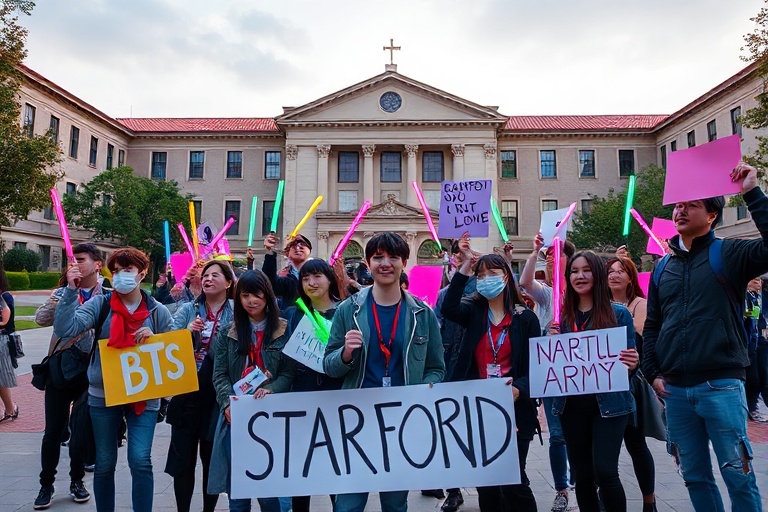
The intersection of global pop culture and higher education rarely garners mainstream attention, yet when BTS—one of the most influential musical acts of the 21st century—visited Stanford University in 2023, it transcended mere celebrity sightings. The event wasn’t just a convergence of fandom and academia; it was a symbolic moment where music, technology, and cultural studies collided in a way that highlighted how K-pop has evolved from niche export to academic subject.
Stanford’s invitation to BTS wasn’t an isolated incident. It reflected a broader trend: universities worldwide are recognizing K-pop not only as a cultural force but also as a lens through which to examine globalization, digital media, and youth culture. From lecture halls to research papers, K-pop is increasingly becoming a legitimate field of study, and BTS stands at its center.
The Stanford Connection: What Actually Happened
In April 2023, Stanford University hosted a private event featuring members of BTS as part of its ongoing Technology, Education, and Culture initiative. The session, titled “Music, Identity, and Digital Culture,” focused on how BTS leverages social media, streaming platforms, and fan engagement to build a global community. According to university reports, the event drew over 500 students, faculty, and invited guests, with additional participation via live-stream to global audiences.
Unlike typical fan meet-and-greets, the Stanford gathering included structured discussions on the psychology of fandom, the role of algorithms in music discovery, and the impact of multilingual content on global audiences. BTS member RM, known for his intellectual engagement with fans, participated in a moderated Q&A, emphasizing the group’s self-awareness about their cultural footprint.
Stanford’s Graduate School of Education later released a case study on the event, noting that it represented one of the first instances where a major K-pop act was analyzed not just as performers but as cultural educators shaping youth identity through media literacy. This underscored a shift: K-pop idols are increasingly seen not only as entertainers but as cultural intermediaries in digital societies.
Why Universities Are Studying K-Pop—and BTS in Particular
K-pop’s academic rise is part of a larger movement in cultural studies known as “transnational pop culture analysis.” Scholars argue that acts like BTS embody the complexities of 21st-century globalization—where cultural products are co-created, distributed, and consumed across borders in real time. Stanford’s Asian American Studies program has integrated K-pop into its curriculum, using BTS’s discography to explore themes of diaspora, self-representation, and soft power in East Asia.
Key Academic Frameworks Being Applied to BTS
- Digital Ethnography: Researchers analyze fan communities on platforms like Weverse, Twitter, and YouTube to understand how transnational fandoms form and sustain themselves.
- Soft Power & Diplomacy: BTS’s partnership with the South Korean government and their role as cultural ambassadors are studied in international relations courses.
- Music Cognition & Emotional Design: Psychologists examine how BTS’s music and visuals trigger emotional responses across cultures, using data from global streaming platforms.
- Media Convergence: Scholars investigate how BTS integrates music, fashion, gaming, and social media into a unified brand ecosystem.
This academic attention is not limited to the West. Universities in South Korea, Japan, and even Latin America now offer courses on BTS and K-pop, often in collaboration with industry partners. For instance, Seoul’s Sungkonghoe University launched a “BTS & Cultural Studies” minor in 2022, combining musicology, digital marketing, and Korean language training.
Fan Culture as a Social Phenomenon: The Stanford Perspective
One of the most compelling aspects of the Stanford event was the conversation around fandom itself. Fan studies scholars at Stanford described ARMY—the global fanbase of BTS—as a “participatory subculture” that blurs the line between consumer and co-creator. Fans don’t just listen to music; they translate lyrics, organize charity campaigns, and even influence album concepts through mass voting.
This behavior reflects what media theorist Henry Jenkins calls “participatory culture,” where audiences actively shape the narratives of the media they consume. At Stanford, this was framed not as mere enthusiasm, but as a form of digital activism and civic engagement. The university’s Digital Civil Society Lab published a report in 2024 highlighting how ARMY’s organized efforts—such as the 2020 Black Lives Matter donation drive—demonstrate how fandom can translate into real-world social impact.
Moreover, the event challenged stereotypes about fandom being irrational or obsessive. Instead, it showcased how structured, goal-oriented communities can mobilize around shared values—whether musical appreciation or social justice. This has led some anthropologists to reclassify fan groups like ARMY as “affinity networks,” a term that emphasizes their role in shaping collective identity in digital spaces.
Broader Implications: What BTS at Stanford Tells Us About Global Culture
The Stanford-BTS collaboration signals a turning point: the moment when pop culture stops being dismissed as frivolous and becomes a subject of serious scholarly inquiry. This shift has several implications.
First, it validates K-pop—and by extension, global pop culture—as worthy of academic attention. Just as jazz, rock, and hip-hop have been analyzed for their social and political dimensions, K-pop is now being dissected for its role in shaping global youth identity, economic models, and even diplomatic relations. The inclusion of BTS in university spaces reflects a democratization of cultural capital, where previously marginalized forms of expression gain institutional legitimacy.
Second, it demonstrates how digital platforms are redefining education. The Stanford event was hybrid, with in-person and online participation, mirroring how learning itself is evolving in the 21st century. Universities are no longer just physical spaces; they are networked communities where knowledge is co-produced across continents.
Finally, it raises a critical question: As K-pop becomes academically canonized, who controls its narrative? While Stanford’s approach was collaborative and respectful, not all institutions have the same sensitivity. There’s a risk that K-pop could be reduced to data points in a spreadsheet, stripping away its emotional and communal essence. The challenge moving forward is to study K-pop not as a phenomenon to be measured, but as a living culture to be understood.
What’s Next for BTS and Academia?
Looking ahead, several trends are likely to deepen the connection between BTS, K-pop, and higher education:
- Cross-disciplinary research: Expect more collaborations between musicologists, psychologists, and computer scientists to study BTS’s impact on brain activity, social bonding, and algorithmic culture.
- Digital archives: Universities are beginning to preserve fan-made content, concert footage, and streaming data as primary sources for future cultural analysis.
- Global symposia: International conferences—like the upcoming K-Pop & Global Culture Summit—will bring together scholars, artists, and fans to discuss K-pop’s evolving role.
- Fan-led scholarship: ARMY members have already started publishing zines and essays analyzing BTS’s music, suggesting a future where fan scholarship is formally recognized in academic discourse.
The Stanford event wasn’t just about BTS. It was about the future of culture itself—a future where music, technology, and learning intersect in ways we’re only beginning to understand. As universities continue to grapple with the digital transformation of society, acts like BTS serve as both mirror and catalyst, reflecting our globalized world back to us while pushing it forward.
In that sense, BTS’s visit to Stanford wasn’t just a cultural milestone. It was a sign of things to come: a world where pop stars don’t just perform on stage—they perform in the classroom, the lab, and the lecture hall.