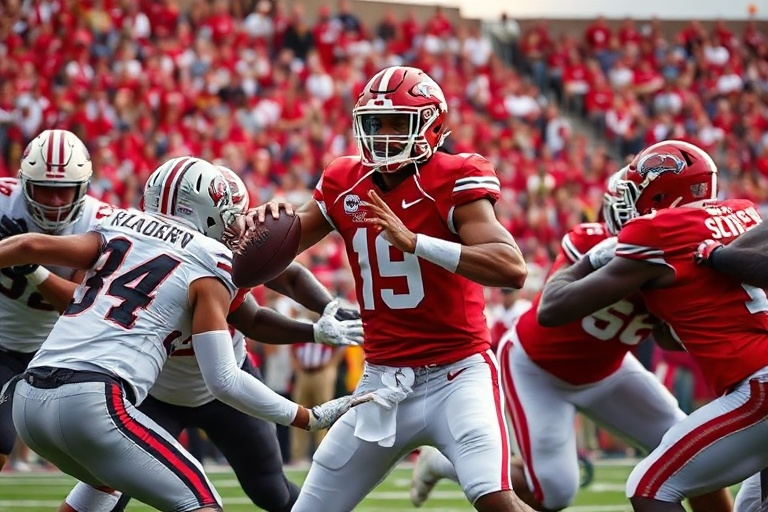
Shedeur Sanders isn’t just another name in the quarterback pipeline—he’s a cultural reset. Since stepping onto the field at Jackson State in 2022 and continuing at Colorado in 2023, Sanders has redefined what it means to be a quarterback in today’s game. His influence extends beyond stats and highlights; it’s about identity, swagger, and the mental edge that separates elite signal-callers from the rest. As more young QBs look to emulate his confidence, his impact on quarterback development is becoming impossible to ignore.
The Evolution of the Quarterback Archetype
For decades, the prototypical NFL quarterback was a statuesque pocket passer with a cannon arm and ice in their veins. Players like Peyton Manning and Tom Brady dominated with precision, procedural thinking, and an almost robotic approach to game management. But Sanders represents a shift toward a more dynamic, improvisational style—one that prioritizes athleticism, charisma, and a willingness to extend plays. His game isn’t built on perfection; it’s built on flair and instinct.
This evolution isn’t happening in a vacuum. Sanders is part of a broader trend influenced by players like Lamar Jackson, Josh Allen, and Taysom Hill. Yet Sanders distinguishes himself by blending that same athletic explosiveness with an unapologetic persona. He wears hats backward, hosts viral podcast segments, and engages directly with fans through social media—actions that resonate deeply with Gen Z athletes. For young QBs watching, Sanders isn’t just a player to study; he’s a blueprint for how to be.
Three Pillars of Sanders’ QB Influence
Sanders’ approach to quarterbacking can be broken down into three key areas that are now being adopted by aspiring signal-callers across the country:
- Confidence Over Caution: Sanders plays with a swagger that borders on reckless at times. He’ll throw into double coverage or run wild outside the pocket with little hesitation. This boldness is trickling down to high school and college QBs who are increasingly encouraged to “play free” rather than stick to conservative schemes.
- Brand as Armor: Sanders leverages his image—through fashion, social media, and public statements—to build a protective layer around his performance. When he’s scrutinized, he leans into the persona. This strategy is teaching young QBs that personal branding can be a form of resilience in the face of criticism.
- Mental Toughness as a Skill: Sanders often speaks about mental conditioning, meditation, and visualization. He’s turned quarterbacking into a holistic discipline, not just a physical one. This has inspired coaches to integrate sports psychology more aggressively into QB training programs.
Coaching and Culture: How Sanders Is Changing QB Development Programs
Sanders’ impact isn’t limited to his own play—it’s reshaping how coaches develop quarterbacks. Programs at every level are rethinking their QB curricula to incorporate elements of Sanders’ style and mentality. At Colorado, under head coach Deion Sanders (his father), the program has become a laboratory for quarterback transformation. The Buffs’ offensive system now emphasizes improvisation, designed rollouts, and RPOs (run-pass options) that give QBs like Sanders the freedom to create.
This approach is trickling down to high school and AAU circuits. More coaches are incorporating “Sanders Drills”—exercises that force QBs to throw on the run, make off-platform throws, and even practice trash-talking as a mental exercise. Some coaches have gone so far as to adopt Sanders’ pre-game rituals, like his signature “hat flip” or sideline swagger walk.
But not all coaches are on board. Critics argue that Sanders’ style is unsustainable at the NFL level, where pocket presence and decision-making under pressure are non-negotiable. They point to his struggles in the 2023 Alamo Bowl against TCU—where he was sacked five times and threw two interceptions—as evidence that his improvisational game has limits. Yet even those critics acknowledge that the Sanders effect has forced a reevaluation of QB evaluation standards.
Where Sanders’ Model Works—and Where It Doesn’t
Sanders’ influence is most visible in programs that prioritize athleticism and creativity. Small-college programs, HBCUs, and programs with mobile QBs (like Florida, Tennessee, and Kentucky) have all seen an uptick in recruits who cite Sanders as an inspiration. These programs benefit from his ability to elevate talent around him, even when the supporting cast is limited.
However, Sanders’ model faces challenges in traditional powerhouses like Alabama, Ohio State, or Georgia, where pocket passers still dominate. In those programs, coaches are more likely to emphasize structure and discipline over flair. Yet even there, Sanders has left a mark. Quarterbacks like Alabama’s Jalen Milroe and Ohio State’s Will Howard have incorporated more improvisational elements into their games, showing that Sanders’ influence is spreading horizontally across the sport.
The Broader Implications for the QB Position
Shedeur Sanders is more than a trend—he’s a symptom of a larger cultural shift in football. The sport is becoming faster, more athletic, and more entertainment-driven. The rise of the dual-threat QB mirrors the rise of the three-point line in basketball or the emphasis on speed in soccer. Football is evolving, and the quarterback position is at the center of that evolution.
This shift has implications for scouting, recruiting, and even media coverage. NFL teams are now prioritizing athletic testing and “upside” over traditional pocket-passer traits. High school recruits are choosing programs based on how much freedom they’ll have to express themselves. And media narratives are increasingly centered on personality—on the QB as a cultural figure rather than just a player.
Sanders’ most lasting impact may be in how he’s redefined success for the position. It’s no longer enough for a QB to be accurate and poised. They must also be compelling, charismatic, and—above all—confident. In an era where highlight reels and viral moments dictate attention, Sanders has shown that the quarterback position is as much about performance art as it is about performance on the field.
What’s Next for Sanders and the QB Pipeline
Sanders’ professional future remains uncertain. After transferring from Jackson State to Colorado, he entered the 2024 NFL Draft but went undrafted. His journey now mirrors that of other athletes who defy convention—like Baker Mayfield or Josh Allen—who had to prove themselves outside the traditional pathway. If Sanders lands on an NFL roster, his development will be closely watched. If he thrives, his model will become gospel. If he struggles, critics will use his case to argue against the Sanders-style QB.
Regardless of his NFL outcome, Sanders has already changed the game. He’s given young QBs permission to be themselves, to take risks, and to build identities that extend beyond the huddle. In doing so, he’s not just influencing a generation of players—he’s redefining what it means to be a quarterback in the modern era.
For coaches, scouts, and fans, the Sanders effect is a reminder that football is not just a sport of systems and schemes. It’s a sport of personalities, of swagger, and of the unshakable belief that one player can change everything. Sanders may not have rewritten the quarterback manual, but he’s certainly added a new chapter—and the next wave of QBs is already reading it.
To explore more on quarterback development and emerging talent, visit our Sports and Analysis sections.