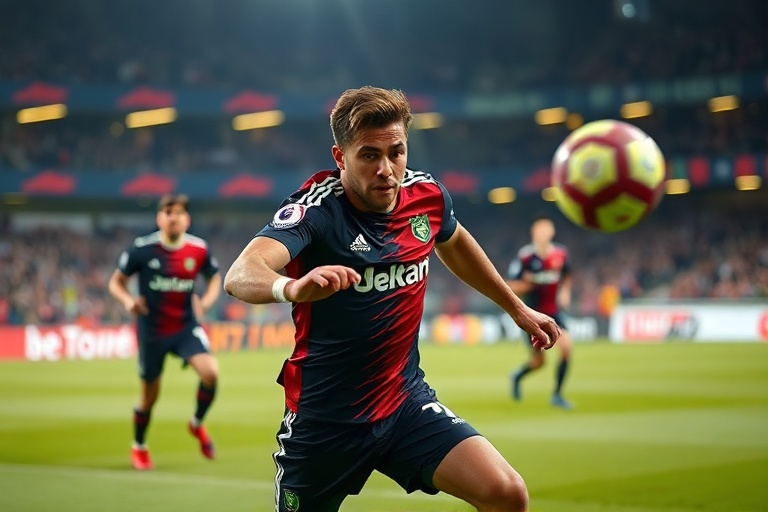
Bruno Fernandes arrived at Manchester United in January 2020 as a marquee signing, but it was his ability to create chances that truly transformed the club. Since then, the Portuguese midfielder has established himself as one of the Premier League’s most creative forces, consistently ranking among the league’s assist leaders. His vision, technique, and timing have made him the focal point of United’s attack, often dictating the tempo of matches with a single pass.
The Evolution of Bruno’s Assisting Role
When Fernandes first joined, he was primarily viewed as a goal-scoring midfielder. However, as United transitioned under Ole Gunnar Solskjær and later Erik ten Hag, his role expanded. Fernandes began to operate deeper, orchestrating attacks from midfield rather than pushing forward as an attacking midfielder. This positional shift allowed him to survey the pitch more effectively, leading to a surge in his assist numbers.
In the 2022-23 season, Fernandes provided 12 assists in the Premier League, ranking third behind only Kevin De Bruyne and Mohamed Salah. His ability to thread passes through tight spaces or deliver crosses with precision has made him a constant threat. What sets him apart is his adaptability—whether playing as a No. 10, a deep-lying playmaker, or even as a false nine, Fernandes finds ways to contribute assists.
Key Attributes Behind His Assisting Prowess
Fernandes’ success as an assist provider stems from several technical and mental attributes:
- Pinpoint Passing Accuracy: His ability to split defenses with through balls or weighted passes is unmatched. Fernandes averages over 85% pass completion in most matches, with a significant portion of those passes leading to shot-creating actions.
- Off-the-Ball Movement: Unlike traditional playmakers who rely on others to create space, Fernandes constantly makes runs into dangerous areas, dragging defenders out of position and opening passing lanes.
- Set-Piece Mastery: His free-kick and corner deliveries have directly resulted in multiple goals, making him a dual threat in dead-ball situations.
- Game Intelligence: Fernandes reads the game at an elite level, anticipating where teammates will make runs before the ball even reaches his feet.
How Fernandes Compares to Other Elite Assist Providers
In the modern Premier League, Fernandes stands alongside the likes of Kevin De Bruyne and Trent Alexander-Arnold as one of the most creative players in the world. However, his style differs from both. While De Bruyne operates as a traditional No. 8 with a focus on long-range passing, Fernandes excels in short-to-medium combinations, often combining with forwards in tight spaces.
Alexander-Arnold, on the other hand, is primarily a right-back whose assists come from crosses and cutbacks. Fernandes, by contrast, is a midfielder who dictates play from deeper positions. This versatility makes him more comparable to players like Bruno’s idol, Andrea Pirlo, who could influence games both as a passer and an assist provider.
Impact on Manchester United’s Tactical Setup
Fernandes’ presence has fundamentally changed how Manchester United build attacks. Under ten Hag, the team has adopted a more possession-based, positional play style, with Fernandes as the hub of their buildup. His ability to receive the ball under pressure and immediately transition into attack has allowed United to dominate games against top-tier opposition.
In matches where Fernandes is absent due to injury or suspension, United often struggles to create clear-cut chances. This was evident during the 2023-24 season when his absences coincided with poor attacking performances. His influence extends beyond statistics—he elevates the entire team’s attacking output simply by being on the pitch.
Broader Implications for Manchester United and the Premier League
The rise of Fernandes as an assist king has had several ripple effects across the club and the league. First, it has redefined the expectations for attacking midfielders in the Premier League. Clubs now prioritize midfielders who can both score and assist at an elite level, shifting away from traditional “pure creators” who lack a goal threat.
Second, Fernandes’ success has influenced Manchester United’s recruitment strategy. The club has increasingly targeted players who can thrive in a system where creativity is central—whether through wingers who cut inside or forwards who make diagonal runs. This shift aligns with United’s goal of becoming a more fluid, attacking team.
Finally, Fernandes’ consistency has solidified his status as a top-tier player in world football. While he may never reach the status of Lionel Messi or Cristiano Ronaldo, his ability to control games through assists places him in an elite bracket alongside players like Kevin De Bruyne and Thomas Müller.
What’s Next for Bruno Fernandes?
At 29 years old, Fernandes is in the prime of his career. The question now is whether he can maintain this level of performance while also helping United challenge for major trophies. With ten Hag’s system evolving, Fernandes may need to adapt further—potentially taking on more defensive responsibilities or refining his long-range shooting to become an even more complete midfielder.
One thing is certain: as long as Fernandes remains at Manchester United, his assist numbers will continue to be a barometer of the team’s attacking health. For a club that has struggled to find consistency in recent years, his creativity remains one of their most valuable assets.
For fans and analysts alike, Bruno Fernandes’ assists are more than just statistics—they are a testament to his vision, his work ethic, and his ability to elevate those around him. In a league that increasingly rewards creativity, Fernandes stands as a reminder that the most valuable players are often the ones who make others better.
To explore more about Manchester United’s tactical evolution and key players, visit our Sports and Analysis sections.