Supermarine Spitfire: Britain’s Legendary WWII Fighter
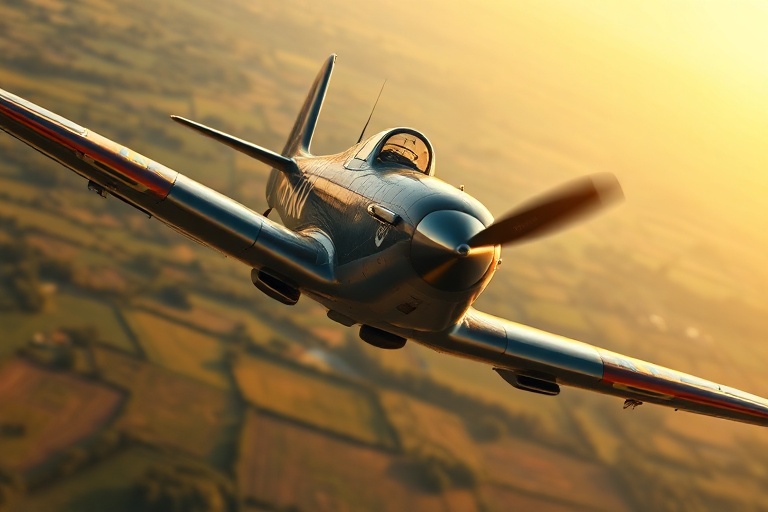
The Supermarine Spitfire remains one of the most recognizable aircraft in history. Designed by Reginald Mitchell and produced by Supermarine Aviation Works, the Spitfire became synonymous with British resistance during World War II. Its elliptical wings, sleek fuselage, and Rolls-Royce Merlin engine set it apart from contemporaries. More than just a fighter, the Spitfire evolved into a symbol of national defiance during the Battle of Britain.
A Design Ahead of Its Time
The Spitfire’s origins trace back to the early 1930s. Supermarine, primarily known for seaplanes, won the Air Ministry’s specification F.7/30 for a new fighter. Mitchell’s team developed the Type 224, but it failed to impress. Undeterred, they refined the design, incorporating a thin elliptical wing that reduced drag and improved performance at high altitudes. This wing shape, inspired by German research, became the Spitfire’s most distinctive feature.
The aircraft’s first flight occurred on March 5, 1936. Powered by a Rolls-Royce PV-12 engine (later renamed the Merlin), the Spitfire demonstrated exceptional speed and maneuverability. Its all-metal construction and retractable landing gear were advanced for the era. By the time war broke out, the Spitfire had already proven its worth, with 310 units delivered to the RAF.
The Spitfire’s design allowed for continuous upgrades. As the war progressed, newer versions received more powerful engines, additional armament, and improved avionics. The Mk IX, introduced in 1942, could outperform the formidable Focke-Wulf Fw 190, securing Allied air superiority. Engineers even experimented with contra-rotating propellers and laminar-flow wings, pushing the boundaries of aeronautical engineering.
Role in the Battle of Britain
The Spitfire’s reputation was cemented during the Battle of Britain in 1940. Alongside the Hawker Hurricane, it formed the backbone of RAF Fighter Command. While Hurricanes accounted for more enemy aircraft, the Spitfire’s superior speed and agility made it ideal for intercepting German bombers and Messerschmitt Bf 109 escorts. Pilots often preferred the Spitfire for its responsive handling and ability to dive away from danger.
RAF pilots achieved remarkable success with the Spitfire. The aircraft’s eight Browning .303 machine guns provided concentrated firepower, though this was later supplemented with Hispano 20mm cannons in later models. The Spitfire’s combat record during the battle was impressive, with 235 enemy aircraft destroyed by Spitfire squadrons between July and October 1940.
Beyond its combat performance, the Spitfire played a crucial psychological role. Its distinctive silhouette made it easily recognizable, boosting British morale. The aircraft’s presence over London and the Home Counties became a symbol of defiance against the Luftwaffe’s Blitzkrieg tactics. Even when outnumbered, Spitfire pilots maintained air superiority, preventing German invasion plans.
Evolution Through Wartime Innovations
The Spitfire’s adaptability allowed it to remain relevant throughout the war. As combat demands changed, Supermarine introduced numerous variants, each tailored to specific roles. The PR (Photographic Reconnaissance) variants operated at extreme altitudes, often without armament, to gather intelligence behind enemy lines. The Seafire, a navalized version, served aboard aircraft carriers, proving the Spitfire’s versatility.
One of the most significant developments was the introduction of the Griffon engine. The Mk XII, first flown in 1942, used this more powerful engine to achieve speeds of over 400 mph. Later Griffon-powered variants, such as the Mk XIV and Mk XVIII, dominated in the final years of the war, outperforming even the latest German fighters.
The Spitfire’s armament also evolved. Early models relied on machine guns, but later versions incorporated 20mm cannons and even 500-pound bombs. Some Spitfires were modified to carry rockets for ground-attack missions, demonstrating the aircraft’s multifaceted capabilities. The ability to switch between roles—fighter, bomber escort, reconnaissance, and ground attack—made the Spitfire indispensable.
Here’s a breakdown of key Spitfire variants and their roles:
- Mk I: Initial production model with eight .303 machine guns; entered service in 1938.
- Mk V: Most numerous variant, powered by the Merlin 45 engine; widely used in North Africa and Malta.
- Mk IX: First Griffon-powered variant; outclassed German fighters in 1942.
- PR.XIX: Unarmed reconnaissance variant capable of operating at 40,000 feet.
- Seafire III: Naval version with folding wings and arrestor gear; served in the Pacific theater.
Legacy Beyond the War
Though the Spitfire’s combat career ended with World War II, its legacy endured. Many aircraft were sold to foreign air forces, serving in conflicts from the Arab-Israeli War to the Indo-Pakistani War. The last Spitfire in military service retired in 1954, but its impact on aviation history remained undiminished.
Today, the Spitfire is a prized collector’s item. Approximately 70 Spitfires remain airworthy, with hundreds more preserved in museums worldwide. The Royal Air Force Museum in Hendon and the Imperial War Museum in Duxford house some of the most famous examples. Restoration projects continue to bring these historic aircraft back to flight, ensuring future generations can witness their grace.
The Spitfire’s influence extends beyond aviation. It has inspired countless books, films, and documentaries, cementing its place in popular culture. From the 1942 film First of the Few to modern video games like War Thunder, the Spitfire remains a symbol of British engineering and wartime resilience. Even its distinctive sound—often described as a “screaming banshee”—is instantly recognizable.
For aviation enthusiasts, the Spitfire represents the pinnacle of piston-engine fighter design. Its combination of elegance, performance, and adaptability set a standard that modern aircraft designers still aspire to. The Spitfire’s story is one of innovation, perseverance, and national pride, making it a timeless icon.
To explore more about historic aircraft and their impact on warfare, visit our Aviation History section. For a deeper look at World War II fighters, check out our WWII Aircraft category.