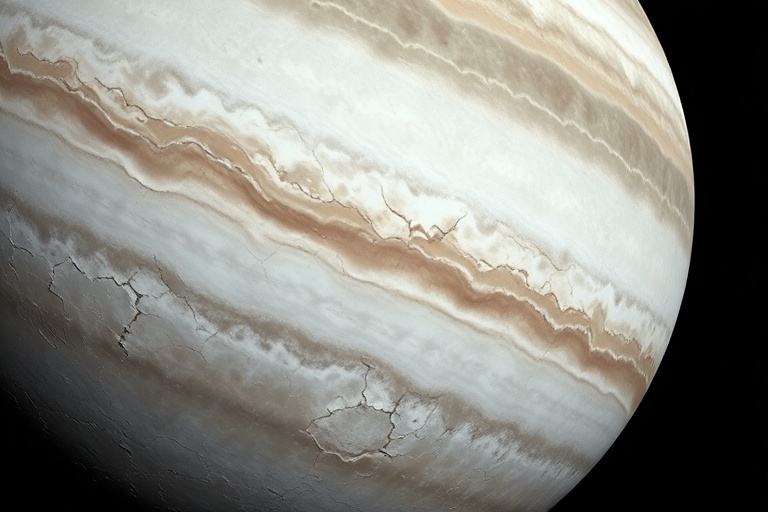
Europa: Jupiter’s Enigmatic Moon Holds Secrets of Life
Europa, one of Jupiter’s four large moons, has long fascinated astronomers and astrobiologists. Discovered by Galileo Galilei in 1610, this icy world orbits the gas giant every 3.5 days, locked in a gravitational dance that keeps its interior warm enough to maintain a vast subsurface ocean. While its surface temperature hovers around -160°C (-260°F), beneath the cracked, rust-colored ice lies a liquid ocean potentially twice the volume of all Earth’s oceans combined.
This hidden ocean, kept liquid by tidal heating from Jupiter’s immense gravity, makes Europa one of the most promising places in the solar system to search for extraterrestrial life. The possibility of hydrothermal vents on its seafloor—similar to those on Earth that support thriving ecosystems—ignites scientific imagination. Missions like NASA’s upcoming Europa Clipper, set for launch in 2024, aim to study the moon’s habitability by analyzing its ice shell, surface composition, and the chemistry of any plumes erupting from beneath the ice.
Why Europa Stands Out in Our Solar System
Europa distinguishes itself from other icy moons like Saturn’s Enceladus or Jupiter’s Ganymede due to several unique features. First, its ocean is in direct contact with a rocky seafloor, a crucial condition for geochemical reactions that could support life. Second, the surface is relatively young, with few craters, suggesting ongoing geological activity. Third, observations by the Hubble Space Telescope have detected water vapor plumes erupting from cracks in the ice, providing a tantalizing glimpse into the subsurface ocean without the need to drill through miles of ice.
The moon’s surface is also a study in contrasts. Smooth plains of ice sit alongside chaotic terrains—jumbled blocks of ice that appear to have broken apart and refrozen. These features hint at the dynamic processes reshaping Europa’s surface over time. The reddish-brown streaks crisscrossing the moon are likely deposits of salts and sulfur compounds, possibly originating from the ocean below and exposed through surface fractures.
Scientific Missions and Future Exploration
The quest to understand Europa has driven decades of planning and technological innovation. NASA’s Galileo mission, which orbited Jupiter from 1995 to 2003, provided the first detailed images and data of Europa, revealing its fractured surface and magnetic field disturbances consistent with a conductive layer beneath the ice—likely a salty ocean.
Now, NASA’s Europa Clipper mission is poised to build on these findings. Scheduled to arrive in the Jupiter system in 2030, the spacecraft will conduct 49 close flybys of Europa, using radar to peer beneath the ice, spectrometers to analyze surface composition, and cameras to map the surface in high resolution. The mission aims to answer critical questions: How thick is the ice shell? Is the ocean habitable? Are there organic molecules present?
Meanwhile, the European Space Agency’s Jupiter Icy Moons Explorer (JUICE), launched in 2023, will also study Europa, along with Ganymede and Callisto, as part of a broader investigation into Jupiter’s habitable zone. These missions represent a collaborative effort to determine whether life could exist beyond Earth—and Europa is at the center of that search.
For those interested in the broader context of space exploration and planetary science, visit Dave’s Locker Science for additional articles on solar system discoveries and astrobiology.
What Europa’s Geology Tells Us About Its Potential for Life
Europa’s geology offers clues not just about its past, but about its potential to host life. The moon’s tidal forces, caused by Jupiter’s gravitational pull, flex its interior, generating heat that keeps the ocean liquid. This process also drives tectonic activity, allowing for the exchange of materials between the ocean and the surface—a critical factor for habitability.
Scientists believe that Europa’s ocean could contain essential elements for life, including carbon, hydrogen, nitrogen, oxygen, phosphorus, and sulfur. The detection of sodium chloride (common table salt) on Europa’s surface, as observed by the Hubble Space Telescope and the James Webb Space Telescope, suggests that the ocean may have a similar chemistry to Earth’s oceans, further increasing its potential habitability.
The presence of these elements, combined with liquid water and a stable energy source, places Europa at the top of the list for astrobiological research. While no direct evidence of life has been found, the conditions are remarkably similar to environments on Earth where life thrives, such as deep-sea hydrothermal vents.
Broader Implications: Europa in the Search for Extraterrestrial Life
The study of Europa extends beyond planetary science. It challenges our understanding of where life can exist and what conditions are necessary for its emergence. If life is found on Europa, it would suggest that life could arise in a variety of environments across the universe, not just on Earth-like planets orbiting in the “habitable zone” of a star.
Moreover, Europa’s potential habitability raises ethical questions about planetary protection. Missions to Europa must be carefully designed to avoid contaminating the moon with Earth microbes, which could compromise the search for native life. This has led to strict sterilization protocols for spacecraft bound for Europa, ensuring that any discoveries are not the result of human interference.
Europa also serves as a testing ground for future technologies. Drilling through miles of ice to reach the ocean remains a daunting challenge, but concepts like cryobots—robotic probes designed to melt through ice—are being developed and tested in Earth’s polar regions. These innovations could one day unlock the secrets hidden beneath Europa’s frozen surface.
The implications of discovering life on Europa would be profound. It would not only revolutionize biology and astrobiology but also reshape our place in the universe. Are we alone? Europa might hold the answer.
Key Points About Europa
- Subsurface Ocean: Europa has a global ocean beneath its icy shell, potentially holding twice the volume of Earth’s oceans.
- Tidal Heating: Jupiter’s gravitational pull generates heat within Europa, keeping the ocean liquid and driving geological activity.
- Water Plumes: Observations suggest that water vapor plumes erupt from Europa’s surface, offering a way to study the ocean without drilling.
- Surface Composition: The presence of salts and organic compounds on Europa’s surface hints at chemical processes that could support life.
- Future Missions: NASA’s Europa Clipper and ESA’s JUICE mission will study Europa in unprecedented detail, searching for signs of habitability.
Conclusion: Europa as a Beacon in the Search for Life
Europa represents one of humanity’s best chances to answer the age-old question: Are we alone? Its subsurface ocean, dynamic surface, and potential for habitability make it a prime target for exploration. As missions like Europa Clipper and JUICE prepare to unlock its secrets, the scientific community—and the world—awaits with anticipation.
The discoveries made at Europa could redefine our understanding of life in the universe. Whether or not life is found, the knowledge gained will expand our horizons and inspire future generations of explorers. In the vastness of space, Europa shines as a beacon, guiding us toward answers that could change everything.
For more insights into space exploration and the search for extraterrestrial life, explore Dave’s Locker Technology section.