ice shelf
“`html
Ice Shelves: Earth’s Fragile Giants at the Frontlines of Climate Change
Ice shelves are colossal, floating platforms of ice that extend from the edges of glaciers into the ocean. They act as natural barriers, slowing the flow of land-based ice into the sea. Yet these frozen behemoths are among the first casualties of rising global temperatures, with their disintegration accelerating sea level rise and disrupting polar ecosystems.
Unlike sea ice—which forms and melts on the ocean surface—ice shelves are anchored to land and can persist for thousands of years. Their stability depends on a delicate balance: cold air keeps their surfaces frozen, while ocean currents and warming waters melt them from below. As human activity drives atmospheric and oceanic warming, ice shelves are thinning, cracking, and collapsing at unprecedented rates. Understanding their role in the climate system is critical to predicting the future of coastal communities worldwide.
The Anatomy of an Ice Shelf: How These Frozen Giants Function
Ice shelves form where glaciers flow into the ocean, stretching seaward until they become buoyant and float. Their structure is layered, composed of compacted snow on top and dense glacial ice beneath. Some shelves, like Antarctica’s Ross Ice Shelf, rival entire countries in size, spanning hundreds of thousands of square kilometers.
Their formation is a slow process, often taking thousands of years. Snow accumulates in the interior, compressing into ice, which gradually creeps toward the coast under its own weight. When it reaches the ocean, it doesn’t immediately break apart—instead, it spreads out like a vast sheet, sometimes hundreds of meters thick. This floating extension can remain stable for millennia, but once it begins to melt or fracture, the effects can be swift and irreversible.
Ice shelves don’t just sit passively. They act as buttresses, holding back glaciers from sliding into the sea. When an ice shelf collapses, the glaciers behind it accelerate, dumping vast quantities of freshwater into the ocean. This process directly contributes to sea level rise, a phenomenon already reshaping coastlines from Miami to Mumbai.
Climate Change and the Collapse of Ice Shelves: A Timeline of Loss
The first major ice shelf collapse captured on camera occurred in 1995, when the Larsen A Ice Shelf on the Antarctic Peninsula shattered in a matter of weeks. Scientists watched in alarm as a region the size of Rhode Island disintegrated into icebergs and sea ice. It was a warning sign.
In 2002, its neighbor, Larsen B, followed suit. Over 3,200 square kilometers of ice—thicker than the Empire State Building is tall—collapsed in a dramatic event that sent shockwaves through the scientific community. Satellite images revealed that the shelf had been stable for at least 10,000 years. Its sudden demise marked the beginning of a new era: one where ice shelves were no longer permanent features of the polar landscape.
Since then, the pace of collapse has accelerated. In 2017, the Larsen C Ice Shelf calved one of the largest icebergs ever recorded, an event that reduced its total area by 12%. While calving is a natural process, the size and timing of this break raised concerns—it occurred during the Antarctic winter, a period when such events are rare. Researchers later found that the ice shelf was being weakened from below by warming ocean currents.
Not all ice shelves are retreating, but most of those in the Antarctic Peninsula and West Antarctica are thinning. Pine Island Glacier’s ice shelf has retreated nearly 30 kilometers since the 1990s, while the Thwaites Glacier—often called the “Doomsday Glacier” for its potential to raise sea levels by several feet—is losing ice at an accelerating rate. Its ice shelf is now riddled with cracks and may not survive the next few decades.
Key Indicators of Ice Shelf Vulnerability
- Thinning: Measured by satellite altimetry, thinning indicates both surface melt and basal melting from below.
- Fractures and Rifts: Large cracks, like those in Larsen C, signal structural weakening.
- Basal Melt Rates: Warm ocean water eroding the underside accelerates disintegration.
- Grounding Line Retreat: Where the ice shelf lifts off the seabed and starts floating marks a critical threshold.
- Surface Melt Ponds: Dark pools of water absorb more solar radiation, increasing melting.
Beyond the Ice: Why Ice Shelves Matter to the Planet
Ice shelves are more than frozen water—they are regulators of global climate systems. Their collapse doesn’t just contribute to sea level rise; it alters ocean circulation patterns, affects marine ecosystems, and even influences weather systems in the Southern Hemisphere.
One of the most immediate impacts is on ocean stratification. When ice shelves melt, they release cold freshwater into the salty ocean, potentially slowing the Antarctic Circumpolar Current. This current plays a crucial role in distributing heat around the planet. Any disruption could have cascading effects on global climate, including changes in storm tracks and precipitation patterns.
Marine life also depends on the stability of these icy platforms. Ice shelves provide platforms for algae growth, which forms the base of polar food webs. When they collapse, entire ecosystems can shift abruptly. Adelie penguins, for instance, rely on stable sea ice and ice shelves for breeding and feeding. Their populations in the Antarctic Peninsula have declined sharply as ice has disappeared.
Perhaps most concerning is the long-term feedback loop. As ice shelves weaken, glaciers behind them accelerate, dumping more ice into the ocean. This process is already underway in West Antarctica, where the Amundsen Sea Embayment is losing ice at a rate that cannot be reversed on human timescales. Some models suggest that once this sector destabilizes, it could contribute up to 1.2 meters of global sea level rise over centuries—but the process may already be in motion.
Can We Save the Ice Shelves? Science, Policy, and the Path Forward
Preventing the collapse of ice shelves is no longer possible without drastic, immediate reductions in global greenhouse gas emissions. Even if warming is limited to 1.5°C—an increasingly ambitious target—some ice shelves are likely to disappear. The focus now is on limiting the damage and preparing for the changes to come.
Scientists are using advanced technologies to monitor ice shelves in real time. Autonomous underwater vehicles (AUVs) and robotic gliders are mapping the undersides of shelves, revealing hidden melt channels and cavities. Satellite missions like NASA’s ICESat-2 provide precise measurements of ice thickness and elevation, helping researchers track changes with unprecedented accuracy.
Meanwhile, policymakers are beginning to recognize the urgency. The 2015 Paris Agreement was a critical step, but its targets are slipping out of reach. Efforts to strengthen climate commitments at COP28 and beyond will determine whether future generations inherit a world with any intact ice shelves—or one where they exist only in history books and satellite images.
For coastal cities, the message is clear: adaptation must begin now. Investments in resilient infrastructure, managed retreat programs, and early warning systems are essential. Cities like Rotterdam and Jakarta are already implementing flood defenses, but many vulnerable nations lack the resources to protect themselves. International cooperation and climate finance will be crucial in supporting those most at risk.
What Individuals Can Do
While systemic change is essential, individual actions still matter. Reducing carbon footprints, supporting renewable energy, and advocating for climate policies can collectively influence global outcomes. Supporting organizations that monitor polar ice, such as the NASA Operation IceBridge or the British Antarctic Survey, helps fund critical research.
Educating others about the importance of ice shelves can also drive collective action. The more people understand the connection between a melting ice shelf in Antarctica and a flooded street in New York, the stronger the demand for meaningful climate solutions becomes.
Ice shelves are sentinels of climate change—silent, massive, and unforgiving. They do not negotiate. They do not adapt. They respond. And their response is a warning we ignore at our peril.
—
METADATA
{
“title”: “Ice Shelves: Earth’s Fragile Giants in the Climate Crisis”,
“metaDescription”: “Ice shelves are melting faster than ever, accelerating sea level rise and disrupting global climate systems. Learn why their collapse matters.”,
“categories”: [“Science”, “Environment”],
“tags”: [“ice shelves”, “Antarctica”, “climate change”, “sea level rise”, “glacier melt”],
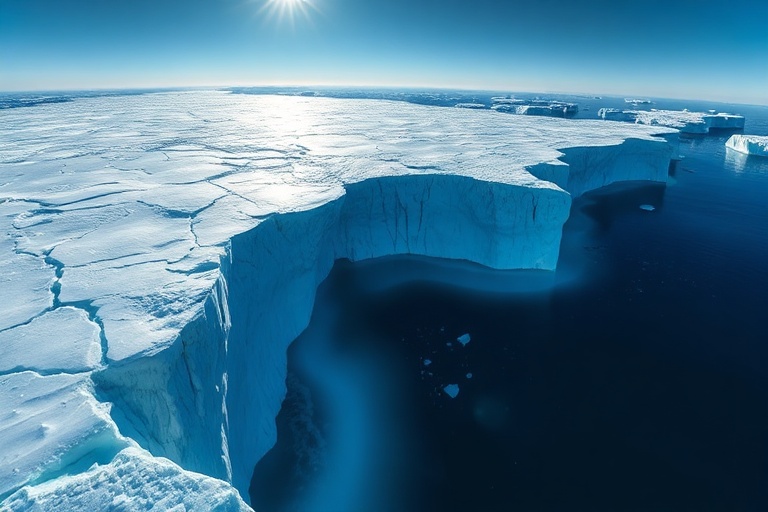
“imageDescription”: “Aerial view of a massive Antarctic ice shelf with visible cracks and meltwater ponds, set against a pale blue ocean and distant mountains under a cloudy sky. The scene conveys both grandeur and fragility, with sunlight casting long shadows across the icy surface.”
}
—END METADATA—
“`