aircraft carrier
“`html
Aircraft Carriers: Floating Cities That Shape Modern Warfare
The aircraft carrier remains one of the most formidable symbols of military power in the modern era. These massive, mobile airfields stretch longer than three football fields, displace upwards of 100,000 tons, and carry dozens of fighter jets, helicopters, and support aircraft. More than just ships, they function as sovereign territories of steel and technology—floating cities that project influence across oceans.
Since their inception in the early 20th century, aircraft carriers have evolved from experimental platforms to the backbone of naval power for the world’s largest militaries. Their ability to deploy air power without relying on foreign bases makes them uniquely versatile in both peace and war. As geopolitical tensions rise in the Pacific, the Mediterranean, and beyond, the role of these leviathans has never been more critical—or more scrutinized.
The Evolution of the Aircraft Carrier: From Wooden Decks to Nuclear Power
The first aircraft carriers emerged from the need to extend air power beyond coastal limits. During World War I, the British Royal Navy converted HMS Furious, a battlecruiser, into a makeshift carrier with a flight deck. Though crude by later standards, it demonstrated the potential of launching aircraft from moving ships. By World War II, purpose-built carriers like the USS Enterprise and Japan’s Akagi became decisive weapons in naval warfare.
After 1945, carriers advanced rapidly. The introduction of jet aircraft in the 1950s required longer, stronger decks, leading to the angled flight deck—a design still used today. Nuclear propulsion, first deployed on the USS Enterprise in 1961, allowed carriers to operate for years without refueling, vastly extending their operational reach.
The modern U.S. Navy’s Nimitz-class and Ford-class carriers represent the pinnacle of this evolution. Each Ford-class vessel, for instance, features electromagnetic catapults, advanced radar systems, and automation that reduces crew size while increasing efficiency. These ships are not merely updated versions of earlier models; they are technological ecosystems designed to dominate the seas.
Key Milestones in Carrier Development
- 1918: HMS Argus, the first full-length flat-deck carrier, enters service with the Royal Navy.
- 1941: Japanese carriers Akagi and Kaga launch the attack on Pearl Harbor, changing naval warfare forever.
- 1955: USS Forrestal becomes the first U.S. carrier designed specifically for jet aircraft.
- 1961: USS Enterprise (CVN-65) commissions as the world’s first nuclear-powered aircraft carrier.
- 2017: USS Gerald R. Ford (CVN-78) begins sea trials, introducing advanced electromagnetic systems.
How Aircraft Carriers Function: A Complex Ecosystem at Sea
An aircraft carrier is not a single-purpose vessel but a floating command center, logistics hub, and airfield. Its crew of nearly 5,000 personnel—including pilots, engineers, medical staff, and intelligence officers—must operate in harmony under extreme conditions. The ship’s flight deck is a controlled chaos of takeoffs, landings, and refueling, all orchestrated in a space no larger than a few city blocks.
The carrier’s air wing is its primary weapon. A typical U.S. carrier air wing includes 60–70 aircraft: F/A-18 Super Hornets for strike missions, E-2D Hawkeye early warning planes, EA-18G Growler electronic warfare jets, and MH-60 helicopters for antisubmarine and search-and-rescue roles. These aircraft enable the carrier to conduct surveillance, strike targets, and defend against aerial, surface, and subsurface threats.
Behind the scenes, the ship must generate and manage vast amounts of power, fresh water, food, and ordnance. Nuclear reactors provide electricity and propulsion, while desalination plants produce thousands of gallons of fresh water daily. Refrigeration units store enough food to feed a small town for months. Every system is duplicated or backed up to ensure survivability in combat.
Command and control are equally critical. The carrier’s battle group, or Carrier Strike Group (CSG), typically includes guided-missile cruisers, destroyers, submarines, and support ships. This integrated force multiplies the carrier’s reach and resilience, allowing it to project power across hundreds of miles of ocean.
The Geopolitical Role: Why Carriers Still Matter in the 21st Century
In an era dominated by ballistic missiles, drones, and cyber warfare, the continued prominence of aircraft carriers might seem surprising. Yet their strategic value endures. Unlike land-based air forces, carriers do not require permission to operate in international waters. They can respond to crises without the political constraints of foreign basing agreements, making them ideal for power projection in unstable regions.
The U.S. Navy alone operates 11 aircraft carriers—more than all other nations combined. These ships serve as diplomatic tools, reassuring allies and deterring adversaries. When tensions rise in the South China Sea or the Strait of Hormuz, a U.S. carrier strike group is often the first major response. China and Russia, recognizing this capability, are rapidly expanding their own carrier fleets, signaling a new chapter in naval rivalry.
Carriers also play a crucial role in humanitarian missions. After the 2004 Indian Ocean tsunami, the USS Abraham Lincoln provided medical aid and supplies. During the COVID-19 pandemic, the USS Theodore Roosevelt became a symbol of resilience when its crew rallied after a major outbreak aboard.
Yet their effectiveness is not without debate. Critics argue that carriers are vulnerable to long-range anti-ship missiles, hypersonic weapons, and submarine attacks. The sinking of the Japanese carrier Shinano during World War II and the attack on the USS Cole in 2000 underscore their susceptibility. Advocates counter that modern carriers incorporate layered defenses—from SM-6 missiles to electronic countermeasures—making them harder to defeat than ever.
Carriers Around the World: A Global Comparison
- United States: 11 active carriers (Nimitz and Ford classes); largest and most advanced fleet.
- China: 3 operational carriers (Liaoning, Shandong, Fujian); aiming for 6–8 by 2035.
- United Kingdom: 2 Queen Elizabeth-class carriers; designed for F-35B Lightning II operations.
- Russia: 1 carrier (Admiral Kuznetsov); limited operational capacity due to maintenance issues.
- France: 1 carrier (Charles de Gaulle); nuclear-powered, deployed in Mediterranean and Indian Ocean.
- India: 2 carriers (INS Vikramaditya and INS Vikrant); expanding indigenous carrier program.
The Future of Aircraft Carriers: Innovation and Uncertainty
The next generation of aircraft carriers promises to be even more transformative. The U.S. Navy’s Ford-class carriers incorporate advanced automation, reduced crew requirements, and next-generation radar systems. China’s Fujian, expected to enter service by 2025, will feature electromagnetic catapults and a larger air wing, closing the technological gap with the U.S.
Emerging technologies are reshaping carrier operations. Unmanned aerial vehicles (UAVs) like the MQ-25 Stingray are being integrated to extend the range of manned aircraft and conduct surveillance. Laser weapons and railguns may soon provide point-defense capabilities against incoming threats. Artificial intelligence is being tested to optimize flight deck operations and predictive maintenance.
Yet the future is not without challenges. The rising cost of carrier construction—over $13 billion per Ford-class ship—raises questions about affordability. Some analysts suggest that smaller, more agile carriers or distributed maritime operations using unmanned systems could offer alternatives. Others argue that carriers will remain indispensable as long as nations seek global reach.
One thing is clear: the aircraft carrier’s role is evolving, not disappearing. As nations invest in hypersonic weapons, cyber warfare, and space-based surveillance, carriers may need to adapt by becoming more networked, resilient, and flexible. But their core mission—projecting air power anywhere in the world—remains as vital as it was a century ago.
Conclusion: The Carrier’s Enduring Legacy
Aircraft carriers are more than machinery; they are instruments of national will. They embody technological ambition, strategic foresight, and the relentless pursuit of dominance in unforgiving environments. While their form may change, their function endures: to assert presence, deter conflict, and, when necessary, wage war.
As geopolitical competition intensifies, the aircraft carrier will continue to be both a symbol and a tool of power. Whether through the thunderous takeoff of a strike fighter or the quiet diplomacy of a port visit, these floating fortresses remain central to how the world’s most powerful nations shape the global order. In an age of shifting alliances and rising threats, the carrier’s ability to sail, fight, and survive may well determine the balance of power for decades to come.
For defense analysts, policymakers, and military enthusiasts, the aircraft carrier is not just a relic of history—it is a living testament to human ingenuity and the enduring quest for control over the world’s oceans.
Explore more on military technology and geopolitical strategy on Dave’s Locker.
—METADATA—
{
“title”: “Why Aircraft Carriers Still Rule Modern Naval Warfare”,
“metaDescription”: “Explore how aircraft carriers evolved from WWI experiments to 21st-century power projection giants shaping global security.”,
“categories”: [“News”, “Analysis”],
“tags”: [“aircraft carrier”, “naval warfare”, “military technology”, “geopolitics”, “U.S. Navy”],
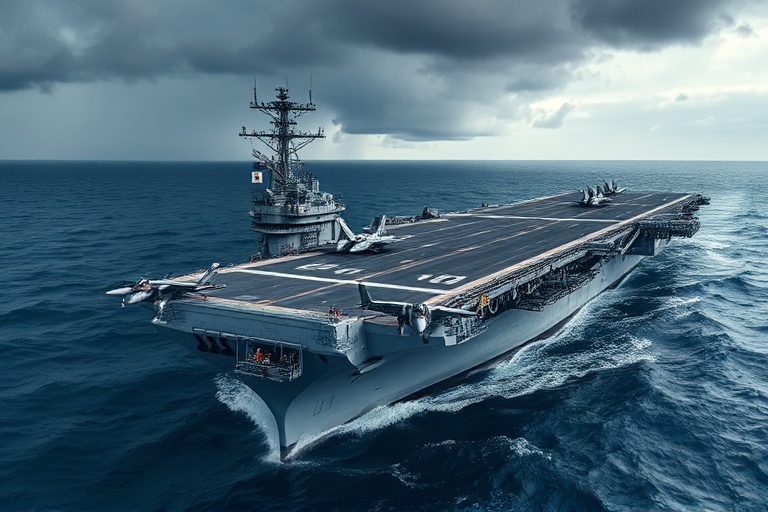
“imageDescription”: “A high-angle shot of a U.S. Navy aircraft carrier at sea, with fighter jets launching from its deck, surrounded by escorts. The carrier is a massive gray vessel with a distinctive angled flight deck, under a clear blue sky. The scene conveys power, precision, and global reach.”
}
—END MET