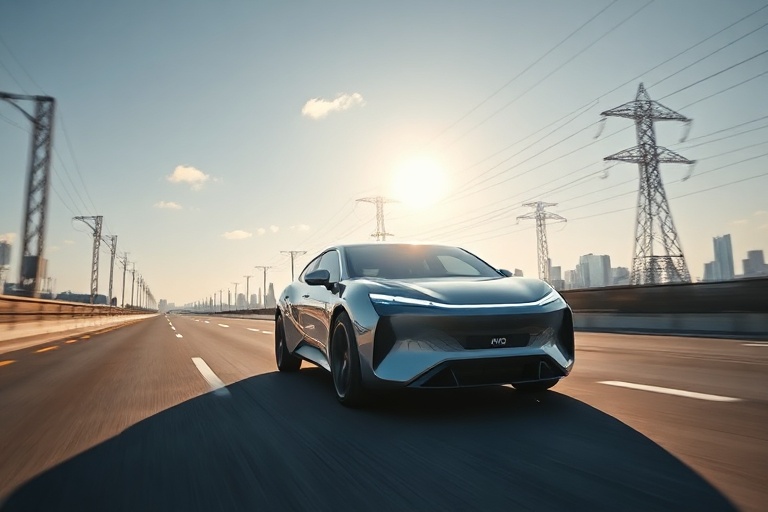
NIO Stock Analysis: Growth, Risks, and Future Outlook for Investors
“`html
NIO Stock: Can China’s Tesla Rival Overcome Its Challenges?
NIO has emerged as one of China’s most ambitious electric vehicle (EV) manufacturers, often compared to Tesla for its innovative approach and premium positioning. Since its 2018 Nasdaq listing, the company has attracted significant attention from global investors. However, NIO’s stock performance has been anything but smooth, marked by volatility, financial losses, and fierce competition. Understanding NIO’s trajectory requires examining its business model, financial health, market position, and the broader EV landscape in China.
NIO’s Business Model and Growth Strategy
Founded in 2014 by billionaire William Li, NIO differentiates itself through a vertically integrated model that combines vehicle manufacturing with battery swapping, software, and autonomous driving technologies. Unlike traditional automakers, NIO positions itself as a “smart electric vehicle company,” emphasizing user experience, connectivity, and ecosystem services.
One of NIO’s most distinctive features is its battery-swapping technology. The company operates over 2,000 battery swap stations across China, allowing drivers to replace a depleted battery in under five minutes—a faster alternative to charging. This infrastructure supports NIO’s “BaaS” (Battery as a Service) subscription model, where customers lease batteries separately from the vehicle, reducing upfront costs. While this model has attracted price-sensitive buyers, it also introduces operational complexity and long-term financial commitments.
NIO’s product lineup includes the ES6, ES8, EC6 SUVs, and the ET7 sedan, all positioned in the premium segment. The ET7, launched in 2021, competes directly with Tesla’s Model S, featuring advanced autonomous driving capabilities powered by NVIDIA’s DRIVE Orin chips. However, despite these innovations, NIO has struggled to achieve consistent profitability, raising questions about the sustainability of its growth strategy.
Financial Performance: Revenue Growth vs. Persistent Losses
NIO’s revenue has grown rapidly, reaching $6.3 billion in 2023—a 30% increase from the previous year. Deliveries also climbed to 122,486 vehicles, up 34% year-over-year. Yet, the company remains unprofitable, reporting a net loss of $2.6 billion in 2023. This financial disconnect stems from high research and development (R&D) costs, supply chain expenses, and aggressive expansion efforts.
In Q1 2024, NIO posted a narrower-than-expected loss of $215 million on $2.2 billion in revenue. Analysts point to cost-cutting measures, including layoffs and reduced marketing spending, as reasons for the improved margins. Still, gross margins remain thin at around 10%, far below Tesla’s 18-20%. The company’s heavy investment in next-generation technologies, such as solid-state batteries and autonomous driving, further pressures its bottom line.
Investors are closely watching NIO’s path to profitability. The company has outlined a goal of achieving positive gross margins on a quarterly basis by the end of 2024, a milestone that could restore confidence. However, execution risks loom large, particularly as competition intensifies in China’s EV market.
Market Position: Competing in China’s Crowded EV Landscape
China is the world’s largest EV market, with over 8 million units sold in 2023. NIO faces competition from domestic rivals like BYD, XPeng, and Li Auto, as well as international players such as Tesla and BMW. BYD, in particular, has surged ahead as the market leader, thanks to its affordable models and vertically integrated supply chain. Meanwhile, Tesla’s Shanghai Gigafactory has made the Model Y one of the best-selling EVs in China.
NIO’s premium positioning limits its addressable market compared to mass-market brands. While its vehicles command higher prices—averaging $50,000 to $70,000—the company must justify this premium through superior technology and brand loyalty. The company’s focus on battery swapping and software updates offers a unique selling point, but adoption remains limited outside of China.
International expansion has been slow. NIO entered Norway in 2021 as its first overseas market but has struggled to gain traction due to high prices and limited infrastructure. The company’s recent foray into Germany and the Netherlands marks a cautious step toward global growth, but scaling operations abroad will require significant capital and regulatory navigation.
Key Competitors in China’s EV Market
- BYD: Market leader with affordable models like the Dolphin and Seal; backed by Warren Buffett’s Berkshire Hathaway.
- XPeng: Focuses on smart EVs with advanced autonomous driving features; expanding into Europe.
- Li Auto: Specializes in extended-range electric vehicles (EREVs), appealing to consumers wary of charging infrastructure.
- Tesla: Dominates with the Model Y and Model 3; benefits from economies of scale and brand recognition.
Investor Sentiment: Risks and Opportunities
NIO’s stock, traded under the ticker NIO on the NYSE and 9866.HK on the Hong Kong Stock Exchange, has seen dramatic swings. In 2020, shares surged over 1,000% amid EV market euphoria. By 2022, they had fallen nearly 70% as growth stocks faced a correction. Despite the volatility, NIO remains a favorite among momentum traders and long-term believers in China’s EV sector.
Several factors could drive NIO’s stock higher or lower in the coming years. On the positive side, the company’s strong brand, technological edge, and government support in China provide tailwinds. The Chinese government continues to incentivize EV adoption through subsidies and infrastructure investments, benefiting players like NIO.
However, risks are substantial. Regulatory changes, such as reduced subsidies, could dampen demand. Geopolitical tensions between China and the West may also impact NIO’s global ambitions. Additionally, rising competition could erode NIO’s market share, particularly if BYD or Tesla introduce compelling alternatives.
For investors considering NIO stock, a balanced approach is essential. The company’s long-term potential hinges on its ability to achieve profitability, expand globally, and maintain its technological edge. Those willing to tolerate volatility may find opportunity in NIO’s high-risk, high-reward profile.
Conclusion: What’s Next for NIO?
NIO stands at a crossroads. Its innovative business model and premium positioning set it apart in China’s crowded EV market, but financial losses and fierce competition pose significant challenges. The company’s ability to refine its strategy, control costs, and execute on its expansion plans will determine whether it can join Tesla as a global EV leader.
For now, NIO remains a stock to watch closely. Investors should monitor its quarterly earnings, delivery numbers, and technological milestones. As the EV industry evolves, NIO’s fortunes could shift rapidly—either upward toward profitability or downward under mounting pressure.
If you’re interested in exploring other trending stocks or market analysis, visit our Analysis section for deeper insights. For the latest updates on electric vehicles and automotive trends, check out our Automotive category.