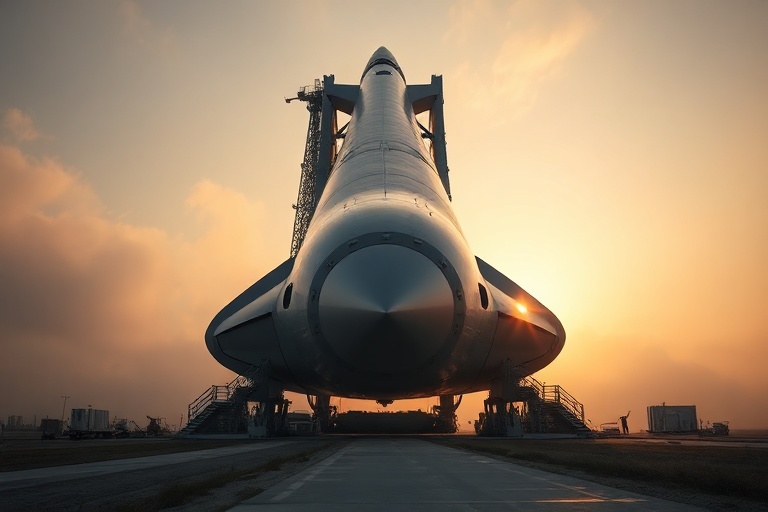
Starship: The Rocket Revolutionizing Space Exploration in 2024
“`html
Starship: The Rocket Redefining Space Exploration
SpaceX’s Starship has emerged as one of the most ambitious projects in aerospace history, blending cutting-edge engineering with a bold vision for the future of space travel. Designed to be fully reusable, this colossal rocket represents a fundamental shift in how humanity approaches interplanetary missions. Unlike traditional rockets, Starship is built to carry both crew and cargo to destinations like the Moon and Mars, all while dramatically reducing the cost of spaceflight.
The project’s scale and ambition have captured global attention, but its significance extends far beyond spectacle. Starship’s development reflects broader trends in space exploration, including the rise of private space companies and the growing demand for sustainable, cost-effective launch systems. As testing continues and milestones are achieved, the implications for science, industry, and even geopolitics are becoming increasingly clear.
The Evolution of Starship: From Concept to Reality
The origins of Starship trace back to Elon Musk’s long-standing goal of making life multiplanetary. Early iterations of the design, first unveiled in 2016 under the name “Interplanetary Transport System,” have undergone significant transformations. The current Starship design features a stainless steel structure, a sleek and futuristic appearance, and a two-stage system consisting of the Super Heavy booster and the Starship spacecraft itself.
Development has been iterative, with SpaceX conducting numerous test flights to refine the rocket’s performance. Early prototypes, such as Starhopper, demonstrated basic flight capabilities, while later versions like SN8 and SN10 pushed the boundaries of altitude and landing precision. Despite several explosive setbacks, each test has provided invaluable data, driving continuous improvement.
One of the most critical aspects of Starship’s design is its reusability. Traditional rockets are discarded after a single use, driving up costs and limiting access to space. Starship, however, is engineered to return to Earth, refuel, and launch again—a capability that could revolutionize the economics of space travel. This approach aligns with SpaceX’s broader mission to reduce the cost of spaceflight by orders of magnitude, making it feasible to establish permanent human settlements on Mars.
Key Milestones and Challenges in Starship’s Development
Starship’s development has been marked by both groundbreaking achievements and formidable challenges. Below are some of the most significant milestones and obstacles encountered along the way:
- Starhopper Test (2019): The first successful “hop” test, demonstrating basic flight and landing capabilities with a scaled-down prototype.
- SN8’s High-Altitude Flight (2020): A 12.5-kilometer test flight that showcased controlled ascent, belly flop maneuvers, and a dramatic—but explosive—landing attempt.
- SN15’s Success (2021): The first fully successful high-altitude test, with SN15 landing intact and paving the way for further refinements.
- Orbital Test Attempts (2022-2023): Multiple attempts to reach orbit, including the first integrated flight test of Starship and Super Heavy, which ended in an explosion but provided critical data.
- Regulatory Hurdles: Starship’s testing has faced scrutiny from agencies like the FAA, which have imposed restrictions to address environmental and safety concerns, particularly around the Boca Chica launch site in Texas.
- Cost and Funding: The development of Starship has required billions in investment, raising questions about long-term financial sustainability and SpaceX’s ability to balance ambitious goals with fiscal responsibility.
Each of these milestones highlights the rocket’s potential while underscoring the complexities of pushing the boundaries of aerospace technology. The challenges are not merely technical but also logistical, regulatory, and financial, requiring a delicate balance between innovation and practicality.
Broader Implications: How Starship Could Reshape Spaceflight
The implications of Starship’s success extend far beyond SpaceX or even the aerospace industry. A fully operational Starship could democratize access to space, enabling a new era of exploration, research, and commerce. Here’s how:
- Reduced Costs, Increased Access: By making rockets fully reusable, Starship could slash the cost of launching payloads to orbit, from hundreds of millions to tens of millions per flight. This would open doors for smaller companies, researchers, and even governments to participate in space missions.
- Lunar and Martian Ambitions: NASA’s Artemis program relies on Starship as a key component for landing astronauts on the Moon. Meanwhile, SpaceX’s plans for Mars colonization hinge on Starship’s ability to transport humans and supplies across interplanetary distances.
- Scientific Breakthroughs: The increased capacity and lower cost of Starship could accelerate scientific research, from deploying large telescopes to studying distant asteroids. It could also enable more ambitious missions to the outer solar system.
- Economic Opportunities: A thriving space economy could emerge, with Starship facilitating activities like space tourism, in-space manufacturing, and even asteroid mining. Companies like SpaceX could become central players in this emerging market.
- Geopolitical Shifts: The dominance of Starship could alter the balance of power in space, with the U.S. and its allies leading the charge in space exploration. This could spark competition or collaboration with other nations, such as China, which is also developing heavy-lift rockets.
However, these opportunities come with risks. The commercialization of space could lead to overcrowding in Earth’s orbit, increased space debris, and potential conflicts over resources. Additionally, the environmental impact of frequent launches—particularly the carbon footprint of methane-fueled rockets—remains a topic of debate.
The Road Ahead: What’s Next for Starship?
Starship’s journey is far from over. While significant progress has been made, the road to a fully operational and reliable rocket is still long. SpaceX is likely to continue refining the design, addressing the challenges that have arisen during testing, and working closely with regulators to ensure safe and sustainable operations.
One of the next major milestones will be a successful orbital test flight, which would demonstrate Starship’s ability to reach space and return to Earth intact. This would be a critical step toward fulfilling NASA’s contract for lunar missions and SpaceX’s own Mars ambitions. Additionally, SpaceX is expected to focus on improving the rocket’s reliability, reducing the frequency of failures, and enhancing the safety of crewed missions.
The broader space community will be watching closely. Starship’s success could inspire a new wave of innovation, attracting investment and talent to the industry. It could also serve as a catalyst for international collaboration, with other countries and companies seeking to partner with SpaceX or develop their own versions of the technology.
Ultimately, Starship represents more than just a rocket—it’s a symbol of humanity’s relentless drive to explore the unknown. Whether it achieves its lofty goals or faces setbacks along the way, its impact on the future of spaceflight is undeniable. As SpaceX continues to push the limits of what’s possible, the world will be watching, ready to witness the next chapter in the story of space exploration.
For those interested in following the latest developments in space technology and aerospace innovation, be sure to check out Dave’s Locker Technology section and Science category for in-depth analysis and updates.